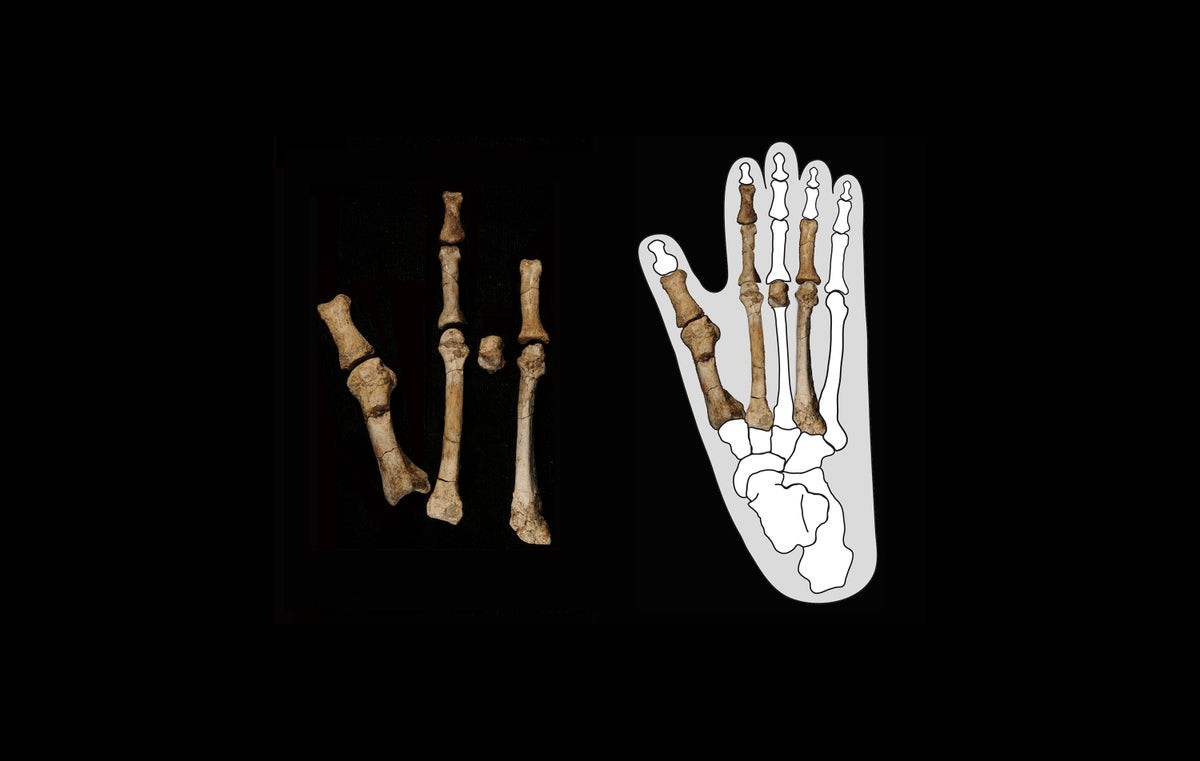
For years, a mysterious 3.4-million-year-old fossil foot found in Ethiopia puzzled anthropologists. The foot—nicknamed the “Burtele foot”—possessed a grasping toe adapted for climbing, unlike the arched feet of Australopithecus afarensis, the species known as “Lucy,” which walked upright. Now, a team of researchers has definitively linked the foot to another hominin species, Australopithecus deyiremeda, proving that early human ancestors weren’t all evolving along a single path.
Confirmed Coexistence: Two Species in the Same Era
The discovery resolves a long-standing debate. In 2015, scientists initially proposed the existence of A. deyiremeda based on jawbone fragments, but conclusive evidence was lacking. The new research, published in Nature, presents additional fossils from the same Woranso-Mille site in Ethiopia: pelvic fragments, a skull, and a jawbone with 12 teeth. These fossils, analyzed for shape and dietary habits, confirm that A. deyiremeda coexisted with Lucy’s species at the same time and in the same region.
Divergent Adaptations: Trees vs. Grasslands
The key difference between the two species lies in their lifestyles. A. deyiremeda appears to have been a more arboreal hominin, preferring a diet of trees, shrubs, fruits, and leaves. Its foot structure—with long, curved toes and flexible bones—indicates a strong ability to climb and grip branches. Lucy’s species, A. afarensis, was better suited for walking upright in mixed woodland and grassland environments. This suggests that early hominin evolution wasn’t about a single progression toward bipedalism but rather a branching exploration of different survival strategies.
Evolutionary Experiments: Not All Ancestors Walked Upright
The confirmation of A. deyiremeda challenges the idea of linear human evolution. The existence of two distinct hominin species in the same time and place shows that early humans were experimenting with different ways of moving and surviving.
“It is a unique mode of locomotion that underwent various experiments throughout human evolution until the emergence of Homo,” says study co-author Yohannes Haile-Selassie.
This finding adds complexity to our understanding of how humans evolved to walk upright, and reinforces the idea that multiple hominin species were exploring different adaptations simultaneously. The debate is not over, but the new evidence strengthens the case for A. deyiremeda as a valid species.
The discovery underscores that early human evolution was not a straight line, but a complex, messy process of adaptation and diversification.