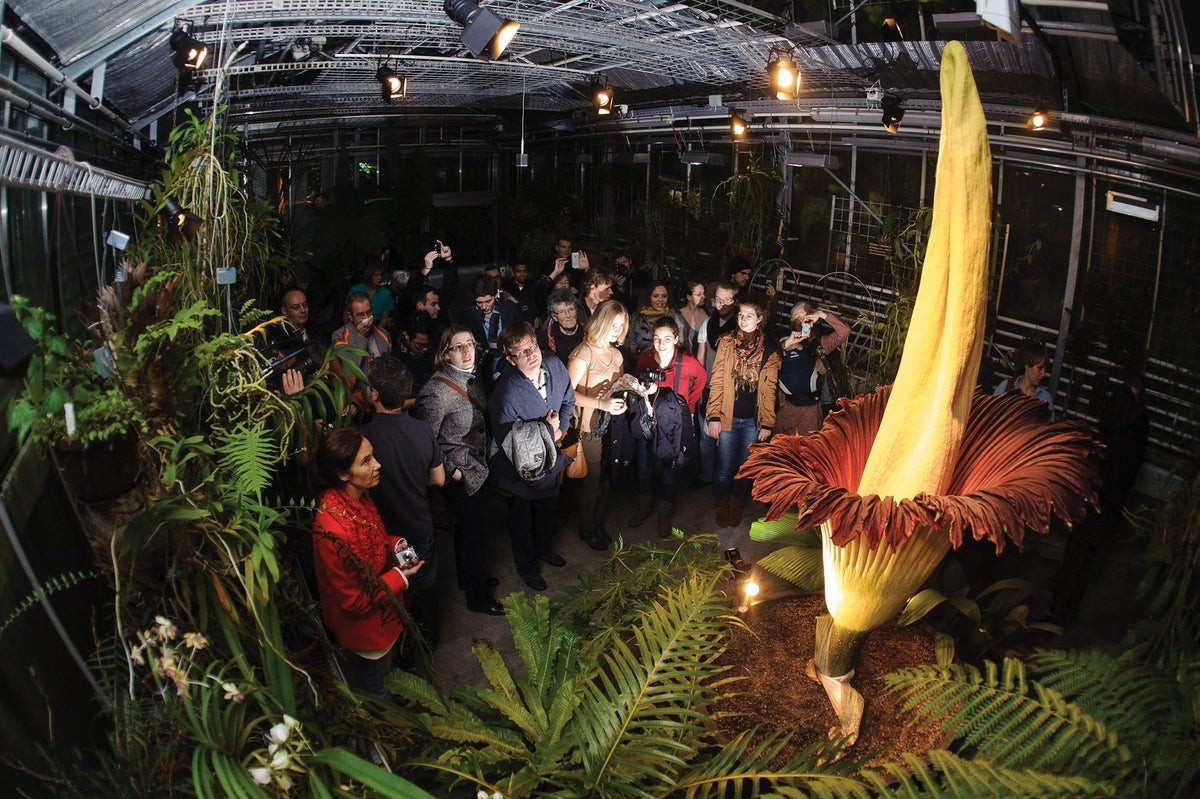
The titan arum, or corpse flower (Amorphophallus titanum ), is a botanical anomaly that captivates and repulses in equal measure. Towering up to 10 feet tall, it emits a stench of rotting flesh, drawing flies and beetles instead of bees and butterflies. The plant’s bizarre traits aren’t random; they are the result of millions of years of evolution shaped by specific ecological pressures.
A Botanical Oddity with a Purpose
The corpse flower isn’t just a curiosity; it’s a prime example of evolutionary mimicry. Unlike most flowering plants that use bright colors and sweet fragrances to attract pollinators, A. titanum has evolved to resemble and smell like decaying meat. This strategy appeals to carrion insects, ensuring pollination where conventional methods fail. The plant’s surface ripples, grooves, and discolorations further enhance this illusion, making it almost indistinguishable from actual carrion.
The Chemistry of Rot: Putrescine and Beyond
Recent research has revealed the chemical basis for this deception. The corpse flower produces sulfur-based compounds, including putrescine—a substance chemically identical to that found in decaying animal meat. This isn’t coincidence; the plant’s metabolic processes break down amino acids in the same way decomposition does, resulting in an identical scent profile. This level of mimicry is rare in nature, where evolution rarely produces perfect replicas.
Heat and Scent: Amplifying the Deception
To maximize its deceptive strategy, the corpse flower generates heat. By metabolizing starch into sugar within its spadix (the fingerlike central structure), the plant raises its temperature by up to 20°F. This heat carries the foul odor further, attracting pollinators from a wider range. The energy expenditure is significant, but the increased pollination rate makes it a worthwhile investment.
Evolutionary Mismatch: Giant Blooms, Tiny Flowers
Perhaps the most peculiar aspect of the corpse flower is the mismatch between its massive inflorescence (the entire flowering structure) and its minuscule flowers. While the overall bloom can reach immense proportions, the individual flowers at its base are reduced to their essential parts, lacking petals or sepals.
This evolutionary paradox raises key questions: Why did the inflorescence become so large while the flowers remained dwarfed? The answer lies in the plant’s evolutionary history. Small flowers were ancestral to Amorphophallus, and selection pressure favored larger blooms rather than individual flower size. Once the plant began evolving a larger inflorescence, it followed a “ratchet effect,” making further enlargement of individual flowers less likely.
Historical Contingency in Evolution
The corpse flower highlights a critical principle of evolution: historical contingency. Whether a species evolves large inflorescences or large individual flowers depends on its lineage’s past. If ancestors had small, clustered flowers, selection might favor larger blooms, as seen in Amorphophallus. If the ancestors had single-flowered stalks, selection might favor bigger individual flowers, as seen in other carrion-pollinated species like Rafflesia.
The titan arum is more than just a spectacle; it’s a living lesson in how evolution tinkers with existing traits rather than inventing entirely new ones. Its bizarre characteristics aren’t random; they are the result of a long, complex history shaped by the relentless pressure of natural selection.
Ultimately, the corpse flower demonstrates that evolution isn’t about perfection but about adaptation. It’s a reminder that the most effective strategies aren’t always the most beautiful or conventional—sometimes, the key to survival lies in embracing the macabre.