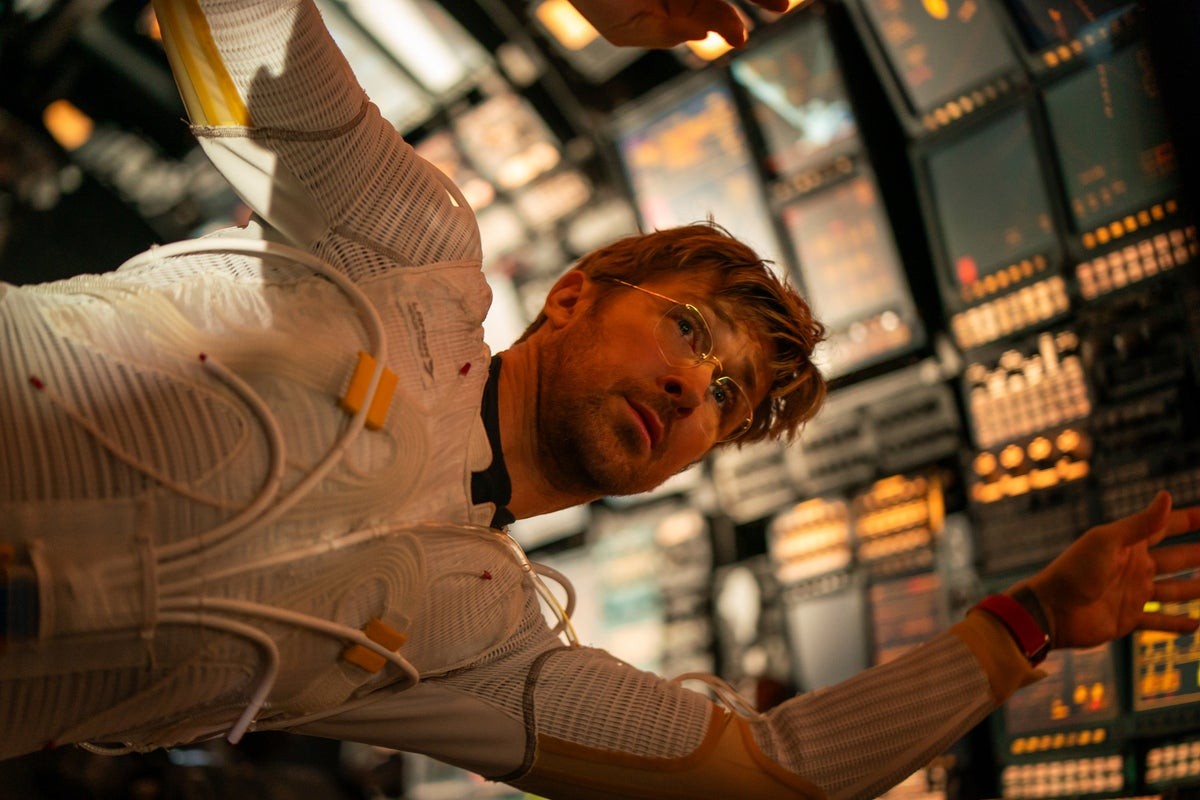
The new sci-fi blockbuster Project Hail Mary presents a dramatic scenario: alien microbes, dubbed “Astrophage,” are dimming the sun, threatening Earth with extinction. A lone teacher-turned-astronaut is dispatched on a desperate mission to find a solution. While the premise is fantastical, the underlying science isn’t as far-fetched as it seems.
The Science Behind the Threat
The film draws heavily on real astrophysical and biological concepts. Andy Weir, author of the source novel, meticulously researched the physics, astronomy, and biology driving the plot, even consulting on set to maintain accuracy. The central idea—microbes consuming stellar energy—while extreme, is rooted in plausible, if speculative, science.
The “Astrophage” in the film are depicted as traveling between the sun and Venus to breed, gradually reducing the sun’s luminosity. Physicist Chad Orzel explains that such a journey isn’t impossible; the sun already emits particles in that direction. The return trip would require more energy to counteract solar wind, but Weir addresses this by imagining the microbes can absorb neutrinos—nearly massless particles that penetrate everything.
If Astrophage could harness neutrinos, converting their energy into thrust, it would be an efficient propulsion method. While theoretical, this concept isn’t entirely outside the realm of possibility. The film uses this to power the Hail Mary, the ship carrying the protagonist to Tau Ceti.
Real Stars, Real Possibilities
The film’s setting includes real star systems like Tau Ceti (12 light-years away) and 40 Eridani (16 light-years away). Weir intentionally chose nearby, sun-like stars, suggesting that life in this region of the Milky Way might share a common origin. Astrobiologist Mike Wong notes that if life originated elsewhere, Earth wouldn’t necessarily be the sole cradle of existence.
The concept of all life being distantly related through ancient Astrophage is a key plot point. This ties into the idea that similar stars would host planets with similar elements, allowing for shared evolutionary pathways.
Artificial Gravity and Astronaut Training
Project Hail Mary features artificial gravity created by rotating spacecraft sections, a method theoretically possible and actively being pursued by space station companies like Vast. However, simulating gravity on land, as depicted in the film, remains beyond our current capabilities.
The protagonist’s rapid transition from teacher to astronaut also raises questions about realism. While NASA has historically included “payload specialists” with niche expertise, their training was significantly less rigorous than that of career astronauts. Former astronaut Mike Massimino points out that basic survival skills – from meal preparation to emergency procedures – are essential, even in space.
The film doesn’t shy away from the unglamorous realities of space travel, showcasing the challenges and gaps in knowledge that even trained astronauts face. Drew Feustel, a technical consultant on the film, emphasizes that space travel is far from glamorous.
Ultimately, Project Hail Mary balances fantastical elements with grounded scientific principles. While the specifics are speculative, the underlying concepts draw from real-world physics, astronomy, and biology, making the film’s threat feel surprisingly plausible.