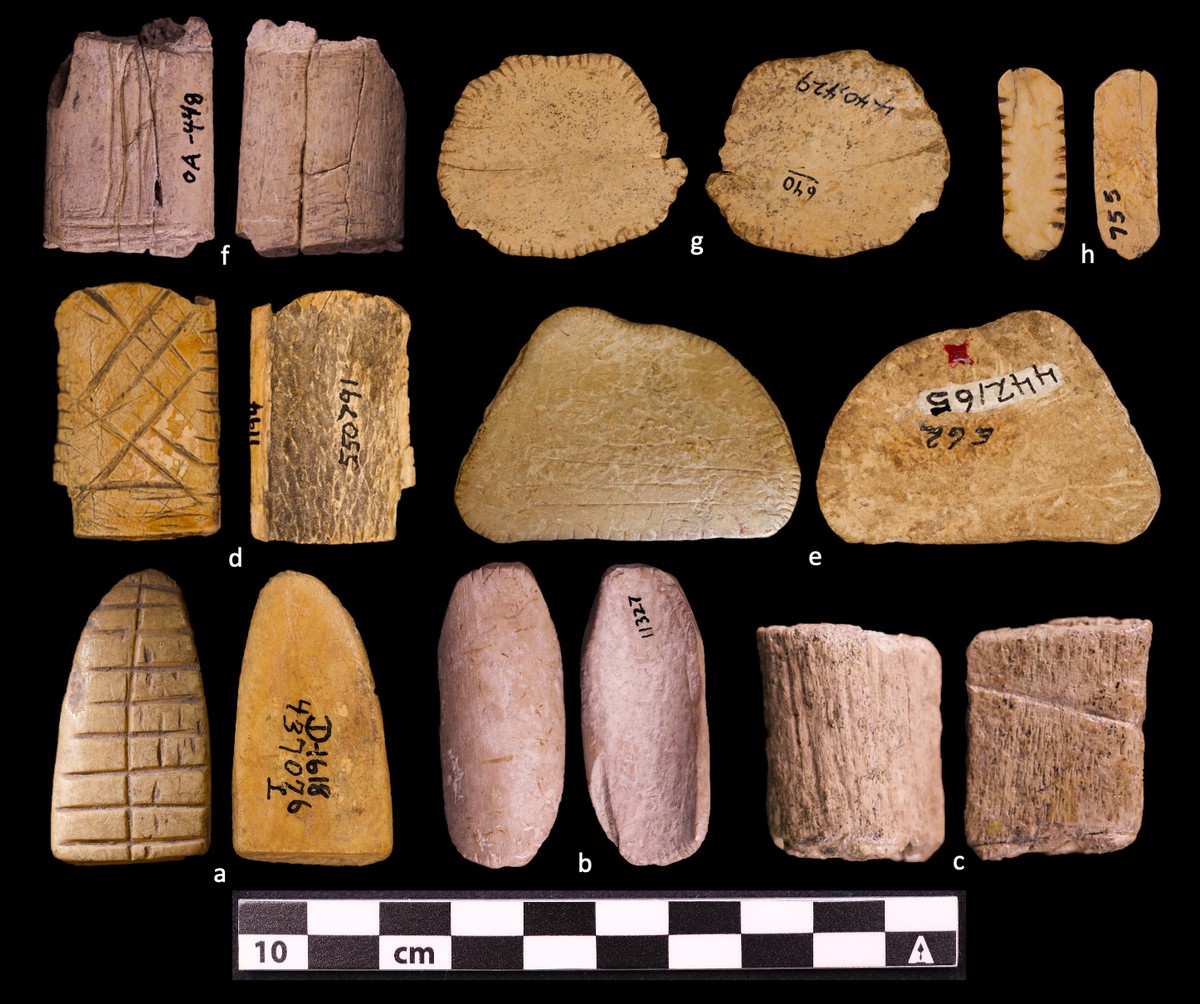
Archaeological evidence confirms that humans have engaged in games of chance for at least 12,000 years, with the earliest dice discovered in North America predating similar artifacts found elsewhere by over 6,000 years. This groundbreaking discovery, published by archaeologist Robert J. Madden in American Antiquity, reshapes our understanding of intellectual history—specifically, the surprisingly ancient recognition of randomness in the natural world.
The Dawn of Probability
All modern games of chance, from lotteries to sports betting, depend on an understanding of probability. For a long time, the origins of this concept were unclear. While dice used in North American games as recent as 2,000 years ago were well-documented, older objects were too isolated or too small to confirm with certainty. Madden’s research systematically links these scattered finds, establishing an unbroken lineage of chance-based games stretching back millennia.
A Native American Intellectual Contribution
The earliest confirmed dice specimens come from sites in Colorado, Wyoming, and New Mexico. Madden identified key characteristics in later, verified dice—such as etched edges or deliberately asymmetrical shapes—and applied those criteria to earlier finds. He spent years combing through archaeological databases to confirm the authenticity of these ancient gaming tools.
This discovery isn’t just about rewriting timelines; it highlights a unique contribution from Indigenous American cultures to global intellectual history. As Dartmouth College archaeologist Robert Weiner notes, “Demonstrating this Native American contribution to global intellectual history is fantastic.”
Gambling as a Social and Economic Tool
The prevalence of gambling in early North American societies suggests more than just recreation. Researchers suggest it served as a social catalyst, bringing groups together for trade, even among those who didn’t share a common language. Gabriel Yanicki of Carleton University points out the “universal acceptance of the economic usefulness of gambling” in the Americas, a phenomenon less common in other regions.
The Birth of Statistical Thinking
Gambling is not merely a pastime; it demands an acknowledgment that some events are inherently unpredictable. Madden argues that this represents a fundamental cognitive leap: the realization that not everything has a direct cause. This recognition predates formal probability theory by centuries; modern statistics only emerged 300 to 500 years ago, as mathematicians attempted to explain how games of chance worked.
“When you start flipping a coin and writing down the outcomes, you are kind of summoning randomness,” Madden says. “You can start to see these patterns emerging, and even more than seeing it, you can harness it.”
The act of gambling, therefore, represents an early form of empirical science—a way of observing, recording, and ultimately exploiting the inherent uncertainty of the universe. The oldest dice discovered in North America weren’t just tools for entertainment; they were precursors to the very foundations of modern statistical thought.