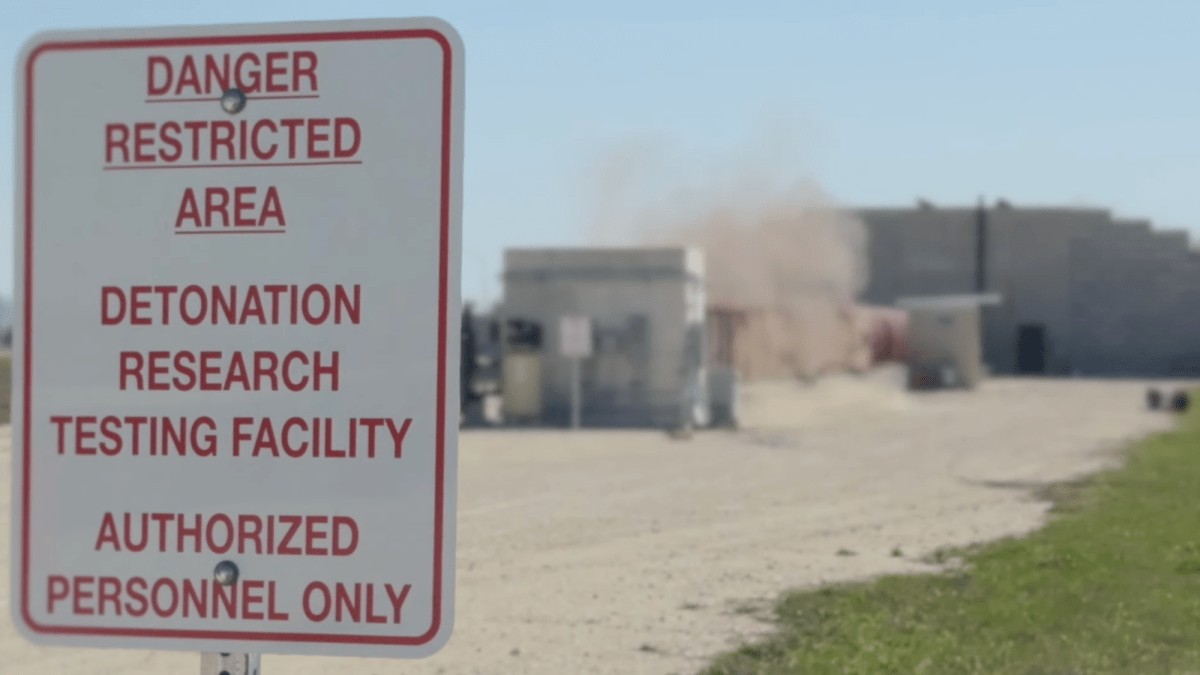
Texas A&M University has opened the Detonation Research Test Facility (DRTF), a massive underground tunnel designed to study how flames transform into deadly shockwaves. By recreating extreme explosion dynamics in a controlled environment, researchers aim to improve industrial safety and inform future aerospace engineering.
The facility, located in Southeast Central Texas, represents a significant leap forward in experimental physics. It allows scientists to observe one of nature’s most violent forces on a scale never before possible, providing data that could save lives in mining, construction, and space exploration.
### A Tunnel Built for Chaos
The DRTF is a behemoth of engineering. The tunnel stretches nearly 500 feet—roughly the length of two football fields—and is six feet in diameter. To contain the immense energy of the tests, the structure is built with three-quarter-inch steel walls and buried under earth to muffle the sound and protect the surroundings.
Inside this metallic artery, an array of high-precision sensors captures every microsecond of an explosion. The goal is to measure the transition from a simple, slow-burning flame to a supersonic detonation. These shockwaves can reach speeds of Mach 5, or approximately 3,800 miles per hour.
“The facility enables us to observe, measure and understand one of nature’s most extreme forces in ways that haven’t been scaled before, or even been possible until now,” said Dr. Elaine Oran, a professor of engineering at Texas A&M.
### From Flame to Shockwave
The scientific process within the DRTF is both methodical and violent. It begins with a simple electrical spark sent through a wire into the chamber. This spark ignites a flame, which then travels down the tunnel.
However, this is not a straight path. The interior of the tunnel is lined with an “obstacle course” of metal beams. As the flame navig these obstacles, turbulence is generated. This turbulence increases the surface area of the burning gas, causing it to burn faster and hotter.
Eventually, the pressure builds until it creates a shockwave ahead of the flame. When this shockwave becomes strong enough, it triggers a secondary, much more powerful explosion. This is the detonation —a sudden, earth-shaking release of energy that researchers can finally measure in real-time.
The visual and auditory impact is dramatic. While the control room remains quiet during the countdown, the resulting detonation shakes the facility’s thick metal exterior, sending soil flying into the air like artillery fire. Despite the facility’s robust safety design, the sheer power of the explosions leaves even seasoned engineers with a sense of nervous anticipation.
“There’s a lot of nervousness, [and] jitters,” noted aerospace engineering student Zachary Wideman. “Because something on this scale with this type of energy, you can’t help but be nervous.”
### Why This Matters: Beyond Industrial Safety
The DRTF originated from a specific request by the coal mining industry, which needed to understand whether trapped natural gas could explode and detonate in mines. The answer is yes, and the facility provides the data to prove how and why.
However, the implications extend far beyond mining. The insights gained from the DRTF have broad applications:
- Industrial Safety: Engineers can use the data to design better ventilation systems and explosion-resistant infrastructure, potentially preventing disasters in factories and chemical plants.
- Aerospace Engineering: The shockwaves generated in the tunnel mimic conditions relevant to hypersonic aircraft and space shuttle propulsion, aiding in the development of next-generation travel technology.
- Astrophysics: On a conceptual level, the physics of these controlled explosions help scientists model supernovas. While a supernova occurs on a cosmic scale, the underlying physical processes of detonation are similar, offering a terrestrial window into the birth and death of stars.
### Conclusion
The Detonation Research Test Facility transforms a dangerous, unpredictable force into a measurable science. By mastering the mechanics of explosions in a controlled setting, Texas A&M is not just satisfying scientific curiosity; it is building a foundation for safer industries and advanced technologies that rely on understanding extreme energy release.