Work changes fast.
Workers now need to navigate shifting tech, cross disciplinary lines, and survive in increasingly complex operational systems. Most K-12 systems try to keep up. They tweak Career and Technical Education programs. They simulate industry inside four walls. It usually falls flat.
The Maritime | 253 Skills center in South Puget Sound is doing something else. Opening this fall, it doesn’t simulate the world. It sits in it.
Built on Tideflats
Located on the Port of Tacoma tideflats, this facility is rising from historic Puyallup Tribal land. Right next to the port’s new headquarters on Thea Foss Waterway, the design is intentional. It mirrors the pace, mess, and collaboration of actual maritime work.
“Ports are major workforce hubs hidden in place.”
— Kristie Wolford, Director, Maritime | 25
Traditional CTE programs suffer from limits. Space is tight. Equipment is old. Time is chopped into fifty-minute blocks. It’s hard to teach the maritime industry from inside a generic high school hallway.
So Wolford’s team moved the school.
The new model embeds students in the Pacific Northwest’s largest maritime ecosystem. Four career pathways anchor the curriculum: Advanced Maritime Manufacturing, Port Operations, Logistics, Maritime Tech, and Sustainability. This is place-based learning. Not metaphorically. Literally.
Students spend half the day here. Over a thousand hours. They keep core classes at their home districts for the rest. It’s a hybrid model. Students earn dual credit, get industry certifications, and learn work-ready skills. Whether they want trade school, community college, or a direct job.
Wolford calls it “direct workforce preparation.” Not just career exploration.
Gold Standard PBL
The instructional backbone is Gold Standard Project-Based Learning. PBL isn’t a buzzword here. It’s the operational reality. Teachers get PD before the year starts. Students tackle six competencies: Solution Design, Collaboration, Gritt, Communication, Leadership, Empathy.
How does it work?
-
Challenging Problems
Industry sets the challenges. Vessel scheduling disruptions? Simulate it. Water quality in the Puyallu River? Monitor it. The Port provides real stakes. The building supports it—flexible spaces for testing, outdoor access for fieldwork. No textbook proxies. -
Sustained Inquiry
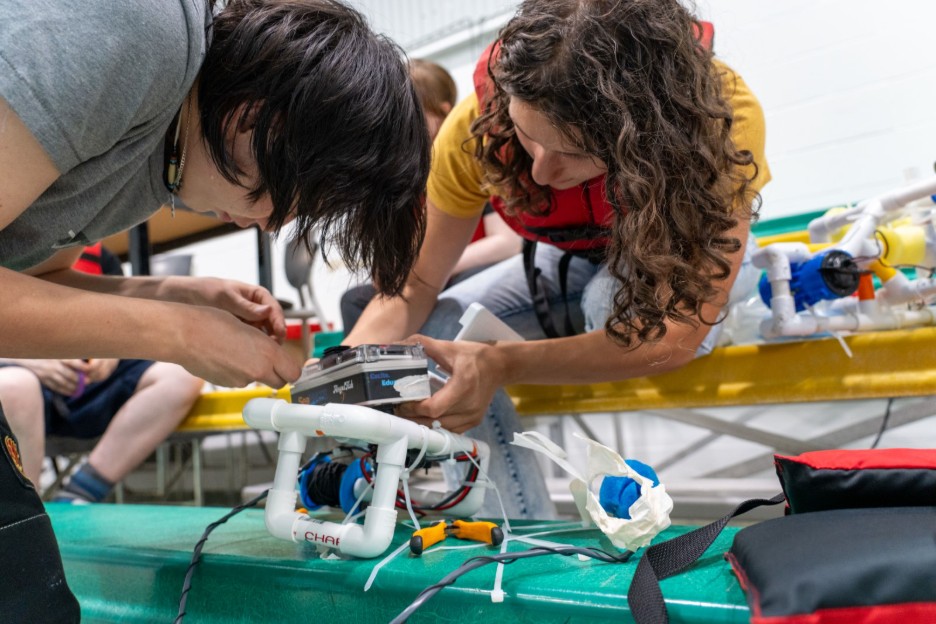
Time is the luxury most schools lack. Half-day blocks allow deep work. In Advanced Maritime Manufacturing, students weld. They also teach robots to weld. They manage evolving conditions. This isn’t task completion. It’s prolonged engagement with content. -
Authenticity
Proximity matters. Relevance matters. Contribution matters.“Students aren’t learning about port ops from a book. They are learning in the middle of it,” says Wolford.
Take the tech pathway. There is a cybersecurity clean room. Students practice defending against malware attacks. There are crane and vessel simulators for real-time navigation training. Teachers, many coming from the industry itself, set norms for professional communication and safety.
-
Voice and Choice
Students pick their pathways. Within those paths, they make choices. They take on leadership roles. They manage project phases. They decide on solutions. It mimics workplace agency. -
Reflection
Structure keeps it from getting messy. Regular checks on technical skills, safety knowledge, and learner competencies ensure growth isn’t accidental. The goal is mindset shift. Confidence. Ownership. -
Critique and Revision
Feedback is constant. Teachers pitch projects to industry partners before the students even see them. During the process, partners critique student work against professional standards. Precision matters. Accountability isn’t optional. -
Public Product
Work must be visible. The facility is both school and community hub. Students present prototypes, exhibitions, and deliverables to actual Port partners. The work exists outside the classroom walls. Peers see it. Partners see it. Mistakes are visible, which builds resilience.
More Than a Location
Maritime 253 won’t be copied tomorrow. But its principles are portable.
Alignment is everything. Education, industry, labor, policy—they must lock step. You cannot replicate this model with a single industry guest speaker. Wolford says that’s a misconception. True integration requires changing the environment. The schedule. The relationships.
“Success looks like a student completing coursework with a fully informed decision… surrounded by a network that will help them dream happen.”
This challenges the linear assumption of CTE. It’s not just prep for one job. It’s prep for identity. When students solve real problems with real tools, they stop seeing themselves as students. They see themselves as emerging professionals.
Advising matters too. Access to these pathways and the credentials that come with them helps students make choices that align with who they are, not just what is available.
The Unfinished Piece
What if the classroom didn’t have walls?
The schedule supports the depth. The specialized space supports the work. But it demands investment. Especially in educators who come from industry, not just theory. High-quality PBL is less about strategy and more about structure. Extended time. Specific spaces. Sustained partnerships.
Maritime 253 suggests that learning is best when it happens in the wild. Near the water. Amidst the noise.
Will other ports follow? Maybe. They would have to ask first if they are ready to hand over control to students and partners. It’s messy. It’s complex. It’s real.
And maybe that’s the point.