Twenty-two billion dollars.
That’s what the market decided BYJU’S was worth.
Today?
Zero.
By their own founder’s admission.
I’m not here to spit on the grave.
I’m here because we’ve made a deal.
Silent. Complicit.
We builders. The EdTech crowd in India.
We stopped asking the only question that counts.
We raised the money. Bought the billboards. Signed the cricketers. Filled the funnels until they burst.
But measure it? Really measure it?
Did the child understand more?
Did the kid with the least actually get ahead?
If you use that ruler… most of what we built is trash.
BYJU’S isn’t an anomaly. It’s just the loudest mirror.
Implicating Myself
I run a learning-tech company in Chennai.
Take this as confession. Not a lecture.
I have three daughters. Eldest in Class 11. Twins in Class 6.
I tell them every day: understand the concept. Don’t memorise.
They memorise anyway.
Why? Because none of them—not the girls, not the teachers, not the schools—has a tool that turns abstract ideas into lived experience.
I watch their attention span shrivel between my eldest and youngest. It’s visceral.
Here’s the sting that kills any excuse I might have had.
I spent twenty years making TV shows and films.
My job was holding eyeballs. Keeping you glued. Increasing watch time.
I thought I could export that trick. Use AR. VR. 360-degree cameras. Make education sticky.
I talked to hundreds of students. Teachers. Principals across every board.
The field humbled me.
The tool? Not the answer.
The Two Problems (One Is Fake)
There are two problems in Indian education.
- Distribution. Not enough reach. Not enough video files. This is fundable. Apps love it. VC loves it. You can track downloads. Daily active users. Watch time. Badges.
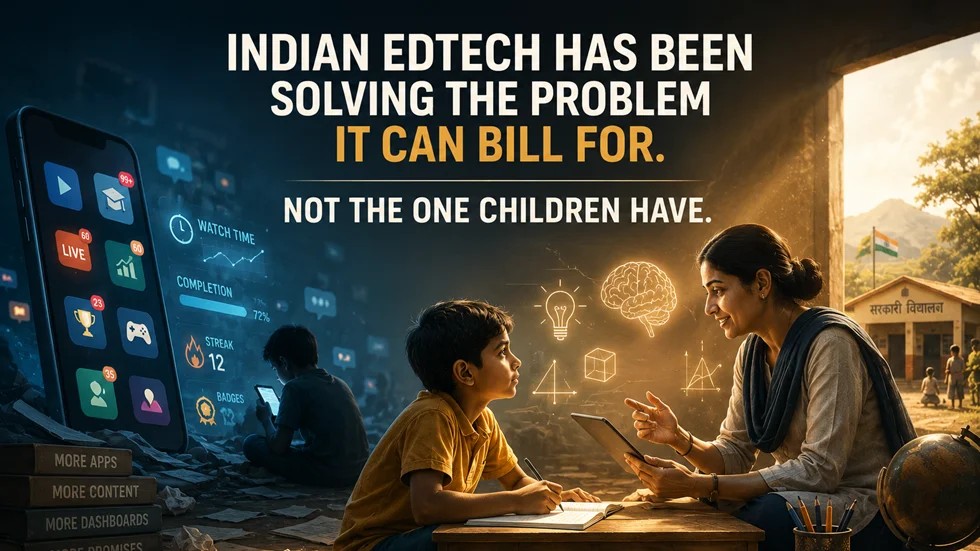
- Learning. Kids sit in class for twelve years and understand nothing. This is not fundable. You can’t zip understanding and send it over HTTP. It doesn’t respond to a marketing budget.
The industry picked number one. Called it progress on number two.
We confused moving data with teaching brains.
Watch-time is not understanding.
A streak is not a skill
An app can hypnotize a kid for forty minutes and leave their head empty. We built business models that relied on keeping that mouth shut.
BYJU’S? It was a monument to this delusion. ASCI flagged their ads. Repeatedly. Misleading claims about outcomes. Sales teams scared parents: “Your child will fail without this.”
That isn’t pedagogy. That’s fear. Sold by the lakh.
Parents flipped. FOMO (fear of missing out) died. FOGS rose up.
Fear of Getting Scammed.
We earned that. The whole category did.
Now? New wave. Same trick. New noun.
“AI Tutor.”
Same pitch: Personalised! Scalable! Available to all!
Some will be useful. Most are just distributing content cheaper. Automating the wrong thing at scale.
What the Science Actually Says
Throw the pitch decks away. Read the papers.
There is a hierarchy. It’s been there since 1985.
In 1984. Benjamin Bloom published the big finding. Still the kingpin of our field.
One-to-one tutoring with feedback. Two standard deviations better than a regular class.
Two sigma.
Mean? The average tutored kid beats 98% of kids taught the old way.
Bloom didn’t call it a triumph. He called it a problem. A challenge. How do you scale this? Give every child mastery. At system scale.
Forty years later? Still the brief.
Everything else? Footnote.
John Hattie meta-analyzed 300 million students. Pattern held.
Real levers are human. Feedback. Teaching quality. Seeing where the kid is.
Hardware? Barely moves the needle.
It’s not the device. It’s what the device makes the child do. And if a skilled adult is in the room.
Biology underneath it all. Ebbinghaus. Forgetting curve. 1885.
We lose 70% of passive input within a day.
Memory is built by doing. Generating. Retrieving.
Acting on a concept sticks. Watching someone else act? It fades.
Science says: Participation. Feedback. A teacher.
Industry sold: Passive video. On a screen. At scale.
We didn’t misunderstand the research. We ignored the research.
Because it didn’t fit the spreadsheet.
Deleting the Teacher (Don’t)
The fantasy repeats every few years. Technology routes around the teacher.
Seductive? Yes. India is short on good teachers.
Selling point? Empowerment.
Look at the Indian experiment. Real. Remarkable. 1999. Sugata Mitra. Hole in the wall in Delhi slum. PC embedded. Walked away. Kids taught themselves.
Curiosity + peer learning = power. Especially where schools don’t exist.
The lesson? Wrong.
We heard “teachers unnecessary.”
That’s not what it said. It said: Kids learn when curiosity switches on. Self-organization beats nothing.
Nothing.
“Better than nothing” isn’t national policy.
Hattie says the teacher is the biggest lever we have.
Tech’s role? Hand the teacher a sharper hammer. Step back. Don’t replace the human.
I saw this.
Pilot session. Expected four active kids. Rest watching.
Didn’t happen.
Teacher ran it. Pulled the class in. Using our tech in her hand.
Not the tech pulling them. She pulled them.
Walked out sure. Teachers aren’t the bug. They’re the feature. They just need the right instrument.
A school isn’t a content pipe.
It’s a place a kid is known.
The teacher notices the quiet kid. Classmates argue wrong answers into right ones.
Strip that out. Call it “personalised.” You didn’t modernize. You hollowed the walls. Slapped a logo on the void.
The Test: Last Child, Last Village
Listen. Founders. Investors. Sit with this line.
If a solution only works for kids who already have enough? It’s not a solution.
It’s a privilege with a checkout button.
Look at reach.
Rural households with internet: 24%. Cities: 66%.
Rural schools with working net: 18%.
Rural homes with smartphones? Under half. The phone usually belongs to a dad who works. Not the kid needing help at night.
Phone use for 11-17 year olds shot up. Yeah. But surveys show over half of rural 14-18 year olds can’t divide like a Class 3 student.
Glowing rectangle isn’t learning.
App-first, one-device-per-kid models miss her.
Built for Metro wifi. Spare iPad. Paying parent.
Field research in govt schools changed me.
Found this: Rich talent lives there. Kids wringing max from min infra. Teachers making magic from mud.
I know it from inside. 1997. College drop-out student. Ran internet center to eat.
Didn’t know computers. Learned by doing. That experience built my brain. It let me adopt every new tool since. Steenbeck editor? Sure. Non-linear editing? Fine. Film. Digital. Optical. VFX. AI.
I used them all. Didn’t flinch.
But I hate tech that dresses up distribution as teaching.
Three commitments. The industry owes them.
I hold myself to them.
How To Be Honest
Measure understanding. Not attention.
Check learning before/after. Someone independent. Publish results even if ugly.
Early session in Chennai? Honest summary: “13 kids. Signal, not study.”
Engagement metrics proving fun should embarrass you. Not satisfy.
Post-pilot feedback was brutal. Teachers tore our product apart.
And yet the data proved their criticism missed a point.
Subject engagement up. Understanding up. Both true.
Honest measurement lets you be flawed. And effective. Tells you exactly what to fix.
Keep teacher at centre.
Product that needs the human removed isn’t helping ed. It’s abandoning it.
Build for last child.
Not premium tier. Not headset. Not metro photo-op.
Reach the village girl. Intermittent power. One shared phone. Bad road.
Reach her. Cheap. Social. Device-agnostic. Empowered teacher.
Design for her? Product gets better. Cheaper. Better.
Design for metro kid? Beautiful thing. She will never see it.
That is the test.
Most EdTech fails. Including stuff I’ve built.
I’ll say that plainly. Rather than lie in a deck.
Worth $22 billion. Then zero.
Taught a generation nothing durable? Maybe.
Verdict on the industry? Answering questions you could bill for.
Not the question the classroom asks.
We know which one matters. Always did.
Only left: Do we finally build it?
Avvaiyar has a line…