It started in June 2026. Not with a bang. But with a quiet, relentless shutter click.
The Vera C. Rubin Observatory opened its eye on the Chilean night. For ten years, it won’t stop looking. This is the Legacy Survey of Space and Time. The LSST.
It is not just a picture. It is a movie. An ultrahigh-definition timelapse of the entire cosmos.
What Is the Rubin Observatory LSST and How Does It Work?
You might know the name. You might not know the machine behind it.
The Rubin Observatory sits high on Cerro Pachón in Chile. It is perched more than 2.7 kilometers up. The air is thin. The sky is steady. Perfect for a decade-long stare.
But the mountain is just the stage. The star is the camera.
The Vera C. Rubin Observatory’s digital camera is the largest ever built. It has 3.2 billion pixels. It measures 64 centimeters across. Two cafeteria trays taped together. Compare that to your phone’s tiny sensor. One square centimeter. The scale difference is dizzying.
The survey works like a film reel.
– Exposures: 30 seconds each.
– Filters: Six different colors.
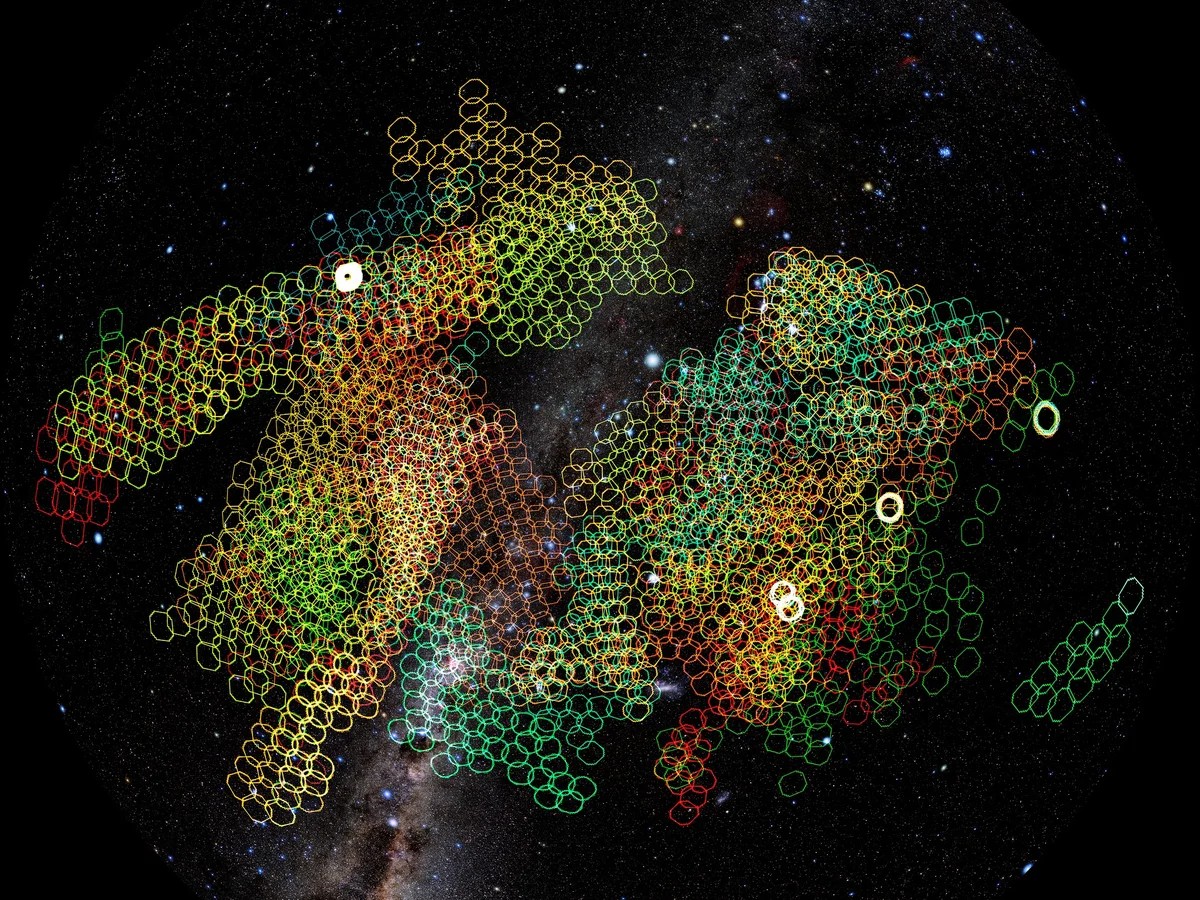
– Coverage: 3.5 degrees per shot. About 50 full moons.
– Frequency: The entire visible sky is imaged every three nights.
Over ten years, every spot on the heavens is revisited 800 times. The result? Millions of images. A dataset so massive it chokes current thinking.
We are not just looking at the sky. We are watching it breathe.
Why LSST Is the Deepest Sky Survey in History
Depth matters. Breadth matters. LSST does both.
By stacking images of the same patch of sky, faint things appear. The survey reaches magnitude 27.8 in brightness.
Think about that. The faintest star you can see with naked eyes is 500 million times brighter. We are pulling ghosts from the dark.
The predicted haul?
– 20 billion galaxies.
– 17 billion stars.
– 10 million supernovae.
– 6 million solar system objects.
No other observatory comes close. Hubble goes deeper in small patches. Wide-field surveys cover more area but lack the resolution or temporal depth. LSST bridges the gap. It sees the whole sky, repeatedly, with unprecedented detail.
Which Cosmic Phenomena Will the Rubin Observatory Discover?
We can predict the list. The list is boring. The finds won’t be.
Supernovae and the Expansion of the Universe
We see a new supernova every 30 seconds on average.
That sounds like noise. It is data. Specifically, data on the universe’s expansion. Cosmologists fight over the rate. More data helps. Even if it drowns them in numbers.
But the real value? The outliers. The weird ones. The rare explosions that break the rules. Normal events teach us basics. Oddballs teach us physics.
Exoplanets in Galactic Crowds
LSST isn’t optimized for hunting planets. It isn’t its main job.
It will find them anyway. And in places where other telescopes fail. Densely packed star clusters? Check. The Milky Way’s satellite galaxies? Check.
Planets in other galaxies. Not just the Milky Way. That shifts the goalposts entirely.
Near-Earth Objects and Planetary Defense
There are millions of asteroids between Mars and Jupiter. The main belt. LSST will map them all.
But look closer to home. More than 100,00 Near-Earth Objects. Asteroids and comets that come within 50 million kilometers.
Some could hit Earth.
Currently, no large impact is predicted for this century. But “currently” changes. The more rocks we find, the better we understand their orbits. The better we know what to stop. And how.
Trans-Neptunian Objects and Planet Nine
Past Neptune. The cold dark.
We know about 5.000 Trans-Neptunian Objects. LSST expects to add 30.000 more.
Why care? Because their orbits are weird. Some point toward a mystery. Planet Nine. A Neptune-sized world lurking in the deep dark.
Its existence is debated. Most models put it right in LSST’s view.
Even if the camera doesn’t see it directly, the data from the TNOs will either prove it’s there or kill the theory for good. It has been 180 years since we found a major planet. The suspense is agonizing.
What Surprises Will the Sky Throw at Us?
The knowns are safe. The unknowns are terrifying.
I don’t care about the catalog. I care about the errors. The glitches. The things the software can’t classify.
Stars shredded by black holes. Little red dots that shouldn’t exist. Gamma-ray bursts in wrong places.
Every time we look at the sky differently, we find something we didn’t know to look for. LSST is a new way of looking. It watches time. It catches change.
The universe loves a good secret.
Rubin is holding a flashlight. The beam is wide. It’s getting brighter.
Whatever is out there? It’s hiding no longer.
What do you think it will show first?