


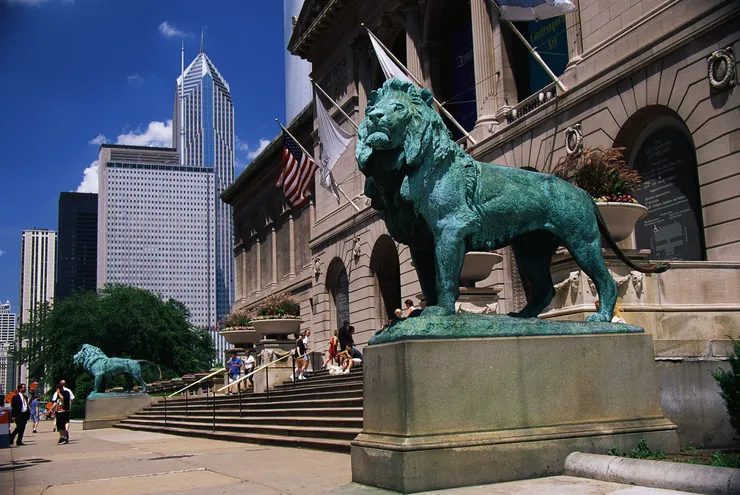
The Art Institute of Chicago isn’t just a building. It is a massive repository for human creativity, stretching from pre-Columbian artifacts to modern masterpieces. It holds collections that span Europe, America, Asia, and Africa. If you’re planning a visit, knowing its history helps you appreciate the weight of the space.
The institution started life in 1866 as the Chicago Academy of Design. It got its current name in 1882. Then, in 1893, it moved into the iconic structure on Michigan Avenue that you see today. That building was designed by Shepley, Rutan, and Coolidge. They created it specifically for the World’s Columbian Exposition.
Which art should you prioritize?
The museum is famous for two main things: 19th-century French painting and 20th-century European and American work. If you only have time for a few stops, focus on the Impressionists. The collection of Claude Monet is particularly extensive.
But the real draw for most visitors is the star power of specific paintings. You likely know them from textbooks, postcards, or memes. Here is what you need to look for.
The Big Three
You cannot visit this museum without seeing these three works. They define the institution’s reputation.
- A Sunday Afternoon on La Grand Jatte (1884–86) by Georges Seurat. This is a giant canvas. It uses pointillism, where tiny dots of color create the image. It captures a lazy afternoon by the river.
- American Gothic (1930) by Grant Wood. This painting features a farmer and a woman (often mistaken for his wife, but actually his daughter) standing in front of a house. It is one of the most parodied images in American art.
- Nighthawks (1942) by Edward Hopper. This depicts a late-night diner scene. The lighting is stark. The mood is isolating. It captures the loneliness of urban life perfectly.
“The Art Institute is noted for its extensive collections of 19th-century French painting and 20th-century European and American painting.”
Why does this matter to you?
If you are a student of art, this is a case study in how styles evolved. You can trace the shift from the loose brushwork of the Impressionists to the rigid realism of Wood and Hopper. The building itself adds to the experience. Being housed in a structure built for a world’s fair gives you a sense of scale.
The museum combines a school and an exhibition space. This dual purpose means the energy is different here than in some colder, more sterile galleries. There is a sense of learning happening alongside viewing.
Practical tips for your visit
Michigan Avenue is busy. The museum is right on it. Get there early. The crowds concentrate around American Gothic and Nighthawks. If you want to see them without a wall of people, go first thing in the morning or right before closing.
Don’t skip the French galleries. Even if you prefer American realism, the Impressionist section provides the context for why American artists later reacted against it. The contrast is educational. It shows how art moves. It doesn’t