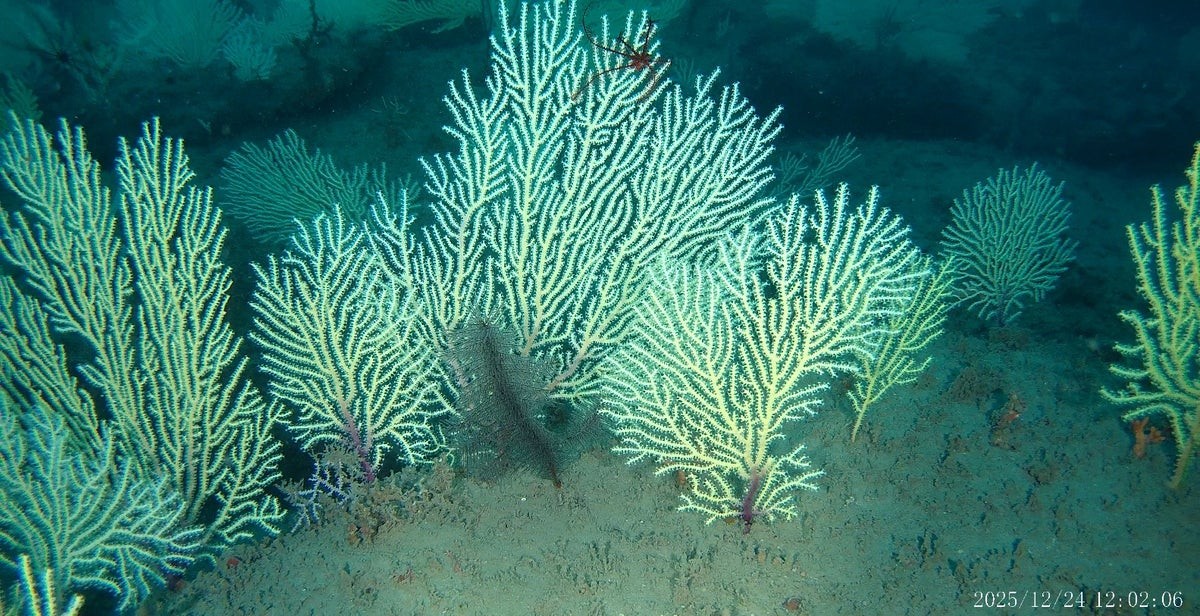
For decades, scientists believed they had mapped every secret of the West African coastline. Or at least, the part of it that mattered to them. Sixty years ago, researchers flagged a strange anomaly off the coast of Benin. Something was growing on the seafloor. But it was deep. Too deep for the technology of the time. They assumed it was dead. Or dying. So they moved on.
Now, that assumption is wrong.
A team led by Gérard Zinzindohouè of the Benin Fisheries and Oceanological Institute has gone back. Armed with modern tools, they didn’t just find life. They found a thriving, breathing ecosystem that had been hiding in plain sight. This is the first confirmed living mesophotic coral reef in the Gulf of Guinea, and it changes what we know about the region’s marine biology.
Why These Reefs Were Missed for Decades
The story starts in the 1960. Fishing surveys detected what looked like a coral formation over 50 meters down. The water there is dark. The pressure is higher. Back then, diving that deep wasn’t an option, and the sonar was vague. Scientists assumed the structures were just rocks. Dead coral. A geological curiosity rather than a biological one.
“I was guided by the hope that sometimes nature can surprises us… what you don’t intend to see is actually happen,” Zinzindohouè says.
He was right. When the new team deployed high-resolution sonar this year, the screen told a different story. Sand. Sediment. And then—rock. Hard, angular rock. The signature looked like a barrier. Or a reef. The team sent down an underwater drone and a Deep Sea Camera System from National Geographic’s Exploration Technology Lab. What they saw on the monitor wasn’t stone. It was tissue. Polyps. Movement.
Mesophotic Reefs Explained: The Ocean’s Twilight Zone
So, what exactly is this? If you picture a Caribbean reef, bright, shallow, and teeming with tourists, that’s not what this is. This is a mesophotic coral ecosystem. These reefs thrive in the “twilight zone”—deeper water where sunlight is dim and limited.
Unlike shallow reefs that often form continuous barriers, the Benin reef is patchy. It’s a scattered community. Coral patches grow on rocky outcrops scattered across the seafloor. It’s not a single wall. It’s an archipelago of life, spread out in the gloom.
“A mesophotic coral ecosystem is formed deeper than the usual shallow reef,” Zinzindohouè notes. “It does not always form a single continuous structure. Instead it appears as patchy communities spread across the seafloor.”
First Confirmed Living Reef on the Gulf of Guinea Continental Shelf
The findings, published July 19 in Frontiers in Marine Science, mark a significant milestone. It’s the first time a living mesophotic coral system has been confirmed on the continental shelf of the Gulf of Guinea.
Does this mean the reef has been alive since the 1960 sightings? Probably not necessarily. Coral reefs are sensitive. They wax and wane. The team doesn’t yet know if this population has persisted for sixty years or if it’s a recent resurgence. Determining the full extent requires more than cameras. It requires direct sampling. Broader surveys along the West African coast are next.
But why did we ignore this for so long?
Zinzindohouè points to a broader issue. Ocean science and marine research in West Africa, particularly in Benin, are underdeveloped. Governments focus on more immediate societal issues. Conservation often falls to the bottom of the priority list.
“We hope that, through this result people will start to look at the Ocean differently,” he says. “And that it might inspire others to do more research and focus on protection.”
It’s easy to assume that once you’ve mapped a region, you’ve seen it. But the deep ocean doesn’t care about our surveys. It waits. And when we finally look back with better eyes, it’s still there. Living. Waiting for us to catch up.