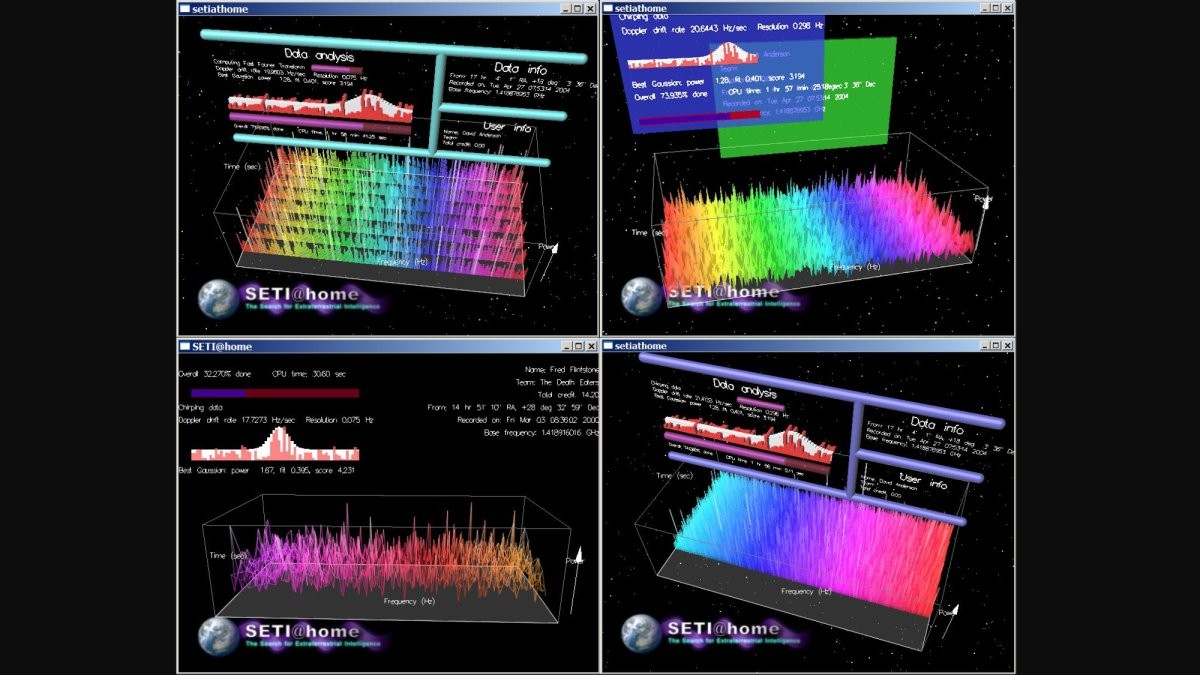
Researchers at the University of California, Berkeley, are re-examining 100 mysterious radio signals detected in deep space, hoping to finally determine if any represent evidence of extraterrestrial life. This renewed effort is built on nearly three decades of data and the unprecedented contribution of millions of volunteer computer users worldwide.
The Power of Distributed Computing
The search for extraterrestrial intelligence (SETI) has always been limited by computational power. Analyzing vast amounts of radio data requires processing capabilities that were once exclusive to large institutions. However, in 1999, scientists realized the potential of harnessing the collective processing power of personal computers. The SETI@home project was born, inviting individuals to download software that would passively analyze data collected by the Arecibo Observatory in Puerto Rico.
This wasn’t just a theoretical exercise; the scale was remarkable. Within days, the project gained over 200,000 participants, eventually exceeding 2 million downloads within a year from over 100 countries. The combined processing power of these home PCs allowed researchers to analyze data in ways previously impossible. As Eric Korpela, one of the project’s astronomers, noted, this made it “the most sensitive narrow-band search of large portions of the sky.”
The Challenge of Filtering Noise
The data wasn’t simply a matter of listening for clear alien messages. Earth’s movement around the sun and the potential movement of any transmitting extraterrestrial civilizations created a Doppler effect, shifting frequencies over time. To account for this, researchers developed complex algorithms to analyze a vast range of possible frequency drifts. This required immense computing power—multiplied by over 10,000, according to David Anderson, one of the project’s computer scientists—but the distributed network of PCs made it feasible.
From Billions to a Final Few
By the time SETI@home concluded in 2020, the team had identified approximately 12 billion signals of interest. These were narrowed down to around 2 million using supercomputers, further refined by eliminating interference from satellites, broadcasts, and even common household appliances. This process ultimately isolated roughly 100 signals worthy of more scrutiny.
Since July 2025, researchers have been using China’s Five-hundred-meter Aperture Spherical Telescope (FAST) to re-examine these regions of space. Studies published in The Astronomical Journal detail both the successes and shortcomings of the project, suggesting that future endeavors will benefit from lessons learned.
A Realistic Outlook
Despite the effort, scientists acknowledge the odds remain low. Arecibo’s limited sky coverage and the lack of immediately striking signals temper expectations. As Korpela admits, “There’s a little disappointment that we didn’t see anything.” Larger telescopes and longer observing times are necessary to probe deeper into space.
However, the project’s legacy extends beyond immediate results. SETI@home demonstrated the power of crowdsourcing and citizen science, proving that even without a definitive discovery, the pursuit of extraterrestrial intelligence can push the boundaries of scientific exploration. The potential for future projects, leveraging faster internet speeds and more advanced computing, remains promising.
Even if no signal is found, the project has established a new benchmark for sensitivity in SETI research. If a detectable signal existed, it would have been found.