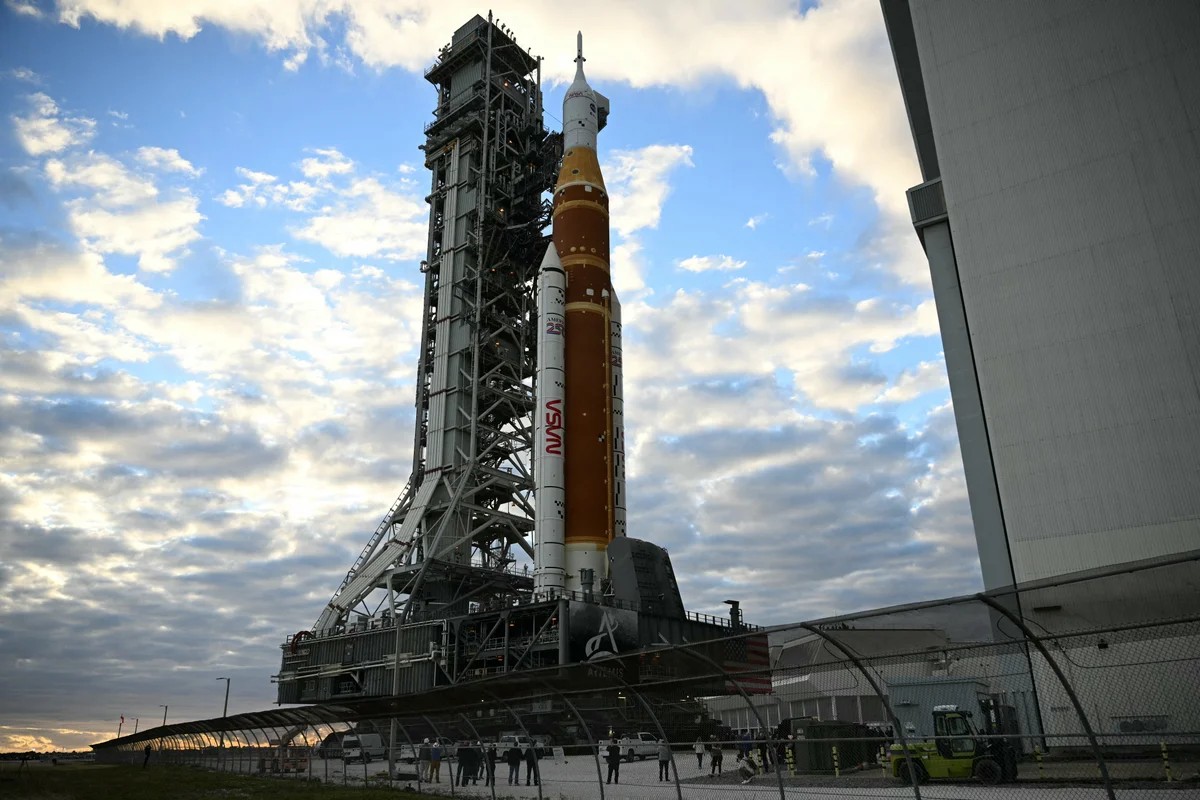
NASA’s Artemis II mission, set to carry astronauts around the moon for the first time in over half a century, has begun its final journey to the launchpad. The fully assembled Space Launch System (SLS) rocket and Orion capsule exited the Vehicle Assembly Building at Kennedy Space Center in Florida on Saturday, marking a significant step towards humanity’s return to lunar orbit.
Slow and Steady to the Pad
The massive rocket is currently moving at a deliberate pace of one mile per hour along its four-mile route to Launch Pad 39B. This carefully controlled transfer is expected to take eight to ten days, allowing for precise positioning and preparation. The slow roll ensures all systems are ready before the high-stakes launch process begins.
Critical Testing Ahead
Once at the pad, Artemis II will undergo rigorous testing, including a “wet dress rehearsal.” This vital procedure simulates a full launch countdown by filling the rocket with cryogenic propellants—testing its limits without a crew onboard. If successful, NASA aims for a launch no earlier than February 6.
A Lunar Loop, Not a Landing
Artemis II is not a landing mission. Instead, the four astronauts—Reid Wiseman, Victor Glover, Christina Koch (all NASA) and Jeremy Hansen (Canadian Space Agency)—will orbit the moon, traveling farther into deep space than any human before. The ten-day flight will serve as a critical test of the hardware and procedures needed for future lunar landings.
Laying the Groundwork for a Lunar Base
This mission is a stepping stone towards NASA’s long-term goal: establishing a permanently staffed base on the moon. Artemis II will collect invaluable data to inform the Artemis III mission, which will include a lunar landing. The space agency intends to use the moon as a launchpad for further exploration, eventually venturing to Mars.
The Artemis program represents a renewed commitment to space exploration, and Artemis II is the first major step in building a sustainable presence beyond Earth.