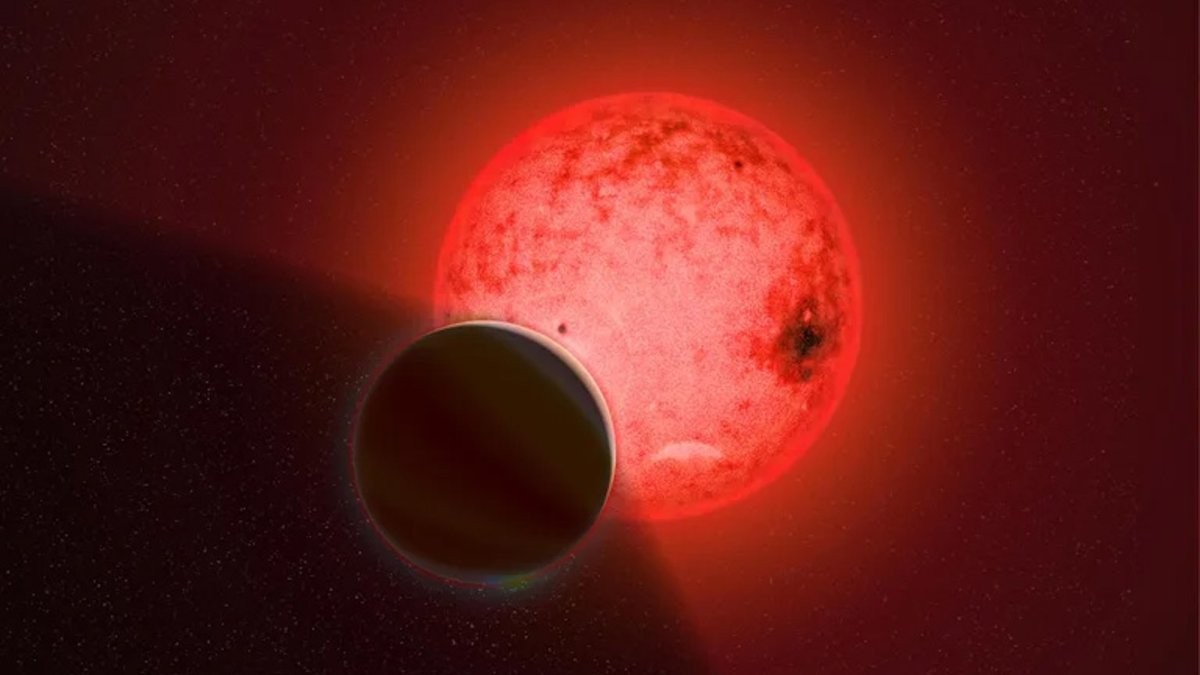
A newly discovered exoplanet, designated TOI-5205 b, is challenging current understanding of how gas giants form. Located 282 light-years from Earth, this Jupiter-sized world possesses an unexpectedly low concentration of heavy elements in its atmosphere – a characteristic that has earned it the nickname “forbidden planet.” The discovery, detailed in The Astronomical Journal, suggests that existing models of planetary evolution may be incomplete.
A Rare Composition
TOI-5205 b was first identified in 2023 by NASA’s Transiting Exoplanet Survey Satellite (TESS). Subsequent spectroscopic analysis revealed an atmosphere containing compounds like methane and hydrogen sulfide. However, the most striking finding is the planet’s internal composition: researchers estimate it to be 100 times richer in metals than its atmosphere. This discrepancy is highly unusual; planets typically accumulate heavier elements over time, and their atmospheres usually reflect that distribution.
“We observed much lower metallicity than our models predicted for the planet’s bulk composition,” explains Shubham Kanodia, an astronomer at Carnegie Science. “This suggests that its heavy elements migrated inward during formation, and now its interior and atmosphere are not mixing.”
Challenging Planetary Formation Theories
Current theory states that planets form from the swirling dust and gas surrounding young stars. The relative metallicity of a planet (the abundance of elements heavier than hydrogen and helium) is a key indicator of where and how it formed. Planets forming closer to their star tend to be more metal-rich due to the higher density of materials in that region.
TOI-5205 b orbits a red dwarf star – a smaller, cooler type of star than our sun. The fact that this planet is metal-poor despite being close to its star is perplexing. The planet’s host star is about four times larger than Jupiter but only 40% the mass of our sun, further complicating the picture. This suggests that the planet’s formation may have been influenced by migration within the early protoplanetary disk, or by some other yet-unknown process.
Implications for Exoplanet Research
The discovery of TOI-5205 b highlights the diversity of planetary systems beyond our own and the limitations of current models. The planet’s peculiar composition may indicate that the early stages of planetary formation are far more chaotic and variable than previously thought.
“These findings have implications for our understanding of the giant planet formation process that occurs early in a star’s lifespan,” says Anjali Piette, an astronomer at the University of Birmingham. “The planet having a lower metallicity than its own host star makes it stand out among all the giant planets that have been studied to date.”
Further observations and refined modeling will be crucial to fully explain the origin of this “forbidden” planet and what it reveals about the broader universe.