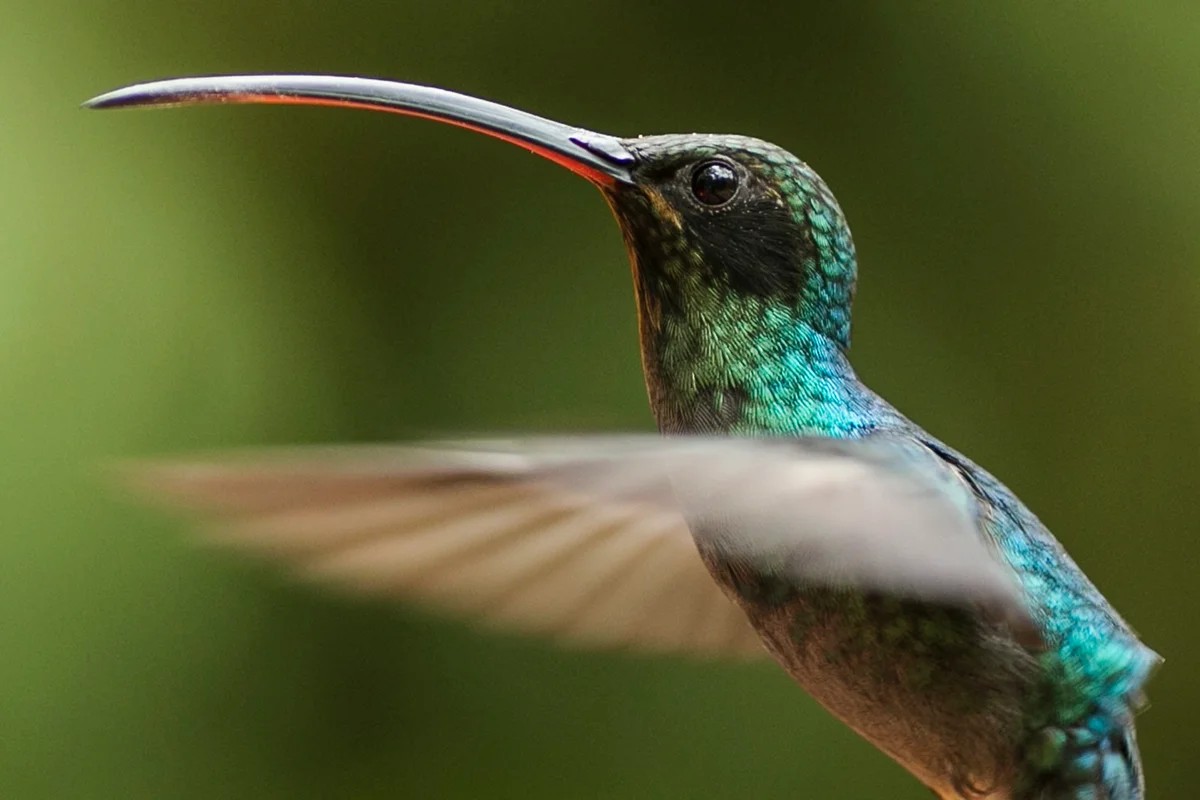
Male green hermit hummingbirds engage in violent, bill-first jousting matches during mating season, new research confirms. These birds aren’t just sipping nectar; they’re locked in an evolutionary arms race where a sharper beak can mean life or death.
The Weaponized Beak
For decades, scientists believed the differing beak shapes between male and female green hermit hummingbirds were purely a matter of feeding habits. Males have evolved straighter, more pointed bills to access specific flower types. But a study in the Journal of Experimental Biology reveals this isn’t the whole story.
The male beak is 3% straighter and 69% more pointed than the female’s, and terminates in a dagger-like tip. Researchers used 3D modeling of museum specimens to demonstrate that this isn’t just incidental; it’s a direct adaptation for combat.
Ritualized Violence
During breeding season, males gather in leks—display grounds where they perform to attract females. Competition for position within the lek is fierce, as birds on the periphery are less likely to be heard. When rivals encroach on occupied perches, the fights escalate.
“The birds fly bill-first at the other bird and poke them with their entire force,” explains lead author Alejandro Rico-Guevara.
These aren’t playful skirmishes. The jousts are aggressive and sometimes fatal, highlighting the brutal realities of natural selection. The violence isn’t new to ornithologists, but the research provides definitive proof of the evolutionary pressure behind this behavior.
Why This Matters
The findings underscore how seemingly innocuous traits can evolve under the intense pressure of sexual selection. The hummingbird’s bill is a prime example: it’s a feeding tool and a weapon. This research helps explain why male hummingbirds have evolved such specialized beaks, and why these characteristics are so vital for breeding success.
The study’s methodology, using 3D modeling, sets a new standard for examining evolutionary adaptations in avian species.
Hummingbird jousting is a reminder that even in the most beautiful ecosystems, survival often comes down to aggression and dominance.