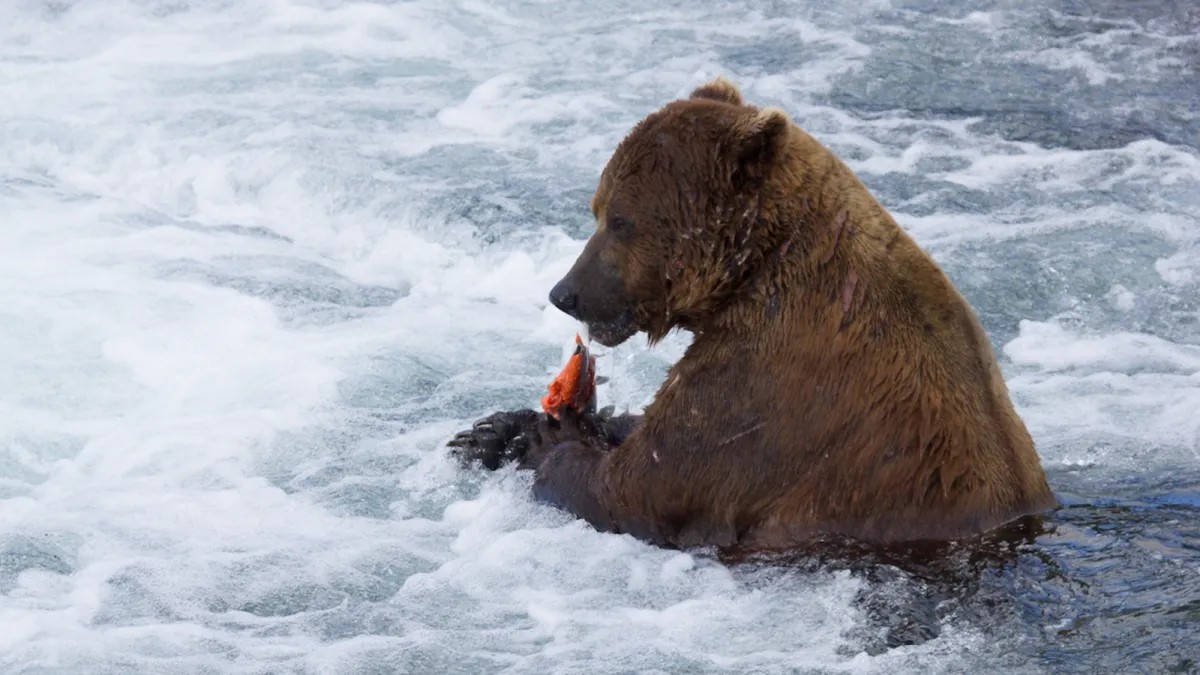
Chunk, the reigning champion of Katmai National Park’s famous “Fat Bear Week,” has made an early and welcome appearance this spring. Maintenance crews from the National Park Service spotted the massive male brown bear strolling across a patch of ice in the park, a sighting that has delighted wildlife enthusiasts and park staff alike.
A Rare Spring Sighting
Spring sightings of brown bears in Katmai are relatively uncommon, making this early glimpse of Chunk particularly significant. The video, shared by the Katmai Conservancy, shows the bear navigating the icy terrain, signaling the start of another active season for one of the world’s most famous bears.
Chunk—officially known as Bear 32 —is a dominant figure in the Brooks River ecosystem. Recognizable by his dark fur, narrow-set eyes, prominent brow ridge, and a distinctive scar across his muzzle, he is renowned for both his size and his resilience. Last summer, after gorging on salmon, he tipped the scales at approximately 1,200 pounds.
The King Returns to the Salmon Run
The appearance of Chunk coincides with the beginning of the annual salmon run, a critical period for brown bears in the region. Bears return to the Brooks River in June to feed on the migrating fish. This summer feast is not just a culinary event; it is a matter of survival. Bears must bulk up significantly during these months to survive hibernation and the long winter ahead.
To celebrate this natural phenomenon and raise awareness for conservation, Katmai National Park hosts Fat Bear Week every autumn. This online tournament allows nature lovers to vote for the fattest bear in the park. Chunk was crowned the 2024 champion, securing 96,350 votes, well ahead of runner-up Bear 856, who received 63,725 votes.
Resilience in the Face of Injury
Chunk’s return is notable not only for his size but also for his adaptability. Last year, during the mating season, Chunk was spotted with a freshly broken jaw, likely sustained while fighting another male for access to a mate. Mating season typically peaks in June, with males sometimes pursuing females for up to a week before mating occurs.
Despite the severity of the injury, Chunk demonstrated remarkable resilience. According to explore.org:
“Chunk proved immediately adaptable. He adjusted his behavior to avoid most direct confrontations with other large male bears. He quickly learned to eat salmon without the full use of his mandible. Additionally, his large body size still gave him easy access to many productive fishing spots.”
This ability to modify his hunting strategy and avoid unnecessary conflict allowed him to maintain his dominance and continue feeding effectively, even with a compromised jaw.
Why This Matters
The health and behavior of bears like Chunk serve as an indicator of the broader ecosystem’s vitality. The Brooks River salmon run is the cornerstone of the brown bear population in Katmai. As climate patterns shift, understanding how key individuals adapt to injuries, competition, and environmental changes provides valuable insights into the resilience of these apex predators.
As the summer progresses, the number of bears in the area is expected to peak in mid-July. For now, however, the early return of the champion serves as a reminder of the enduring cycle of life in Alaska’s wilderness.
In summary, Chunk’s early appearance marks the beginning of another critical feeding season for Katmai’s brown bears, highlighting both the importance of the salmon run for bear survival and the remarkable adaptability of one of nature’s most iconic creatures.