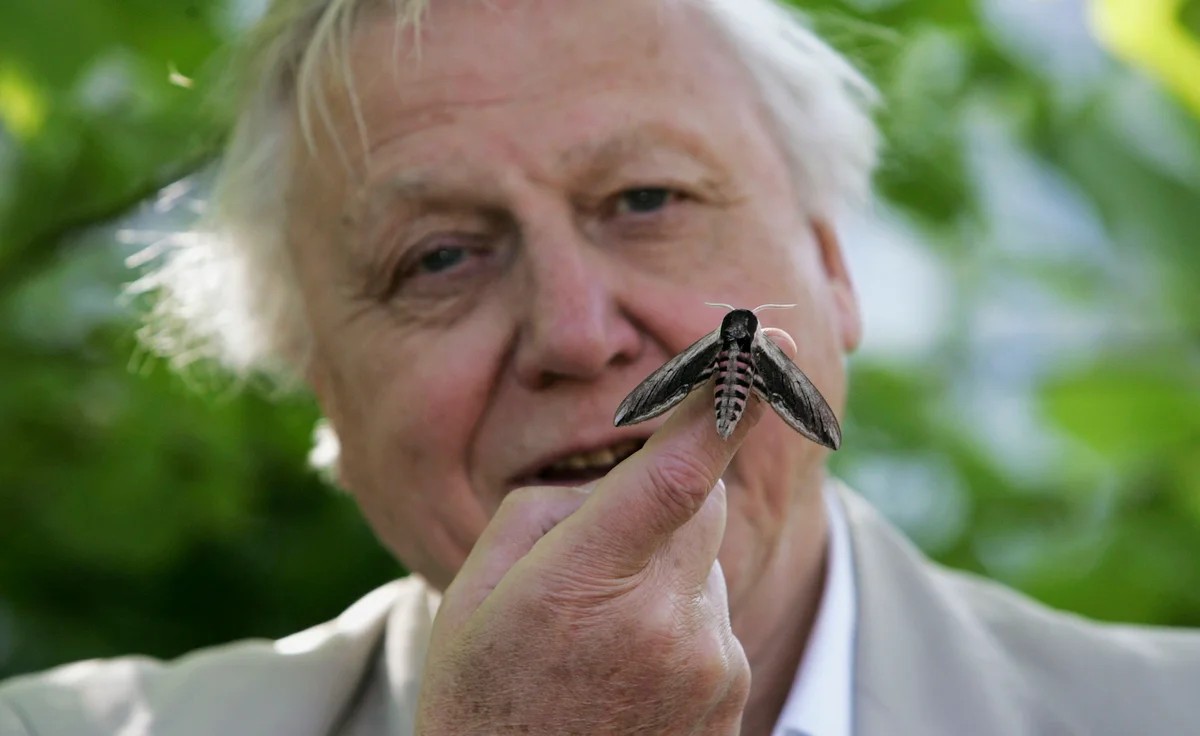
Sir David Attenborough, the voice that has guided generations through the natural world’s most remote corners, has reached a historic milestone: his 100th birthday. Born on May 8, 1926, near London, the broadcaster and naturalist has spent a century not only documenting the Earth’s biodiversity but also shaping how humanity perceives its place within it.
While Attenborough had hoped for a quiet celebration, the global response has been anything but subdued. In a message released by the BBC, he noted being “completely overwhelmed” by greetings ranging from preschool groups to care home residents. Among the myriad tributes, a tiny parasitic wasp was officially named in his honor—a fitting addition to a long list of species bearing his name, including a genus of marine reptiles, a critically endangered echidna, and a ghost shrimp.
From Fossil Hunter to Global Icon
Attenborough’s journey began not in a television studio, but in the mud of childhood. As a boy, he was an avid collector of fossils and animals, even earning small fees by supplying newts to his father’s university zoology department. After studying geology and zoology at Cambridge University, he joined the BBC in 1952 as a producer.
His early career was defined by exploration. In 1954, he co-launched Zoo Quest with reptile expert Jack Lester, a series that took viewers beyond the zoo enclosure into the wild. By the late 1960s, Attenborough had risen to become the BBC’s Director of Television Programming. However, he famously resigned from the executive suite in 1972, turning down consideration for the role of Director General. He chose instead to devote himself fully to writing and producing, a decision that allowed him to create the seminal nature documentaries that would define his legacy.
A Legacy Defined by Curiosity, Not Status
Despite winning four Emmys and multiple BAFTAs across decades of technological shifts—from black-and-white film to 3D—Attenborough has remained remarkably grounded. Colleagues describe him as a “normal bloke” who flies coach class and insists on helping carry crew members’ bags.
“Who you see on TV is who he is…. He’s just genuinely interested in everything,” said Gavin Thurston, a cinematographer who has worked with Attenborough on numerous series.
Yet, humility does not equate to a lack of authority. Keith Scholey, co-director of Silverback Films, noted that Attenborough commands a room with his presence and maintains a “phenomenal” work ethic. He expects excellence from everyone around him, driven by a deep-seated need for scientific accuracy.
The Shift from Observer to Advocate
For much of his career, Attenborough avoided political commentary, adhering to a strict personal code: he would only speak out if he could categorically and scientifically prove his point. This caution sometimes drew criticism in his earlier years, with some arguing he did not speak up enough on environmental issues.
However, as the climate crisis has accelerated, so has Attenborough’s voice. In recent years, he has moved from observer to urgent advocate. At the 2021 COP26 climate summit, he delivered a stark warning:
“Our burning of fossil fuels, our destruction of nature, our approach to industry, construction and learning, are releasing carbon into the atmosphere at an unprecedented pace and scale.”
This shift reflects a broader trend in environmental journalism and activism: the realization that documenting beauty is no longer enough; explaining the threat to that beauty is essential. Attenborough’s latest projects, including the 2025 film Ocean with David Attenborough, continue this dual mission of awe and advocacy.
Why This Century Matters
Attenborough’s centenary is more than a celebration of a long life; it is a marker of a changing relationship between humans and nature. He began his career when the natural world was largely viewed as a resource to be exploited or a curiosity to be observed. Today, he stands as one of the most influential voices arguing that nature is a system we are inextricably part of—and one that is currently fragile.
His enduring optimism is perhaps his most powerful tool. Rather than wagging a finger, Attenborough has spent a century opening doors, showing viewers the mind-blowing colors of coral reefs and the intricate lives of invertebrates. He has impassioned millions with stories of species and places, hoping that wonder will translate into protection.
As he enters his tenth decade, the question remains not just how long he will continue to broadcast, but whether the world will listen to the warnings embedded in his life’s work. The answer may determine the future of the very planet he has spent a century celebrating.