Eggs are evolutionary marvels. They must balance protection with permeability, ensuring developing life survives harsh conditions while still allowing eventual emergence. Over millennia, species have evolved astonishing egg-laying strategies to maximize survival, resulting in forms ranging from gelatinous blobs to durable shells. Here’s a look at three of the most intriguing adaptations.
Blue Crabs: Migratory Sponges of the Atlantic
Blue crabs (Callinectes sapidus ) face unique pressures during their lifecycle. From coastal larvae to mature breeding adults, they adapt to shifting habitats, predators, and salinity levels. Mature females undertake epic migrations—up to 150 miles into the open Atlantic—to lay their eggs, relying on a single mating episode to fertilize all future broods over their roughly four-year lifespan.
These females produce around three million eggs per brood, which appear as dark, sponge-like masses—hence the nickname among Chesapeake Bay fishers. As embryos develop, the “sponge” darkens due to larval pigmentation. This process demands precise timing: molting, mating, migration, and incubation must all align.
Salamanders and a Symbiotic Algae
Spotted salamanders (Ambystoma maculatum ) exhibit a remarkable symbiosis with the green alga Oophila amblystomatis. The algae live inside the salamander embryo’s cells—an exceptionally rare vertebrate-algae relationship. This gives the embryo an additional energy source and oxygen, while the embryo provides the algae with nutrients and shelter.
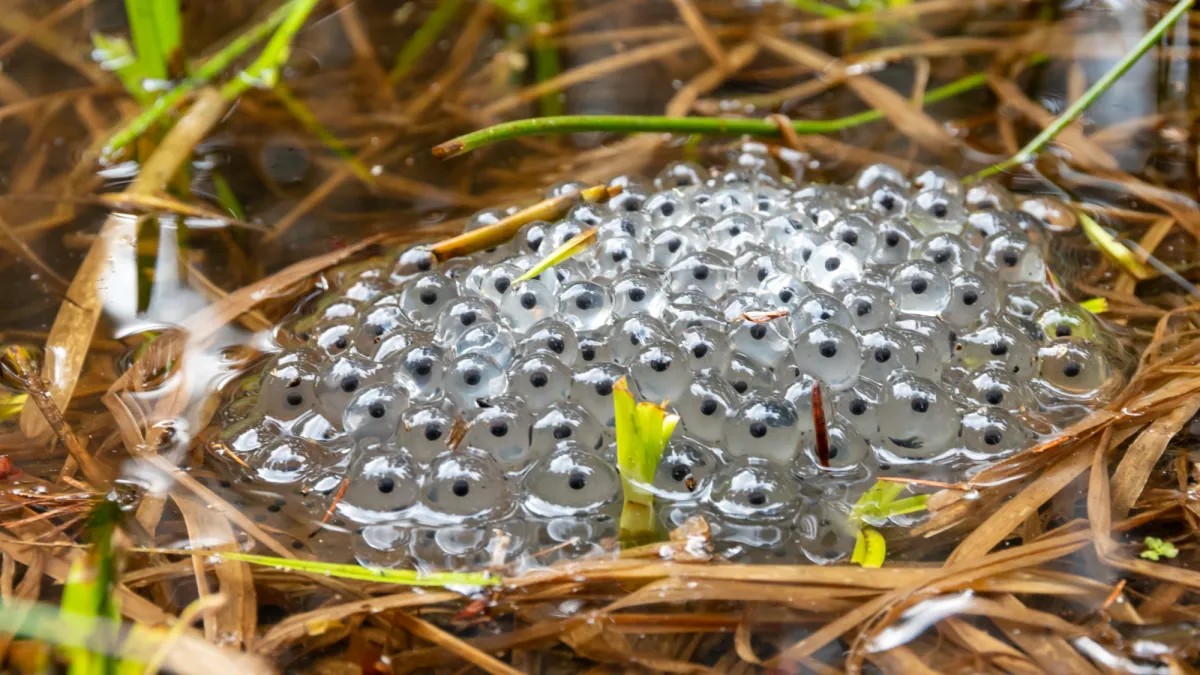
These gelatinous egg masses, often laid in spring pools, turn green due to the algae. Though the color provides camouflage, eggs remain vulnerable to predators like raccoons and wood ducks. The symbiosis is a clear example of mutually beneficial adaptation in action.
Birds: Biodiversity in Shells
Bird eggs demonstrate perhaps the greatest diversity. Each species adapts its egg’s color, size, and shape to its environment. Camouflage is essential, but egg traits also influence temperature regulation and structural stability.
Emperor penguins (Aptenodytes forsteri ) in Antarctica incubate eggs by having males sit on them during extreme cold, while desert-dwelling verdins (Auriparus flaviceps ) rely on speckled eggs to blend into thorny nests in scorching heat. Size extremes include the ostrich egg—weighing over four pounds—and the bee hummingbird egg, smaller than a jellybean.
American robin eggs stand out with their vivid blue-green hue, potentially protecting embryos from UV radiation. Some theories suggest the color may also signal female health, though further research is needed.
In conclusion, these three examples highlight how natural selection shapes egg-laying strategies to ensure survival. From migratory crustaceans to symbiotic amphibians and adaptable birds, eggs represent a stunning convergence of biology, environment, and evolutionary pressure.