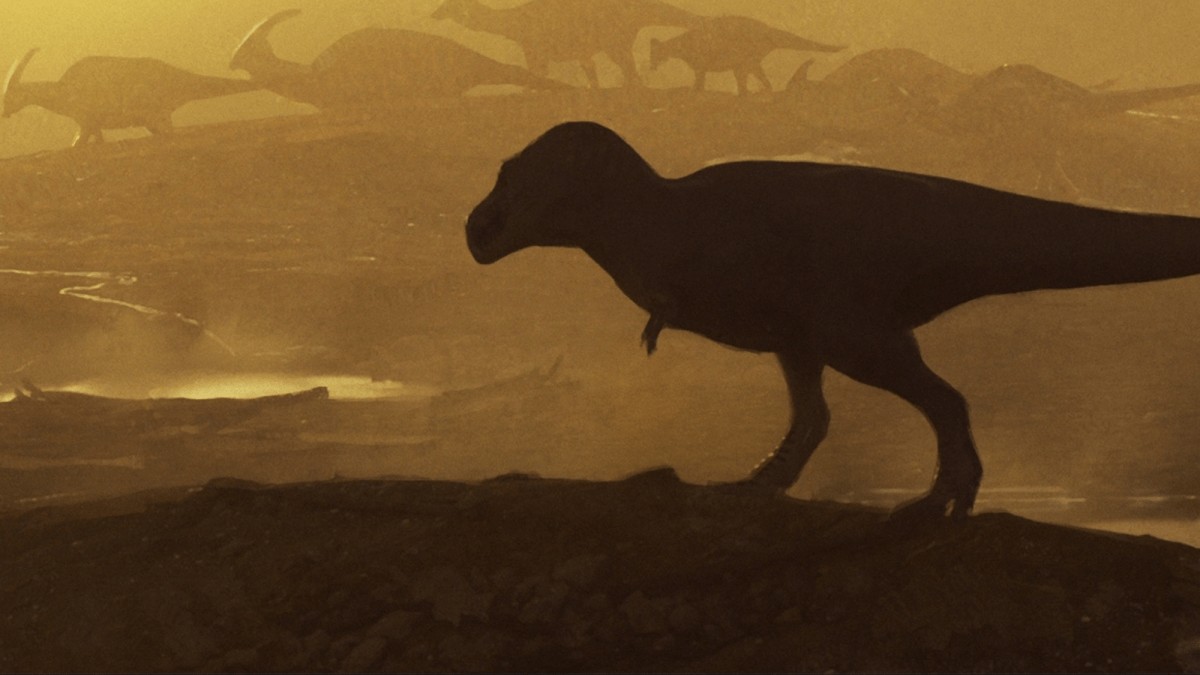
A remarkably large tyrannosaur leg bone unearthed in New Mexico is rewriting our understanding of these apex predators. The fossil, a shinbone measuring three feet long and five inches in diameter, suggests a dinosaur weighing over 10,000 pounds roamed North America roughly 74 million years ago. This discovery pushes back the timeline for giant tyrannosaurs and supports a potential North American origin for the lineage.
A Predator Out of Time
The bone was recovered from the Kirtland Formation in northwestern New Mexico, a region dating back to the Late Campanian age. During this period, present-day North America was a subtropical landscape bisected by a massive inland sea stretching from the Gulf of Mexico to the Arctic. This particular tyrannosaur lived near the western coast of this seaway, within a dense network of jungles and forests teeming with armored, horned, and duck-billed dinosaurs.
“Think of the current Gulf Coast – a low-lying floodplain – but 74 million years ago,” explains Anthony Fiorillo, a paleontologist at the New Mexico Museum of Natural History & Science. The ecosystem was lush, supporting diverse flora including conifers, flowering plants, ferns, and horsetails.
Larger Than Expected
The sheer size of the bone surprised researchers, but its age is even more significant. The fossil is older than previously expected for tyrannosaurs of this size, challenging existing theories about their evolutionary timeline.
“That it is a very large tyrannosaur for its time, and much older geologically than anybody would have predicted,” says Spencer Lucas, another paleontologist involved in the study.
The bone is only slightly smaller than the equivalent limb from “Sue,” the largest and most complete Tyrannosaurus rex specimen ever found at the Field Museum in Chicago. This means the New Mexico tyrannosaur was likely the largest predatory dinosaur of its era, weighing significantly more than later tyrannosaurs (approximately 10,361 pounds versus the 4,000 to 6,000 pounds seen in more recent fossils).
Implications for Tyrannosaur Origins
The discovery supports the idea that tyrannosaurs may have originated in North America, specifically the southern part of the continent. This challenges competing theories that place the evolutionary roots of these dinosaurs in Asia. The bone’s characteristics suggest a close relationship to both Tyrannosaurus rex and Tyrannosaurus mcraeensis, potentially placing it within an early branch of the Tyrannosaurini group (which includes iconic species like Tarbosaurus and Zhuchengtyrannus ).
However, the debate is far from settled. Further excavations in both North America and Asia are needed to determine the true origin of tyrannosaurs. A complete skeleton is also crucial for accurately identifying the species, clarifying its relationships with other tyrannosaurs, and refining size estimates.
“Science is a process that unfolds on its own schedule,” says Fiorillo. “Each new fossil discovery forces us to step back and re-evaluate what we think we know, and that is why science can be so dynamic.”
The discovery emphasizes how much remains to be learned about these iconic predators. Each new find continues to refine our understanding of their evolution, distribution, and dominance over the prehistoric world.