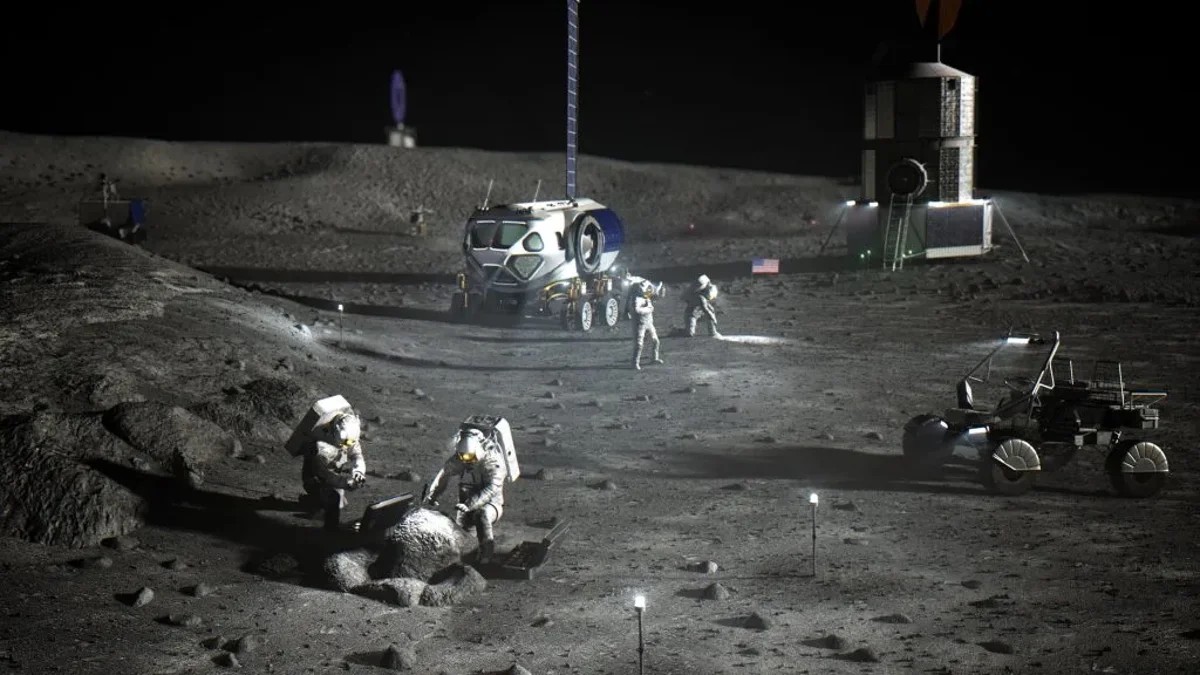
The renewed global push to return to the moon isn’t just about flags and footprints; it’s about establishing a permanent, crewed presence. Both the United States and China have ambitious plans for a lunar base, but their approaches diverge significantly, raising questions about who will reach the moon first—and what that means for control of lunar resources and operations.
China’s Calculated Approach
The China Manned Space Agency (CMSA) aims for a human landing by 2030, utilizing its Mengzhou capsule and Lanyue lander launched on Long March 10 rockets. Their strategy mirrors NASA’s early Apollo missions: a relatively safe landing near the lunar equator. This cautious approach prioritizes feasibility over risk, ensuring a stable foundation for later expansion.
China’s vision extends beyond a single landing. The International Lunar Research Station (ILRS), developed with Russia’s Roscosmos, will unfold in two phases. First, uncrewed missions like Chang’e 7 will survey the Shackleton Crater at the south pole for water ice and other resources. Then, Chang’e 8 in 2029 will test base-building techniques, including 3D-printing structures from lunar soil. The long-term goal is in situ resource utilization —creating water, fuel, and building materials directly on the moon.
NASA’s Bold Gamble
NASA is targeting a 2028 landing, employing the Orion capsule atop the Space Launch System and commercial landers (SpaceX’s Starship or Blue Origin’s Blue Moon). Unlike China’s conservative plan, NASA intends to land near the lunar south pole, a more challenging but resource-rich region.
The Artemis Base Camp is designed as a U.S.-led project with international and commercial contributions. NASA administrator Jared Isaacman candidly described the early stages as a “futuristic junkyard” before evolving into a more developed infrastructure. Key to this is the proposed installation of a fission reactor by 2030, though details remain scarce.
A Legislative Push for Permanence
The Senate Committee on Commerce, Science, and Transportation recently passed legislation mandating NASA to establish a permanent moon base. Senator Ted Cruz explicitly stated the goal: “to get there before China does.” This directive transforms a long-term aspiration into a concrete policy objective, signaling a decisive commitment to lunar colonization.
What “Permanent” Really Means
Establishing a sustainable presence on the moon differs from maintaining a station in low Earth orbit (like the ISS). A lunar base requires a robust landing and launchpad, continuous logistical support, and the ability to extract and utilize local resources. Habitats must be shielded from radiation and micrometeoroids, likely by burying them beneath lunar soil.
Legal experts like Michelle Hanlon emphasize that “permanence” isn’t about a single structure but a network of systems—power, landing sites, resource processing, and habitation. The 1967 Outer Space Treaty prohibits national appropriation, but allows for “safety zones” to protect operations. The real challenge will be balancing cooperation with potential exclusion, particularly given the limited number of viable landing sites at the south pole.
The Geopolitical Stakes
The race to establish a permanent moon base is fundamentally about control. The ability to extract resources, conduct research, and maintain a long-term presence will reshape the future of space exploration. The nations that succeed will wield significant influence over lunar development and potentially beyond.
Ultimately, building a moon base isn’t just a scientific or technological feat. It’s a political one. The coming decade will determine which country—the United States or China—will lead the way in humanity’s next giant leap.