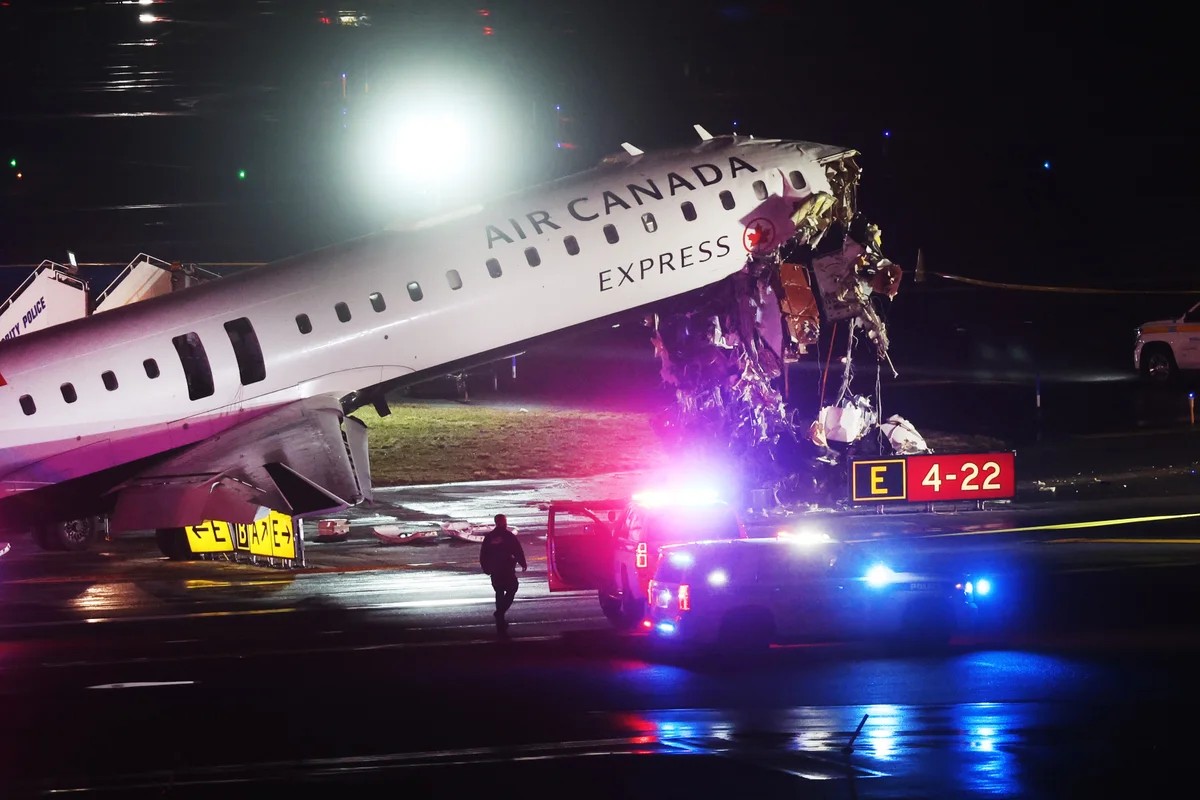
The recent collision between an Air Canada plane and a fire truck at LaGuardia Airport, resulting in two fatalities and multiple injuries, underscores a critical design flaw in modern aviation: airplanes are engineered for airborne threats, not ground-level impacts. The incident, which occurred Sunday night as the Air Canada flight from Montreal touched down, sheared off the aircraft’s nose cone while traveling at over 90 mph. Forty-one passengers and two firefighters were hospitalized, though most were released by Monday afternoon.
The Collision’s Fatal Design Weakness
The core issue isn’t simply the accident itself, but why it proved so destructive. Unlike automobiles, which undergo rigorous crash testing and incorporate safety features like airbags and reinforced frames, aircraft prioritize airworthiness over road collision resilience. According to Michael McCormick, an air traffic management professor at Embry-Riddle, planes are built to withstand turbulence, bird strikes, and even emergency water landings—but not head-on impacts with heavy vehicles.
This is a matter of physics and design compromise. Aircraft manufacturers balance strength with weight: adding more crash protection would reduce fuel efficiency. John Hansman, a professor at MIT, explains that planes are not built to “bump into things.” The nose cone, in particular, uses plastic to house radar equipment, making it especially vulnerable.
Why Aircraft Can’t Swerve
The situation was further exacerbated by LaGuardia’s short runways, which were extended in the 1960s to accommodate larger jets. Once an aircraft begins landing, it requires considerable distance to regain takeoff speed, leaving little room to maneuver around sudden obstructions. According to experts, pilots have limited options when a vehicle appears unexpectedly on the runway. The plane cannot swerve like a car, and attempting a rapid takeoff might not be feasible given runway length.
Investigation & Future Implications
Federal authorities have launched a thorough investigation, including examining air traffic control procedures, which apparently cleared the fire truck onto the runway before halting its movement. While the investigation’s outcome remains uncertain, the incident raises questions about whether current safety protocols adequately address the risk of ground-level collisions.
The LaGuardia crash isn’t just a tragedy; it’s a stark reminder that aviation safety standards must account for the limitations of aircraft design in real-world scenarios.