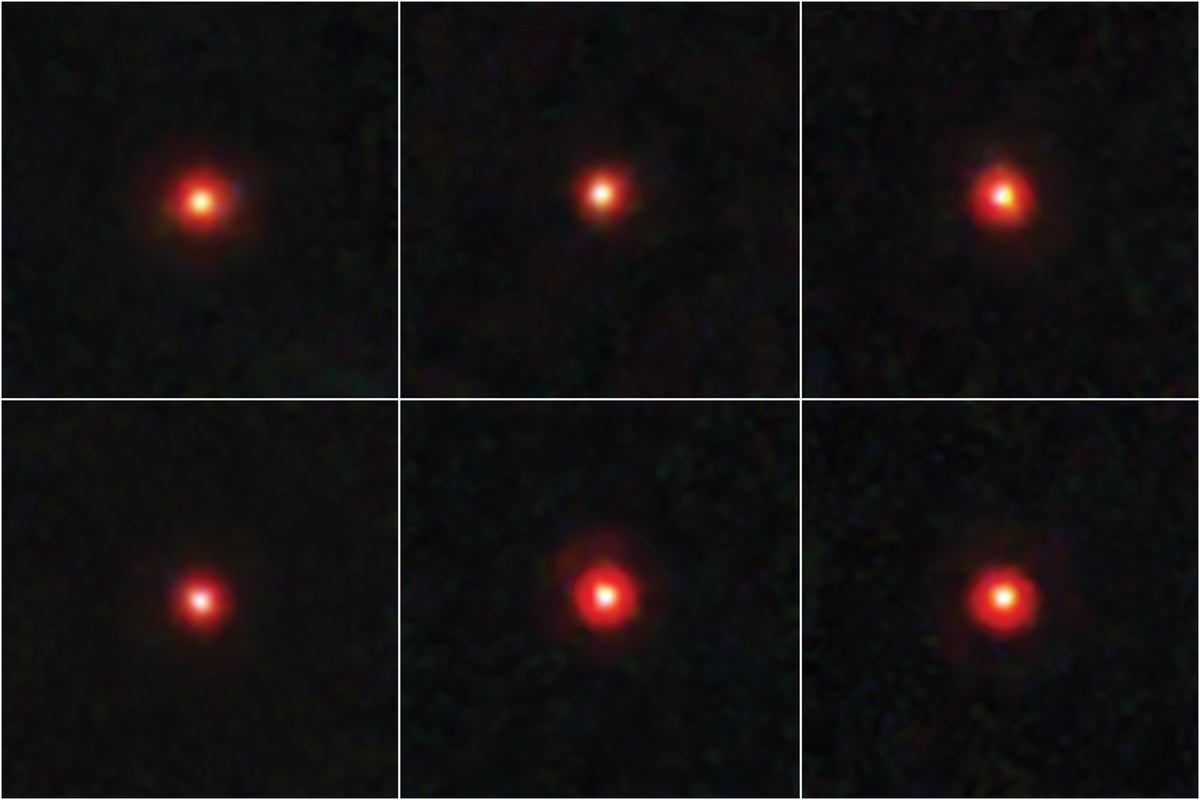
The James Webb Space Telescope (JWST) has already delivered on its promise of revolutionizing astronomy, but even its creators were surprised by a recurring anomaly: tiny, intensely red spots appearing in nearly every deep-space image. Dubbed “Little Red Dots” (LRDs), these objects have become one of the biggest mysteries in modern cosmology, forcing scientists to re-evaluate our understanding of the universe’s first billion years.
The Discovery and Initial Puzzlement
When JWST’s first images were released in 2022, astronomers expected the usual: vibrant nebulae and distant galaxies. Instead, they found a consistent pattern of compact, bright red points scattered across the cosmos. These LRDs originated from a period just 600 million years after the Big Bang, meaning their light traveled almost the entire age of the universe to reach us. Strangely, they largely vanished by 1.5 billion years later.
The prevalence of LRDs immediately raised questions. Why were these objects so common in the early universe, then seemingly disappeared? What could produce such a distinct red signature? The answer, as with many things in cosmology, is far from simple.
Competing Theories: From Black Holes to Novel Objects
Initial hypotheses centered around familiar structures: compact galaxies hosting supermassive black holes, dusty starburst galaxies undergoing rapid formation, or even previously unknown stages in the black hole life cycle. If LRDs were black holes, their sheer number would challenge existing models of how these gravitational behemoths form and grow in the early universe.
However, as more data accumulated, these explanations began to falter. The LRDs were too small to contain billions of stars, yet too dense to be simple galaxies. Their spectra lacked the expected X-ray emissions common in black holes, and their rapid spin defied conventional physics.
The Rise of Quasi-Stars and Black Hole Stars
In 2024, a new, more radical theory gained traction: LRDs might represent a fundamentally new class of cosmic object. Physicists revisited a concept from two decades prior—”quasi-stars,” hypothetical structures born from collapsing gas clouds rather than dying stars.
The idea is this: a dense gas cloud collapses directly into a black hole, surrounded by an envelope of hot gas. This structure emits intense infrared radiation, explaining the red color. These “black hole stars” wouldn’t be true stars in the traditional sense, but rather a hybrid entity powered by a central black hole.
Why This Matters: Rewriting the Early Universe
The implications are profound. If LRDs are quasi-stars, it means our understanding of black hole formation is incomplete. The early universe may have been seeded with massive black holes far more efficiently than previously thought.
These objects could also explain how supermassive black holes grew so rapidly in the early cosmos—a long-standing puzzle for astrophysicists. The current models struggle to explain the existence of such massive black holes so soon after the Big Bang. The discovery of LRDs suggests an alternate, more direct pathway for their formation.
The Ongoing Investigation
As of late 2025, the debate continues. Astronomers are racing to gather more data, refine their models, and definitively identify the nature of LRDs. New observations confirm that some are further away than originally thought and that the Balmer break, a key spectral signature, could be produced by other mechanisms.
One recent study, using JWST’s RUBIES program, analyzed over 4,500 distant galaxies, finding about 40 LRDs. One object, nicknamed “The Cliff,” displayed a particularly sharp Balmer break, suggesting an unusual energy source.
Conclusion
The mystery of Little Red Dots is far from solved, but the investigation is pushing the boundaries of our knowledge. Whether they represent a new class of black hole-powered objects, exotic star formations, or a combination of both, LRDs are forcing astronomers to rethink the earliest stages of cosmic evolution. The universe has once again revealed its capacity for surprise, reminding us that the most groundbreaking discoveries often come from the most unexpected places.