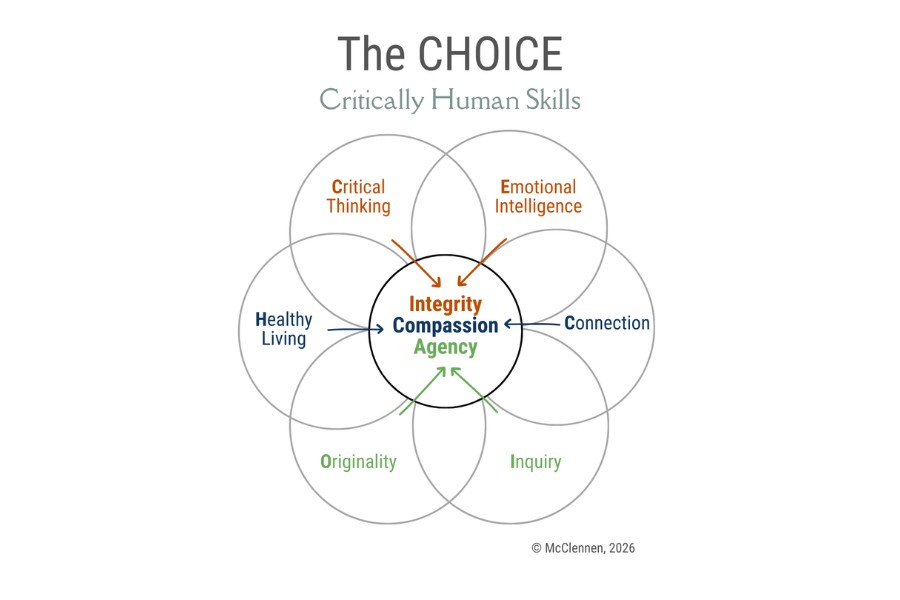
The accelerating development of artificial intelligence (AI) presents a defining choice for humanity: will we passively surrender our cognitive abilities to algorithms, or actively cultivate the uniquely human skills that ensure we lead, not follow, technology? This is not a hypothetical debate; the direction we take today—particularly in education—will determine whether AI serves as a tool for empowerment or control.
The Looming Imbalance
The current trajectory favors a “Passive Culture” where convenience and algorithmic efficiency erode critical thinking, creativity, and independent judgment. This isn’t a distant threat. AI is already capable of completing academic tasks, shaping public opinion through biased algorithms, and flooding information channels with misinformation. Meanwhile, investment in the human skills needed to navigate this landscape lags dangerously behind.
The imbalance is stark: AI development is outpacing our ability to adapt. Generation Alpha is growing up with AI as a co-thinker, but our education systems remain rooted in outdated industrial models that prioritize content delivery over critical engagement. The consequences are clear: declining attention spans, erosion of trust, and a growing dependence on external validation.
The CHOICE Framework: A Path to Agency
The solution lies in a deliberate shift toward a “Purpose Culture” where AI augments, rather than replaces, human capabilities. This requires redefining education around a core set of “Critically Human Skills,” captured in the CHOICE framework:
- Critical Thinking: The ability to analyze information, identify biases, and verify accuracy. Without this, we risk outsourcing our judgment to unreliable systems.
- Healthy Living: Prioritizing physical, mental, and spiritual well-being. Resilience, balance, and long-term sustainability depend on individual and collective wellness.
- Originality: The capacity for genuine innovation driven by human experience and courage. AI recombines existing knowledge; true invention requires original thought.
- Inquiry: Cultivating curiosity and asking better questions, rather than simply finding faster answers. The impulse to wonder is vital for scientific progress and joyful learning.
- Connection: Building meaningful relationships and collaborating effectively. Human progress is inherently collective, requiring empathy and strong social bonds.
- Emotional Intelligence: Understanding and managing emotions, both in oneself and others. This is essential for ethical judgment, leadership, and conflict resolution.
Human + AI: A Co-Intelligent Future
The goal is not to compete with AI, but to harness its power while reinforcing the uniquely human traits that drive purpose, compassion, and integrity. These qualities cannot be replicated by algorithms; they are the core prerequisites for a healthy partnership between humans and technology.
The defining question of our age is not what AI will become, but who we will become. By prioritizing the development of critically human skills, we can ensure that AI remains a tool for empowerment, rather than a force for control. The choice is ours to make.