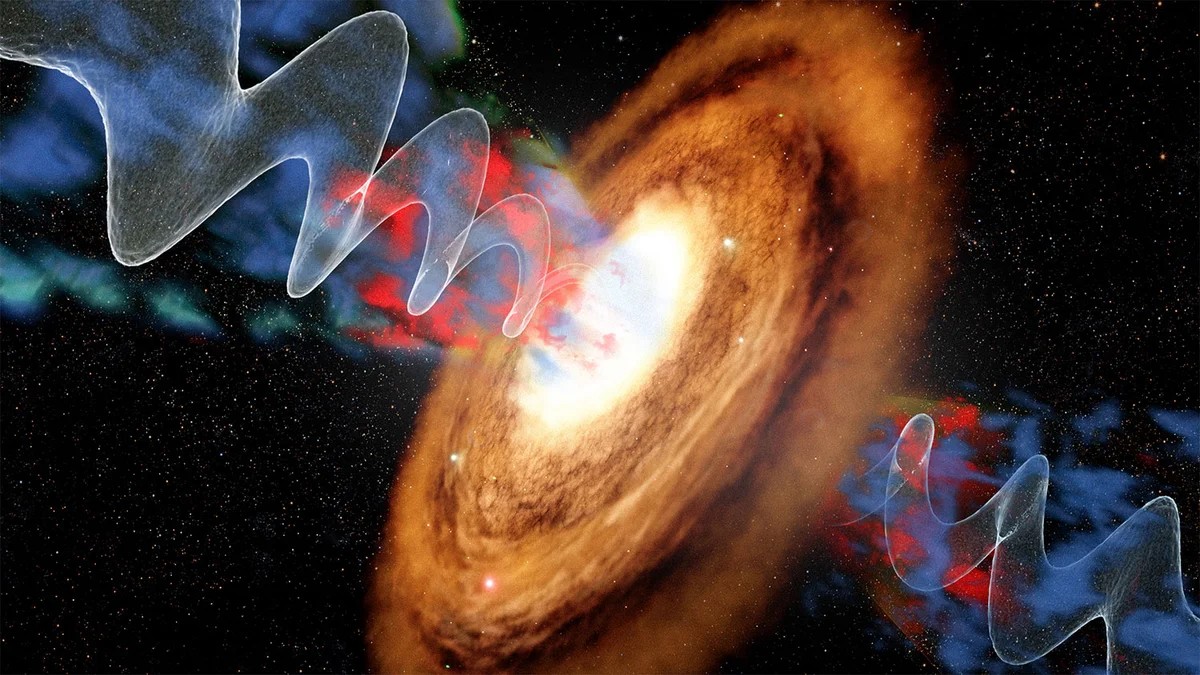
For decades, astronomers have observed supermassive black holes (SMBHs) at the centers of most large galaxies. These SMBHs periodically consume matter and eject powerful jets of energy and particles. A recent study reveals how this activity actively suppresses star formation in spiral galaxies, a phenomenon previously understood only in broad strokes.
Wobbling Jets: A New Mechanism for Galactic Regulation
Researchers studying the galaxy VV 340A, located 450 million light-years away, discovered that its central SMBH emits a unique, wobbling jet. Unlike conventional outflows that either heat surrounding gas or compress it to trigger star birth, this jet acts like a “cosmic snowplow,” forcefully expelling gas needed for new stars. The findings were presented at the American Astronomical Society’s winter meeting.
Astrophysicist Justin Kader explains that black hole outflows typically fall into two categories: radiative mode, where hot accretion disks expand, and jet-driven mode, where focused jets compress gas clouds. VV 340A defies both. Its jet is not straight but shaped like an “S,” and its effects are dramatically different.
The VV 340A Anomaly: A Precessing Jet in Action
VV 340A is part of a merging system with VV 340B, forming a distinctive celestial configuration. The edge-on orientation of VV 340A allowed researchers to probe its central region effectively. Using the James Webb Space Telescope, they detected an unprecedented cloud of superheated plasma extending nearly 20,000 light-years. Further observations confirmed this plasma was ejected at high speeds, aligned with the SMBH’s wobbling jet.
This wobble, or precession, resembles the motion of a spinning top or a lawn sprinkler. As the SMBH spins, its jet sweeps through space, pushing away star-forming gas at a rate of roughly 20 solar masses per year. Researchers estimate this process could reduce VV 340A’s star-forming lifespan by approximately 250 million years.
Unanswered Questions: Binary Black Holes or Disk Instabilities?
The cause of the jet’s precession remains uncertain. Two main possibilities have been proposed: accretion disk instability (where gas clumps disrupt the disk) and the presence of a binary SMBH system. If two black holes orbit each other, their gravitational interaction could whip the jet around like a hose. While direct evidence of binary SMBHs is lacking, it remains a strong hypothesis.
Astronomer Andrew Fabian notes that precessing jets as drivers of gas outflows are a new discovery. Higher-resolution observations from future telescopes like NASA’s Nancy Grace Roman Space Telescope may help resolve this mystery. Researchers have already identified 32 similar galaxies for further study, aiming to understand how galaxy mergers influence star formation.
By understanding how SMBHs regulate star formation, scientists gain deeper insights into galactic evolution and the processes that shape the universe.
This discovery highlights the complex interplay between black holes and their host galaxies, reinforcing the notion that SMBHs play a critical role in controlling galactic growth.