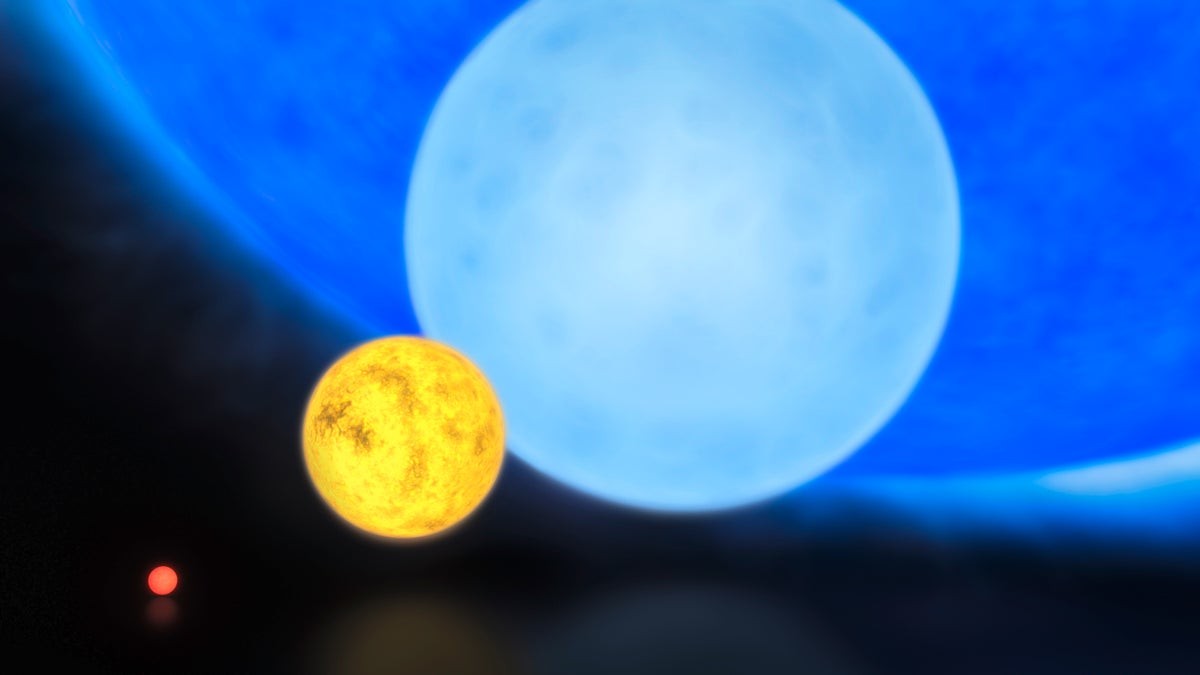
The sun is often called an “average” star, but this is misleading. In reality, it falls within the top 10% of stars by mass. The universe is dominated by small, dim red dwarfs, many of which are less than half the sun’s size. A star must have at least 7-8% of the sun’s mass to sustain nuclear fusion – the process that defines it as a star. But at the other extreme, how massive can a star become?
The Limits of Stellar Mass
There is an upper limit. Beyond a certain point, stars generate so much energy they destabilize and tear themselves apart. This limit isn’t fixed; it has changed over cosmic time. The key factor isn’t size or weight, but mass, which dictates the balance between gravity pulling inward and energy pushing outward. More mass means higher core pressure, temperature, and a runaway fusion rate.
The rate of fusion scales exponentially with temperature. In the sun, a small temperature change drastically affects energy production. But in massive stars, doubling the temperature increases energy generation by a factor of a million. This extreme coupling is why stars can’t simply grow indefinitely.
The Feedback Loop: Mass, Energy, and Destruction
If a star gains too much mass, its gravity intensifies, raising core temperature and accelerating fusion. This releases energy that blasts away the star’s outer layers, reducing its mass. This negative feedback loop prevents stars from becoming too massive. These unstable stars undergo violent outbursts, making them short-lived.
The theoretical upper limit for stellar mass is around 300 times the sun’s mass. These stars are rare; only a few exceeding 200 solar masses have been observed. The most massive known star is R136a1, located in the Large Magellanic Cloud, 160,000 light-years away. It emits seven million times the sun’s energy, justifying its distant location.
R136a1, part of the R136 cluster, was initially mistaken for a single star due to its extreme luminosity. Hubble Telescope observations confirmed it’s a cluster, but R136a1 remains a monster at approximately 290 solar masses – close to the theoretical limit. It’s young, only a million years old, and will likely explode as a supernova within another two million years.
The Role of Heavy Elements
The presence of heavier elements in a star’s outer layers also limits its mass. These elements absorb energy, increasing temperature and accelerating mass loss. Even small amounts of heavy elements have a significant effect.
However, the universe’s early stages were different. The first stars formed in an environment almost entirely devoid of elements heavier than hydrogen and helium. Without these elements to absorb energy, early stars could become far more massive – some models suggest thousands of times the sun’s mass. These first-generation stars lived fast and died young, seeding the universe with heavier elements through supernova explosions.
The Hunt for First-Generation Stars
No confirmed first-generation star has been observed yet, despite ongoing searches. Their immense luminosity, combined with extreme distances, makes them faint and difficult to detect. Once found, confirming one would force astronomers to revise their estimates of how massive stars can truly become – perhaps not today, but in the distant past.
Understanding the limits of stellar mass reveals fundamental truths about star formation, evolution, and death, all of which depend on composition and cosmic timing.