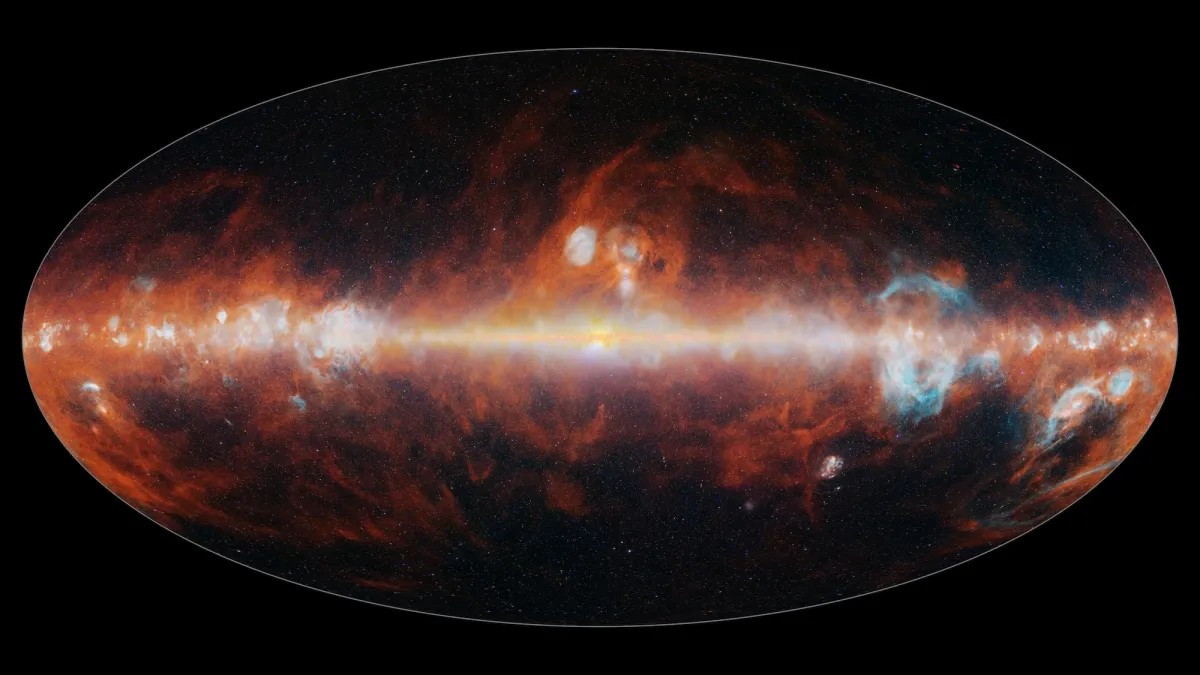
NASA’s SPHEREx space telescope has delivered its first full-sky map in infrared light, marking a major leap in our ability to study the universe’s early history and galactic evolution. Completed after just six months of operation, this map is the most comprehensive infrared survey ever created, providing astronomers with a powerful new tool to peer deeper into the cosmos than ever before.
Unprecedented Infrared Coverage
The SPHEREx telescope scanned the entire sky across 102 different infrared wavelengths—light invisible to the human eye but rich with information about celestial objects. This is not merely a visual upgrade; infrared allows us to see through dense dust clouds where stars and planets form, revealing hidden cosmic nurseries that would otherwise remain obscured. As Shawn Domagal-Goldman, NASA’s Astrophysics Division director, explains, “We essentially have 102 new maps of the entire sky, each one in a different wavelength and containing unique information.”
Peering into the Early Universe
The significance of this map lies in its potential to unlock secrets of the universe’s infancy. Scientists hope to use the data to analyze conditions in the first trillionth-of-a-trillionth of a second after the Big Bang—a period that shaped the distribution of galaxies across space-time. The new data will be used alongside existing surveys to understand how galaxies evolved over the past 14 billion years.
SPHEREx’s Unique Capabilities
SPHEREx distinguishes itself from other telescopes in two key ways. First, its wide-field view allows it to survey the entire sky in relatively short periods—completing a full scan every six months. This contrasts sharply with the James Webb Space Telescope, which excels at detailed spectroscopy but has a much narrower field of view. Second, SPHEREx’s multi-wavelength approach builds on previous infrared surveys (like NASA’s Wide-field Infrared Survey Explorer) by providing far greater spectral depth. As project manager Beth Fabinsky put it, “The superpower of SPHEREx is that it captures the whole sky in 102 colors about every six months.”
The Future of SPHEREx Missions
The telescope will repeat the full-sky scan three more times over the next year and a half, with the goal of increasing data sensitivity. All collected data will be made publicly available, allowing researchers worldwide to contribute to the analysis.
“SPHEREx is a mid-sized astrophysics mission delivering big science,” said JPL Director Dave Gallagher. “It’s a phenomenal example of how we turn bold ideas into reality.”
The SPHEREx mission represents a significant step forward in astronomical research, offering a new perspective on the universe’s origins and evolution. With its unique capabilities and commitment to open data, this telescope promises to reshape our understanding of the cosmos for years to come.