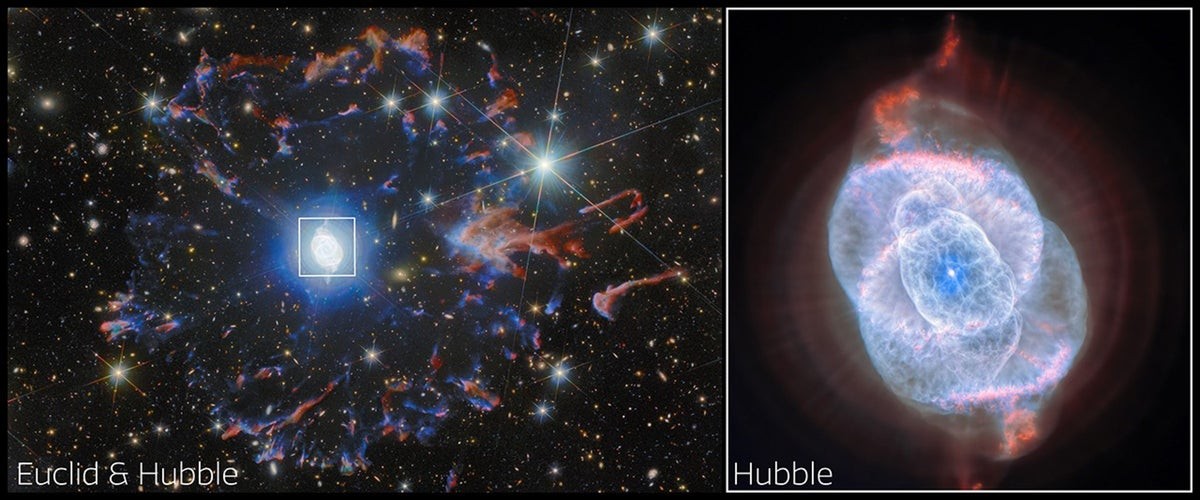
NASA has released breathtaking new images of the Cat’s Eye Nebula (NGC 6543), a celestial object located approximately 4,400 light-years from Earth. These images, captured by the Hubble Space Telescope in conjunction with the Euclid telescope, provide the most detailed view yet of a dying star’s final stages. The nebula’s intricate structure reveals a complex history of stellar evolution.
A 30-Year Look at Stellar Evolution
First observed by Hubble in 1995, the Cat’s Eye Nebula has long fascinated astronomers due to its complex formations. The new observations expand on that work, showing a wider view of the nebula and revealing details previously unseen.
The images highlight a distinctive halo surrounding the central star. Crucially, this halo wasn’t created at the same time as the rest of the nebula—it was expelled by the star system long before the surrounding gas clouds formed. This suggests a multi-stage process in stellar death.
Unraveling the Cosmic Fossil Record
NASA describes the new observations as revealing a “tapestry of concentric shells, jets of high-speed gas, and dense knots sculpted by shock interactions.” This isn’t just beautiful imagery; it’s a scientific record. By studying these structures, astronomers can piece together the history of the star at the nebula’s center.
“The observations could offer clues to how nebulas like this one form.”
The nebula acts as a “cosmic fossil record,” allowing scientists to trace the star’s final evolutionary stages. The data supports the idea that stellar death isn’t a single event, but a series of expulsions and interactions over time.
Why This Matters
Understanding stellar death is fundamental to astrophysics. Stars are the engines of the universe, forging heavier elements and scattering them across space, seeding new star systems. The Cat’s Eye Nebula provides a rare, high-resolution look at this process, helping scientists refine models of stellar evolution and planetary nebula formation.
The ongoing study of nebulae like this one will refine our understanding of how stars live, die, and ultimately shape the cosmos.
These findings underscore the importance of continued space-based observation and the unique capabilities of instruments like Hubble and Euclid in unraveling the mysteries of the universe.