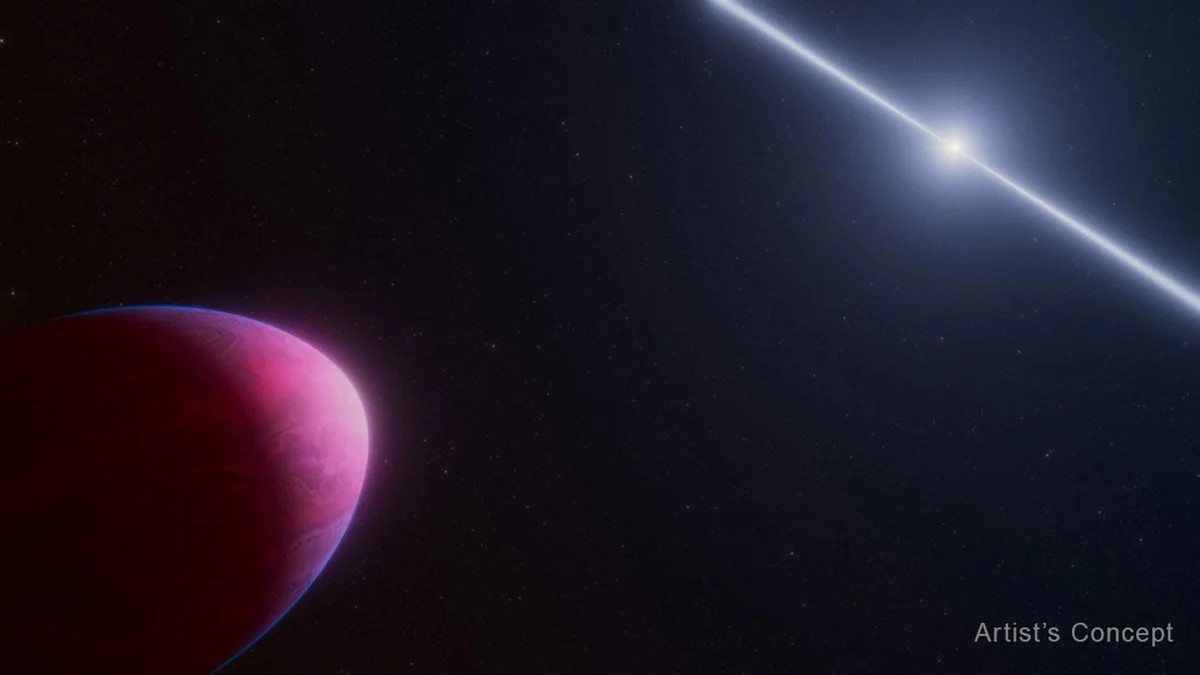
Astronomers have detected an unusually shaped exoplanet, PSR J2322-2650b, orbiting a pulsar (a dense, rapidly spinning dead star). The planet’s distorted, lemon-like form and bizarre atmospheric composition have left scientists puzzled, challenging conventional understanding of planetary formation.
The Peculiar Shape and Composition
The exoplanet is a gas giant roughly the size of Jupiter, but its orbit around the pulsar’s intense gravity stretches it into an elongated, lemon-like shape. This distortion is far more extreme than any observed around typical stars, making it unique in itself.
More strikingly, the planet’s atmosphere is dominated by carbon, with almost no traces of nitrogen or oxygen. This is highly anomalous: carbon, nitrogen, and oxygen are typically found together throughout the universe. The absence of the latter two suggests fundamentally different formation conditions than anything seen before.
What Makes This Planet So Weird?
The discovery raises several questions. First, how did such a planet form around a pulsar? Pulsars emit intense radiation, making stable planetary formation unlikely. Second, why is its atmosphere so chemically unbalanced? The team speculates the planet might be the remnant of a former star stripped down to its core, where carbon could exist as diamonds. But this does not explain the complete lack of nitrogen and oxygen.
“It’s really hard to explain by conventional means,” says Michael Zhang, co-author of the study. “I’m open to the possibility that this is an entirely new type of object.”
The James Webb Space Telescope was instrumental in revealing the composition of the planet’s atmosphere by analyzing the wavelengths of light passing through it. This method allowed astronomers to detect the presence of molecular carbon.
Implications and Next Steps
PSR J2322-2650b may represent a previously unknown class of planetary objects that form under extreme conditions. The discovery challenges current models of planetary evolution and could require rethinking how planets can exist in the most violent corners of the universe.
Further research will focus on refining atmospheric models and searching for similar anomalies in other extreme environments. Understanding this planet may reveal new insights into the diversity of exoplanetary systems and the limits of habitability.