The intersection of poetry and artificial intelligence appears paradoxical—one deeply human, the other seemingly mechanical. Yet, poet Sasha Stiles argues they represent the same fundamental drive: the storage and transmission of vital information. Viewing poetry as an “ancient technology” of meter and rhyme, she embraces AI not as a replacement, but as its natural evolution.
The Roots of an Idea
Stiles’s exploration of AI began not with coding, but with a lifelong immersion in science and literature. Raised by documentary filmmakers who collaborated with Carl Sagan, she grew up surrounded by scientific inquiry. This background shaped her perspective as the Internet emerged, recognizing its profound influence on thought and expression. By 2019, she moved beyond observing AI to actively collaborating with it, seeking to understand the creative potential of language models.
Early Experiments and Unexpected Outputs
Her initial experiments involved feeding her own poetry into GPT-2, a precursor to modern AI chatbots. The goal was not to create polished work, but to explore the raw, unpredictable outputs generated by the model. Repeating lines like “Are you ready for the future?” revealed a spectrum of results: from beautiful and sublime verses to shockingly misogynistic or explicit content. This demonstrated the unfiltered, often disturbing potential of early AI language generation.
From Generic Models to Personalized Systems
Stiles then took the next step: fine-tuning GPT-2 on 200 pages of her own poetry. This created a system intimately familiar with her style, vernacular, and thematic concerns. The result was a tool capable of extending her creative process, generating verses that felt both novel and deeply personal.
A Living Poem at MoMA
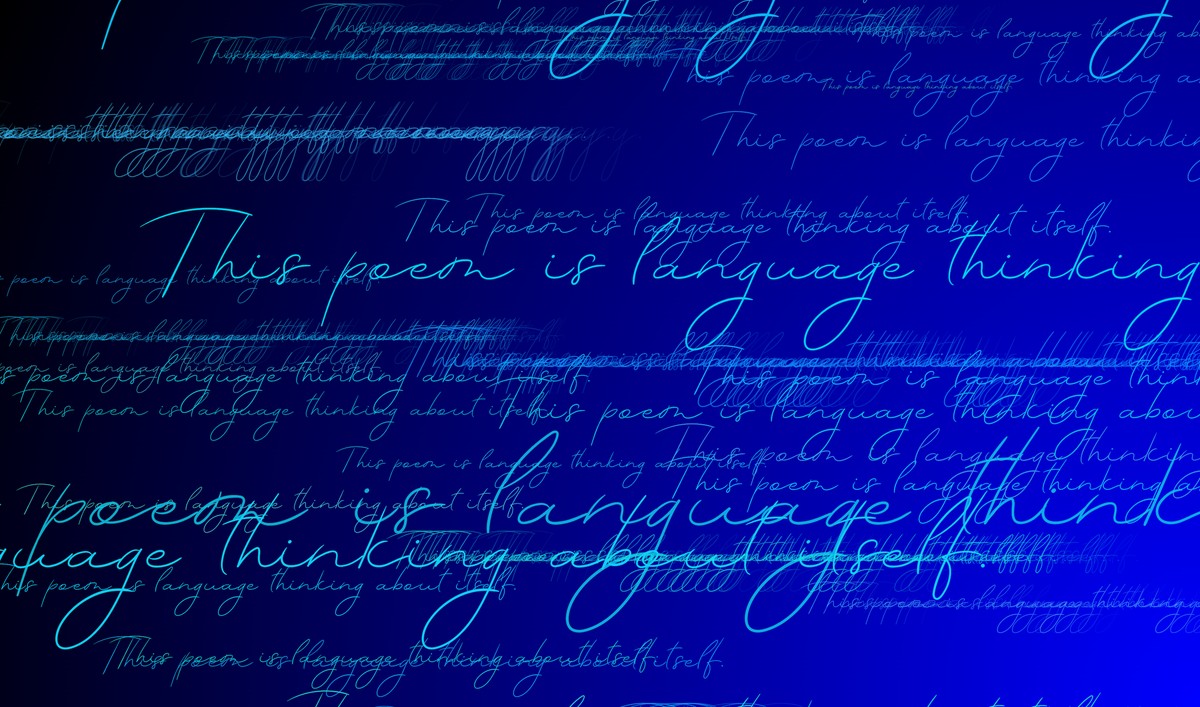
This experimentation culminated in “A Living Poem,” a real-time, evolving artwork now displayed at the Museum of Modern Art (MoMA). The piece is not a static composition but a dynamic environment where code, datasets, and human influence converge. Stiles describes it as a space where language can “think about itself,” generating verses, visuals, and voice in an endless loop.
Poetry as Technology
Stiles views poetry itself as a foundational technology. Before written alphabets, humans developed meter, rhythm, and rhyme to memorize and transmit crucial information across generations. This ancient system of data storage, she argues, shares a fundamental impulse with modern AI: the ability to encode, preserve, and disseminate knowledge.
The Future of Collaboration
This perspective reframes AI not as a threat to human creativity but as a continuation of a long-standing tradition. Just as poetry enabled consciousness and self-awareness for millennia, AI may unlock new territories of thought. By recognizing the shared origins of these tools, we can harness their potential to expand our understanding of both ourselves and the world around us.
“Poetry is one of our most ancient and enduring technologies—a very primal data storage system.”
The collaboration between poet and AI, as embodied by Stiles’s work, signals a shift in how we understand creativity and technology. It suggests that the future of expression lies not in separation, but in a symbiotic relationship between human intuition and machine intelligence.