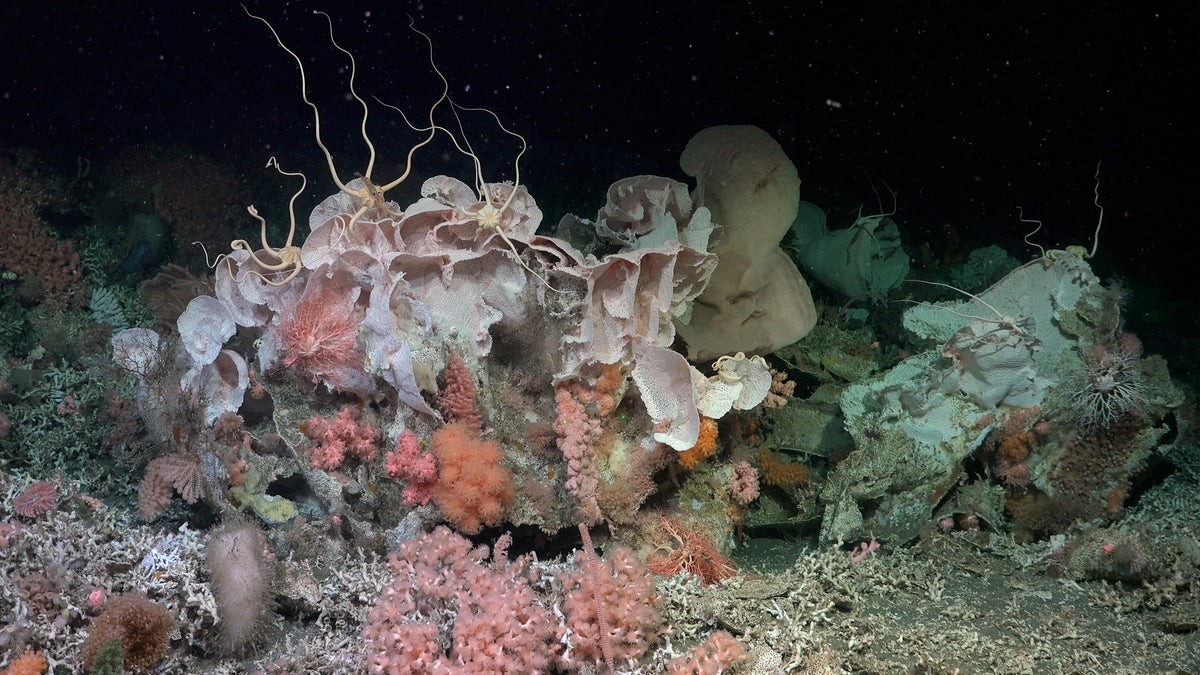
For over a century, the existence of a massive, thriving coral reef off the coast of Argentina has been known, yet unseen. Recent expeditions led by the Schmidt Ocean Institute have finally revealed this hidden ecosystem in stunning detail – and scientists are now racing to understand and protect it.
The Scale of Discovery
Two research voyages in 2025 explored the Mar Del Plata Submarine Canyon, a feature rivaling South Africa in size and plunging to depths exceeding 3,500 meters. These expeditions weren’t just about mapping; they were about witnessing an extraordinary environment. Biologist Santiago Herrera described the scene as “lush,” so vibrant that it felt more tropical than deep-sea. The deep-sea coral colonies, unlike their shallow-water counterparts, thrive in complete darkness, filtering nutrients from sinking organic matter.
Viral Recognition and Scientific Value
The expeditions were not conducted in secrecy. Researchers live-streamed footage to YouTube and Twitch, captivating a massive Argentine audience. The broadcasts peaked at over 92,000 viewers and even won a prestigious Martín Fierro Award, the country’s equivalent of an Emmy. The viral attention underscores the public’s fascination with deep-sea discoveries. Beyond spectacle, the expeditions yielded invaluable biological data. DNA analysis is underway to identify at least 40 potentially new species, highlighting how much remains unknown about the deep ocean.
Conservation Efforts and Restoration Challenges
The newly discovered reef is not immune to global threats such as rising water temperatures and acidification. However, its isolation has spared it the worst impacts so far, giving scientists a rare opportunity to study a healthy coral ecosystem. To aid in preservation, researchers are experimenting with artificial coral structures made from concrete and aragonite, hoping to provide a substrate for polyp colonization. This approach, borrowed from shallow-water restoration efforts, is largely untested in the deep sea. As ecologist Erik Cordes puts it, “We’re sort of making it up as we go along.”
“We still have a chance to do conservation instead of restoration,” says expedition chief scientist Daniel Lauretta. “And this is crucial because it’s much easier and simplest to protect rather than to restore, especially in the deep sea.”
The discovery underscores the urgency of protecting unexplored ecosystems. While restoration efforts may prove necessary, the primary goal must be preventing damage in the first place. Further expeditions are planned to assess the artificial structures and map the full extent of this remarkable reef system.
This hidden world, now brought to light, serves as a potent reminder of the ocean’s unexplored depths and the critical need for its conservation.