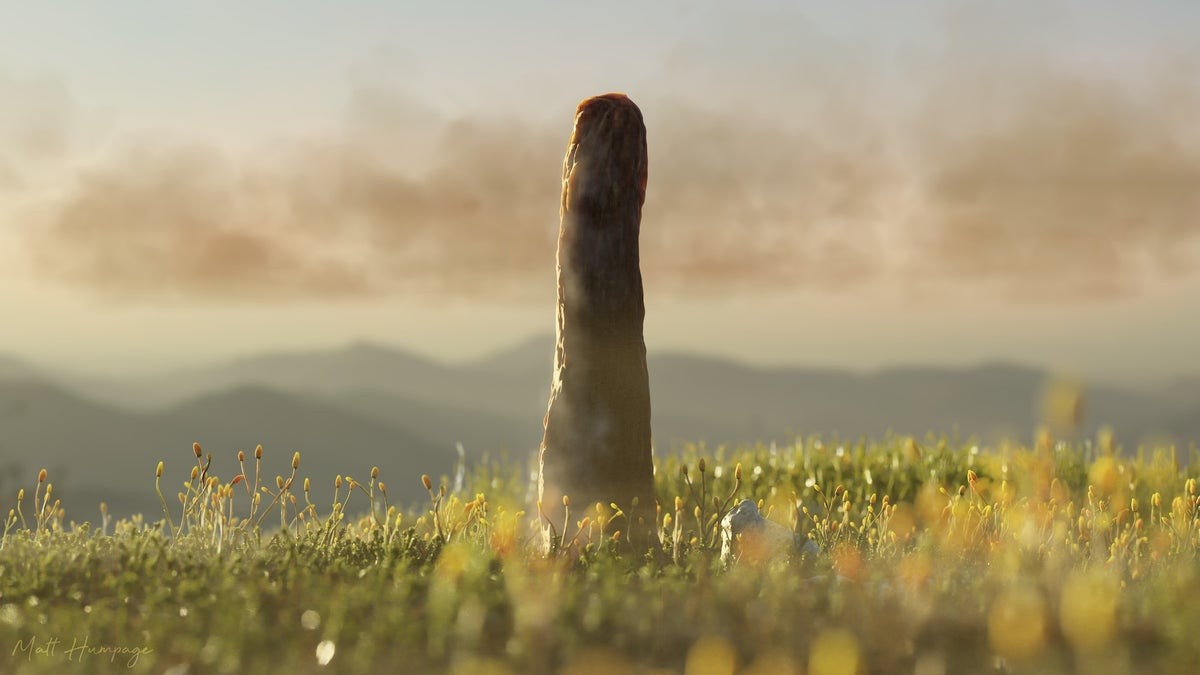
For over 170 years, scientists have puzzled over the identity of Prototaxites, towering, tree-like fossils that predate forests by millions of years. These structures, reaching over 25 feet tall, dominated Earth’s landscapes before the evolution of modern trees. Despite intense scrutiny, their place in the history of life remained a mystery – until now.
The Long-Standing Enigma
Discovered in 1843, Prototaxites fossils resisted easy classification. Early theories suggested they might be a primitive form of tree, but inconsistencies quickly emerged. Alternative hypotheses proposed a giant land-based kelp or a colossal fungus. However, nothing quite fit. As Matthew Nelsen of the Field Museum puts it, “It feels like it doesn’t fit comfortably anywhere.” The core issue was that Prototaxites shared superficial traits with fungi, but lacked key characteristics, making categorization impossible.
New Evidence Points to a Unique Lineage
A new study published in Science Advances suggests Prototaxites may represent a previously unknown kingdom of life. Researchers compared Prototaxites fossils with well-preserved fungal remains from the same geological period. The findings revealed critical differences in internal structure: Prototaxites displayed chaotic branching patterns unlike the orderly growth of fungal hyphae. Crucially, the fossils lacked chitin, a defining chemical component of all known fungi.
Implications for Life’s History
The absence of chitin, combined with structural anomalies, supports the hypothesis that Prototaxites wasn’t just an unusual fungus; it was a distinct, independent lineage. This would effectively expand the known kingdoms of life—plants, animals, fungi, protists, bacteria, and archaea—by one. This discovery fundamentally challenges our understanding of early terrestrial ecosystems and the diversification of life.
A “Weird” Evolutionary Experiment
Even if Prototaxites ultimately proves to be an extremely divergent fungus, the study highlights its unique evolutionary path. As Kevin Boyce of Stanford University notes, the organism independently developed complex multicellularity. Whether a distinct kingdom or an outlier, Prototaxites represents a remarkable example of life exploring alternative evolutionary strategies.
The existence of Prototaxites underscores that early life on Earth was far more experimental than previously understood. Its discovery forces us to reconsider the boundaries of established biological kingdoms and the diversity of life that once thrived before our modern ecosystems emerged.