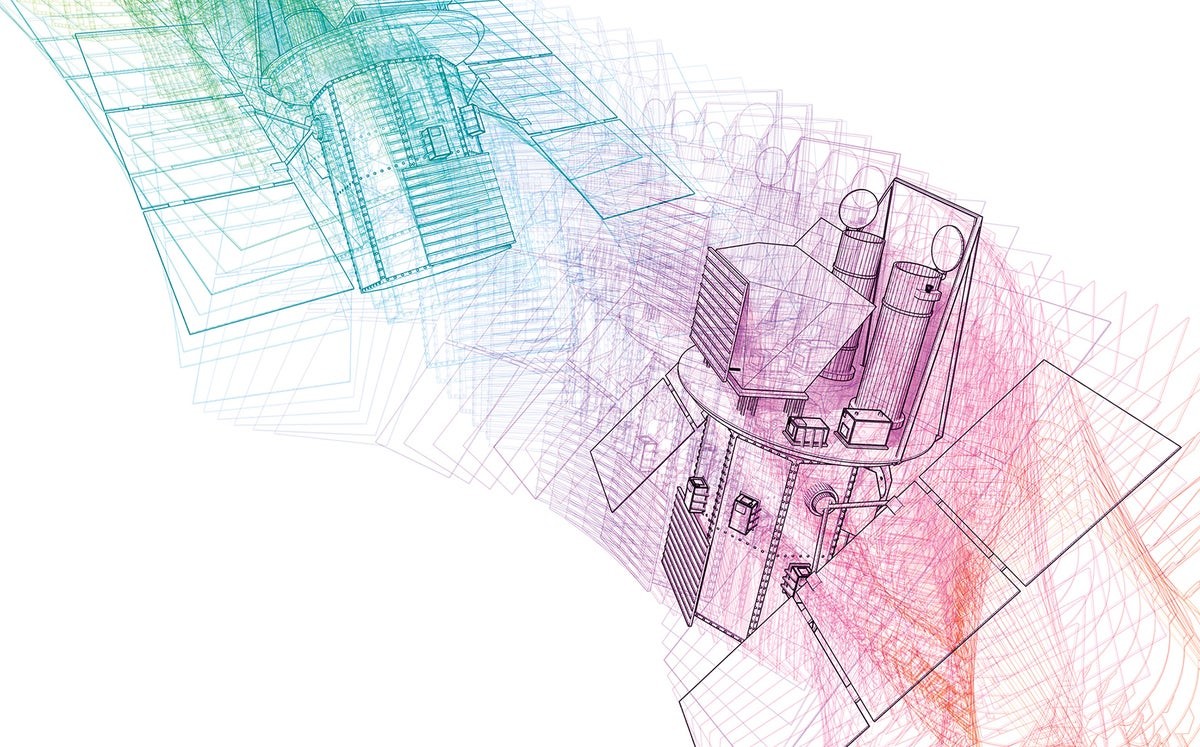
For over two decades, NASA’s Neil Gehrels Swift Observatory has been a vital tool for astronomers, detecting and analyzing the universe’s most powerful explosions: gamma-ray bursts. However, the spacecraft is now in a critical race against time. Collisions with atmospheric particles are steadily dragging it towards Earth, threatening a fiery end later this year.
Instead of letting Swift fall, NASA has greenlit an audacious rescue mission: a robotic spacecraft will attempt to gently capture Swift, boost it into a safer orbit, and then release it. This effort isn’t just about saving one telescope; it’s a test case for extending the lifespan of future space science missions. The technology behind this mission is improving rapidly, making such interventions increasingly feasible.
The Challenge of Orbital Decay
All spacecraft in low Earth orbit (especially below 600 kilometers) are affected by atmospheric drag. Solar activity increases this drag, meaning Swift is now losing altitude faster than initially predicted. The observatory launched at 600 km, and despite early projections for survival into the 2030s, increased solar activity has forced a reevaluation. Without intervention, Swift will re-enter Earth’s atmosphere and burn up later this year.
The urgency of this situation prompted NASA to act. While a failure means the loss of the telescope anyway, success could unlock years of additional scientific data.
The $30 Million Rescue Plan
NASA has awarded a $30 million contract to Katalyst Space Technologies for a rescue mission launching in early June. This timeline is exceptionally fast for such a complex endeavor: robotic servicing in space is notoriously difficult, and has never been attempted for a science mission.
Past servicing missions, like the Hubble Space Telescope repairs done by astronauts, relied on human adaptability. This robotic attempt will be far more challenging. However, industry advancements suggest it’s now within reach. Northrop Grumman has already proven the viability of robotic life extension with commercial satellites using their Mission Extension Vehicles.
The Robotic Grapple
Katalyst is building a three-armed robotic spacecraft designed to capture Swift. The biggest challenge? Swift wasn’t built with robotic servicing in mind. “The spacecraft was built more than 20 years ago, so there’s not even great documentation around what some of these interfaces look like,” explains Kieran Wilson, Katalyst’s principal investigator.
The spacecraft will launch via a Pegasus rocket dropped from a modified jet plane to reach Swift’s equatorial orbit. Over several months, the robot will gently pull Swift to an altitude of 550 km, then detach itself to burn up in the atmosphere—a fitting sacrifice for the mission.
A New Era for Spacecraft Lifecycles?
The mission carries significant risks. As Katalyst CEO Ghonhee Lee admits, “What keeps me up at night is the things that we don’t control.” But if successful, this rescue could redefine how we think about spacecraft lifecycles.
Swift’s ability to quickly follow up on astronomical events is invaluable, especially as new observatories come online. Robotic servicing could offer a far cheaper alternative to building entirely new missions, making space science more sustainable. As Brad Cenko, an astrophysicist at NASA, puts it, “It’s almost like it’s a new mission…but you’re getting it for just a fraction of what it would cost to actually build something from scratch.”