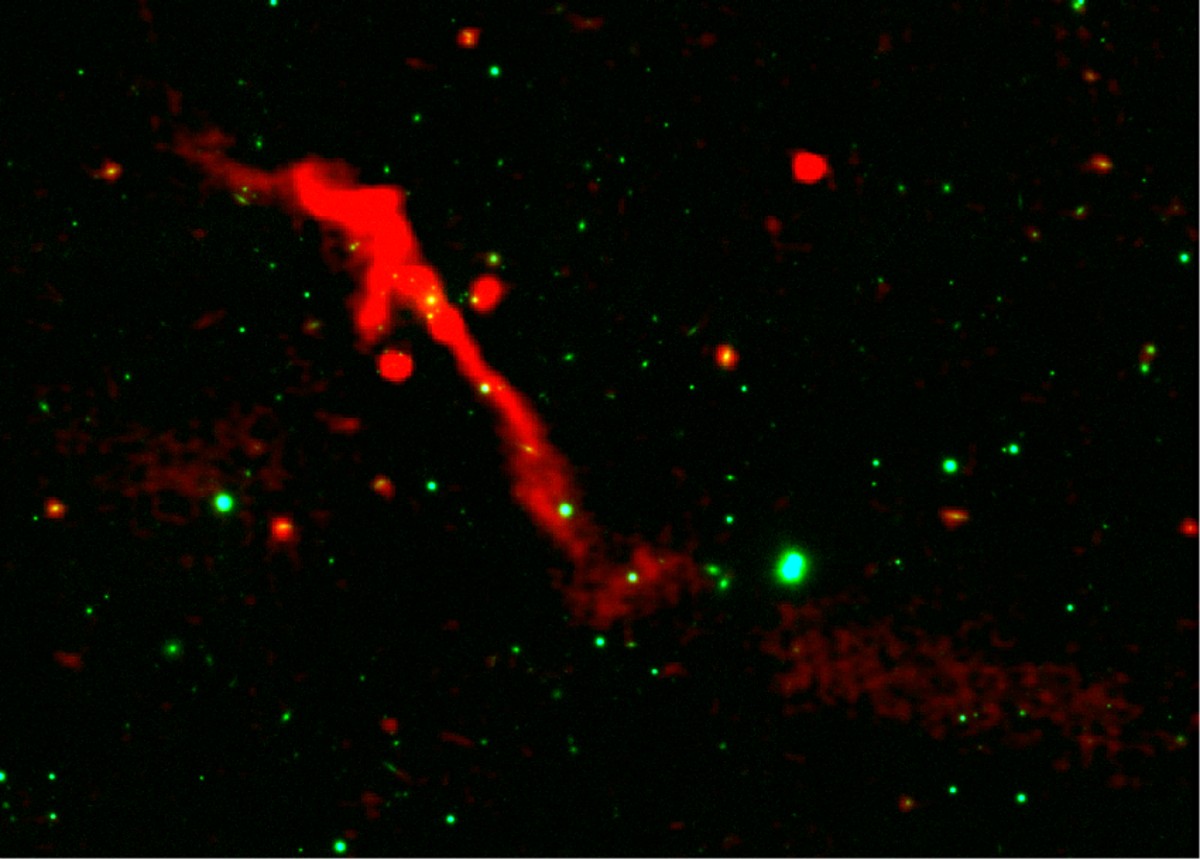
A supermassive black hole at the center of galaxy J1007+3540 has dramatically reignited after a dormancy lasting roughly 100 million years, sending a one-million-light-year-long stream of energized particles and gas into space. This rare event, captured in detailed radio images, offers scientists a unique opportunity to study the behavior of “episodic” galaxies – those whose central black holes cycle between periods of intense activity and prolonged quiet.
A Cosmic Reawakening
The eruption, observed by astronomers using radio telescopes in the Netherlands and India, marks the first confirmed outburst from this black hole in a vast span of cosmic time. This makes J1007+3540 an exceptionally clear example of a galaxy where the central engine turns on and off, rather than maintaining a steady output of energy. The study, published in the Monthly Notices of the Royal Astronomical Society, reveals not only the newly formed jet but also remnants of previous, ancient bursts.
Why This Matters: Understanding Galactic Evolution
The black hole’s sudden activity is significant because most supermassive black holes don’t remain constantly active. They consume surrounding gas and dust, then go quiet until enough material accumulates to trigger another outburst. This cycle can span millennia, making it difficult to observe in real-time. J1007+3540 provides a rare snapshot of this transition, allowing scientists to study how these powerful events shape the surrounding galaxy cluster and its gas-rich environment.
The Interaction With The Cosmos
The newly ejected jet is interacting with the “intracluster medium” – the hot, diffuse gas between galaxies. This interaction isn’t simply a forceful expulsion; rather, the jet’s path and energy are being constantly reshaped by the gas it encounters. This dynamic interplay can influence star formation within the galaxy, potentially triggering or suppressing the birth of new stars.
“These observations help us understand that the relationship between a galaxy’s jets and the cluster environment is very dynamic,” says Vivian U, an astronomer at Caltech. “The jets don’t just carve a path through empty space—they are constantly shaped and changed by the gas they encounter.”
The system’s sheer size – it’s a physically large galaxy – makes it ideal for detailed study. Researchers can now investigate the complex feedback loop between the black hole’s activity and the surrounding galactic environment. Understanding this process is crucial for refining models of how galaxies evolve over billions of years.
The discovery highlights the unpredictable and energetic nature of supermassive black holes, and how their intermittent outbursts can profoundly affect the cosmos around them. By studying these “oddballs,” scientists hope to uncover more clues about the fundamental forces governing galactic evolution.