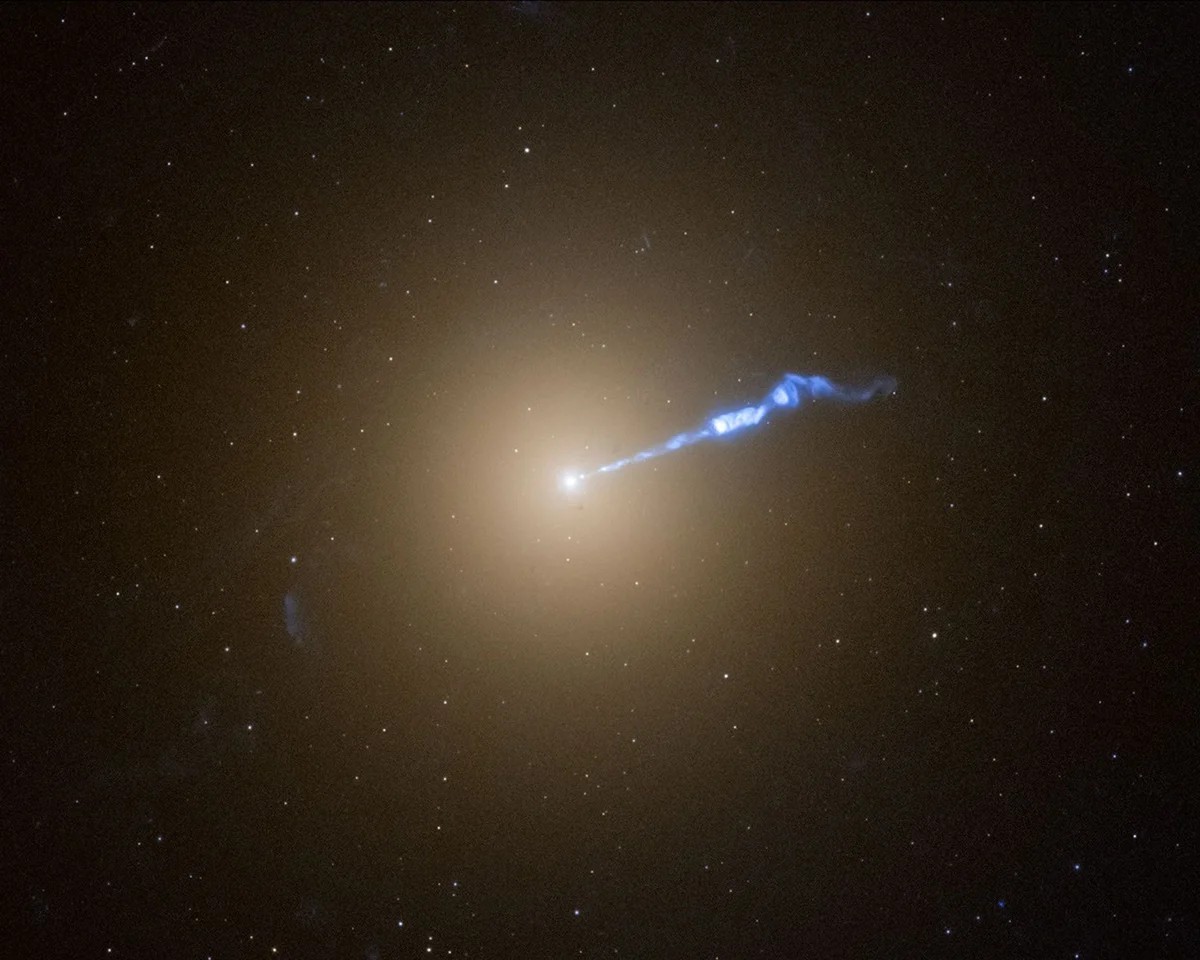
Astronomers have pinpointed the likely origin of a colossal jet erupting from the supermassive black hole M87*, located 55 million light-years away in the galaxy Messier 87. This breakthrough provides the first direct evidence of how material is launched from the base of such an extreme cosmic phenomenon.
The First Imaged Black Hole
M87 holds historical significance as the first black hole ever directly imaged * in 2019, thanks to the Event Horizon Telescope (EHT). The image revealed a glowing ring around a dark central region—the black hole’s “shadow”—and hinted at powerful jets extending far into space. These jets are streams of high-energy particles ejected at near-light speed.
Unveiling the Jet’s Launchpad
New research, published in Astronomy & Astrophysics, presents observations from the EHT that identify the probable source of M87‘s jet. By studying the superheated material swirling around the black hole, scientists located a region where the jet appears to originate. The jet itself extends an astonishing 3,000 light-years * through intergalactic space, making it one of the largest observed.
Why This Matters
Understanding how black holes launch these jets is crucial for several reasons:
- Energy Output: Jets carry away huge amounts of energy, influencing the surrounding galaxy’s evolution.
- Accretion Processes: The jet’s origin reveals how material falls into black holes (accretion) and how this process generates such extreme phenomena.
- Black Hole Physics: By studying M87*, scientists can test theories about black hole behavior under the most extreme conditions.
As lead author Saurabh of the Max Planck Institute in Germany stated, this study is “an early step toward connecting theoretical ideas about jet launching with direct observations.” The findings will inform future research on M87* and other supermassive black holes, allowing scientists to further unravel the mysteries of these cosmic engines.
The clear identification of the jet’s base adds a key piece to the puzzle, bringing us closer to understanding how black holes operate at their most powerful.