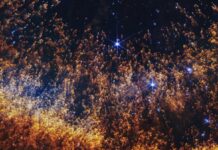
The James Webb Space Telescope (JWST) has produced the most detailed map of dark matter to date, revealing the invisible scaffolding that underpins the visible universe. While JWST’s stunning images showcase distant galaxies, astronomers have now turned its observations inward, tracing the subtle distortions caused by dark matter – a substance that makes up 85% of the universe’s mass but remains undetectable by conventional means.
The Invisible Universe Comes Into Focus
Dark matter isn’t directly observable; it doesn’t interact with light. Instead, its presence is inferred through its gravitational effects. Just as a glass lens bends light, dark matter warps spacetime, subtly altering the paths of photons traveling from distant galaxies to Earth. This phenomenon, called weak gravitational lensing, allows scientists to map the distribution of dark matter by analyzing how it distorts the images captured by JWST.
The latest map, built from observations of the COSMOS field (a well-studied region of the sky), surpasses previous efforts in detail despite covering a smaller area than earlier surveys. The new data reveals clumps of dark matter too small for older telescopes like Hubble to detect. This enhanced resolution is critical because it allows researchers to study dark matter’s role in the early universe – an era known as “cosmic noon” when galaxies were rapidly forming.
Why This Matters: Understanding the Universe’s Structure
The discovery isn’t just about refining a map; it’s about understanding how the universe evolved. Dark matter is believed to be the gravitational framework upon which galaxies and larger structures formed. By studying its distribution at different points in cosmic history, scientists can test theories about how galaxies cluster and grow over billions of years.
“Before we only had dark matter simulations, and I always wanted to be able to see it… What I love about weak lensing is: it allows us to see the invisible.” — Catherine Heymans, University of Edinburgh
Future Prospects: Expanding the Map
The current map, though detailed, is just the beginning. Upcoming missions like the European Space Agency’s Euclid and NASA’s Nancy Grace Roman Space Telescope are designed to extend these observations across much larger areas of the sky. Meanwhile, ground-based projects like the Dark Energy Survey and the Vera C. Rubin Observatory also employ weak lensing to study dark matter and the expansion of the universe.
This new map confirms a long-held hypothesis: dark matter exists and shapes the cosmos in ways we’re only beginning to understand. As technology advances, astronomers will continue to refine these maps, bringing the invisible universe into sharper focus and potentially unlocking the secrets of its most mysterious component.