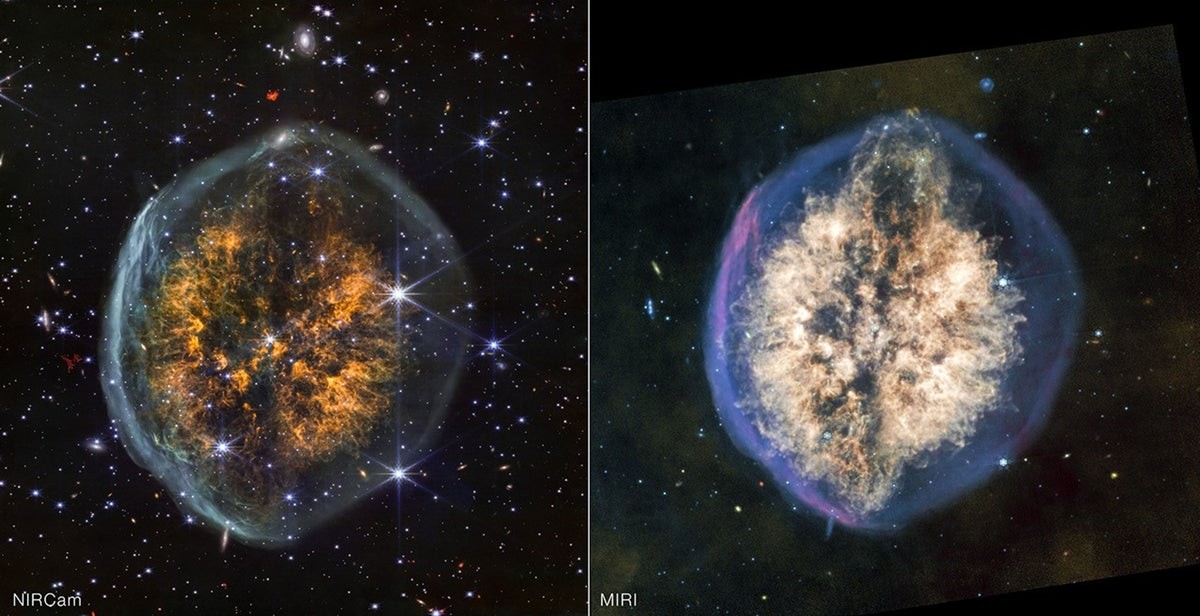
The James Webb Space Telescope (JWST) has revealed a breathtaking new image of a dying star’s remnants, strikingly resembling a human brain. Dubbed the “Exposed Cranium” Nebula (also known as PMR 1), this celestial structure is located approximately 5,000 light-years away in the Vela constellation.
The Death of a Star, Reimagined
The nebula’s eerie resemblance to a brain isn’t coincidental. As a massive star nears the end of its life cycle, it begins shedding layers of gas and dust into space. JWST’s observations, captured in both near- and mid-infrared light, show a dark channel bisecting the nebula’s billowing clouds – mirroring the longitudinal fissure that divides the human brain’s hemispheres.
Scientists believe this distinctive feature is likely caused by powerful jets of gas ejected from the dying star itself. These jets push the inner gas outward, creating the dark, brain-like structure. The outer layers of gas are primarily composed of simple hydrogen, while the inner clouds contain more complex compounds.
Why This Matters
This image isn’t just visually striking; it provides valuable data about stellar death and the processes that shape nebulae. Studying the composition and structure of dying stars helps astronomers understand how elements are dispersed into space, eventually seeding new star systems. The JWST’s ability to observe in infrared light allows it to penetrate dust clouds, revealing details previously hidden from other telescopes.
The “Exposed Cranium” Nebula demonstrates the violent beauty of stellar evolution and highlights the JWST’s power to uncover previously unseen cosmic structures. This discovery reinforces the idea that even in death, stars play a critical role in the universe’s ongoing cycle of creation.
The image serves as a poignant reminder of the cyclical nature of the cosmos: from stellar birth and life to their dramatic, yet beautiful, demise.