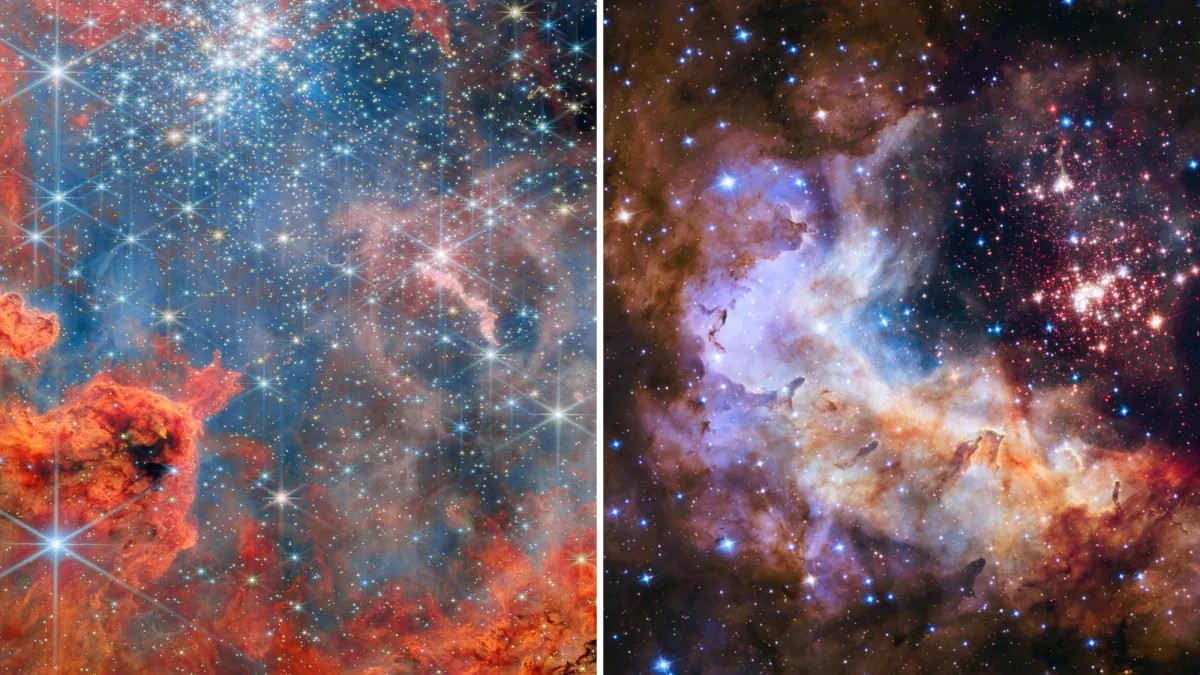
The James Webb Space Telescope (JWST) and its predecessor, the Hubble Space Telescope (HST), have both captured images of the Westerlund 2 star cluster, offering a striking comparison of observational power across a decade. In 2015, Hubble showcased a vibrant view of this nebula, located 20,000 light-years from Earth. But in January 2023, Webb surpassed that clarity, and in late 2025, the European Space Agency released a new, even more detailed image.
Technological Leap: Webb vs. Hubble
The JWST’s advanced instruments—the Near-InfraRed Camera (NIRCam) and Mid-InfraRed Instrument (MIRI)—reveal previously unseen details. While Hubble’s images clearly showed the brightest stars in Westerlund 2, Webb’s observations unveiled hundreds of additional, dimmer stars in the background. The ESA provided a slider tool to allow direct comparison between the two images, highlighting this technological advancement.
A Stellar Nursery in Action
Westerlund 2 stretches between 6 and 13 light-years across and contains some of the galaxy’s hottest and most massive stars. The nebula’s young stellar objects emit powerful radiation, interacting with the surrounding gas clouds. Webb’s image shows a dynamic interplay of red, orange, blue, and pink gas, depicting a highly active stellar nursery.
Beyond Visuals: New Scientific Insights
This isn’t just about aesthetics; the JWST data also includes the nebula’s population of brown dwarf stars—objects as small as ten times the mass of Jupiter. Astronomers can now study how these objects form and how planets arise in dense star clusters. This research provides insights into the early stages of star and planet formation, previously obscured by Hubble’s limitations.
The JWST’s ability to penetrate dense gas clouds and reveal hidden stars marks a significant step forward in astronomical observation. It allows scientists to study stellar environments with unprecedented precision, pushing the boundaries of our understanding of the universe.
The comparison between Hubble and Webb’s observations of Westerlund 2 underscores the rapid progress in space telescope technology. This leap in observational power will reshape our understanding of stellar evolution and galactic structures for years to come.