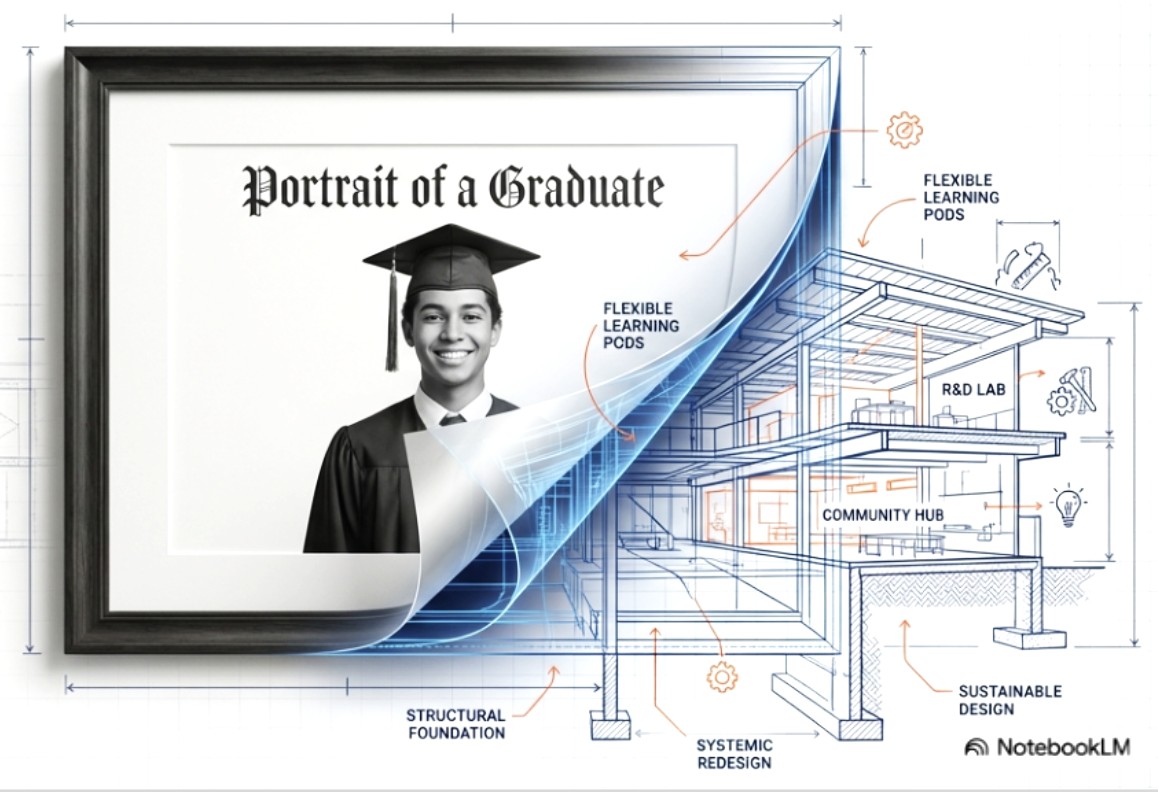
For over a decade, school districts across the U.S. have crafted “Portraits of a Graduate” — ambitious visions outlining the skills students need for future success, such as adaptability, collaboration, and critical thinking. However, many systems remain stuck in outdated models that contradict these ideals. The gap between stated values and actual practice isn’t a lack of vision; it’s a design problem.
The Problem with Pilots
Most districts rely on pilots — small-scale tests of individual units or programs. While pilots can show if something works, they rarely reveal why scaling fails. True transformation requires a different approach: Research and Development (R&D). R&D doesn’t just test an idea; it tests a system shift, interrogating the underlying rules governing schools — grading, scheduling, staffing, and even unspoken policies.
As Dr. Erin Whalen of Da Vinci Schools puts it, “Pilots are safe; R&D is courageous.” Pilots tweak instruction. R&D challenges the foundations of how schools operate.
Disciplined R&D: A Step-by-Step Approach
Effective R&D follows a clear process:
- Identify a Constraint: Name a specific systemic barrier (e.g., rigid seat-time requirements).
- Protected Testing Space: Create a controlled environment with diverse students.
- Rigorous Documentation: Track what works, what fails, and what support adults need.
- Systemic Integration: Use the findings to inform broader redesign efforts.
Calling the work “R&D” itself lowers risk, framing it as disciplined experimentation rather than radical change. Leaders can confidently say, “We’re learning before we scale.”
Scaling Complexity: Matching the Test to the Challenge
The scale of your R&D should match the complexity of what you’re testing. A rubric change doesn’t require a full-scale overhaul; a shift to competency-based progression does. Districts often underestimate this, leading to stalled efforts.
Cheney Public Schools, for example, is testing “quality, rigid, and time flexible” learning pathways at the district level, requiring experimentation across classrooms, cohorts, and dedicated microschool environments.
The Role of Microschools in Systemic Change
Microschools, when strategically integrated, function as infrastructure-level R&D labs. They allow for simultaneous shifts in multiple structural elements — policy, grading, staffing — that are impossible in traditional settings.
They are most useful for testing:
- Policy flexibility around seat time.
- Competency-based progression.
- Community-integrated, real-world learning.
- Redesigning scheduling, grading, and staffing in tandem.
Equity is essential. A district microschool serving only high-achieving students isn’t innovation; it’s segregation with better marketing. As Whalen warns, “If it doesn’t reflect your full demographic reality, it’s not innovation, it’s insulation.”
Readiness Before Urgency
R&D is demanding. Before launching, assess readiness:
- Leadership Stability: Can the project be protected for at least two years?
- Teacher Buy-In: Do you have volunteers eager to co-design?
- Clear Problem Definition: Can you articulate the constraint being tested?
- Documentation Plan: How will learning be captured and shared?
- Student and Family Engagement: Are participants willing to participate?
Additional factors for microschools: policy flexibility, sustainable funding, facility access, and equitable enrollment. Failed experiments make future redesign harder to justify. Building readiness first is crucial.
The key takeaway: A “Portrait of a Graduate” names the promise. A rigorous R&D strategy for design makes it real.