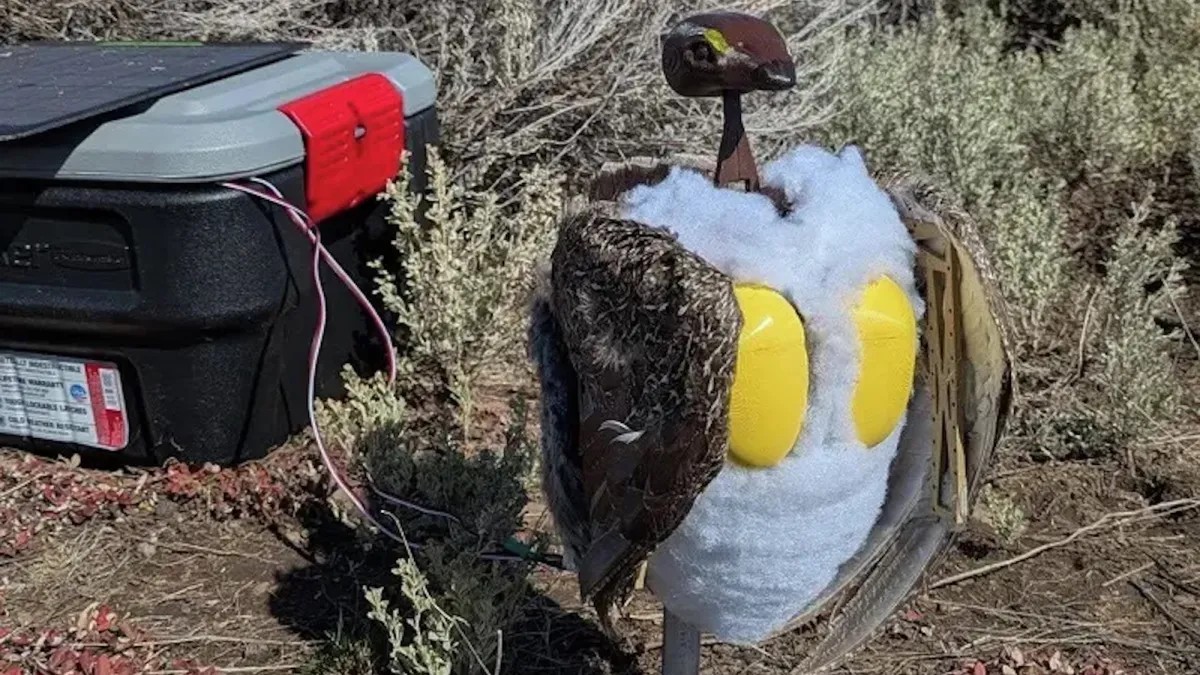
In a unique intersection of robotics and conservation, Grand Teton National Park is deploying mechanical decoys to help revive a dwindling bird population. These “robot birds” are designed to mimic the courtship rituals of the greater sage-grouse, acting as digital lures to encourage the species to breed in newly restored habitats.
The Crisis: A Population in Decline
The greater sage-grouse (Centrocercus urophasianus ) serves as a stark indicator of the health of North American ecosystems. Once numbering roughly 16 million at the turn of the 20th century, the species has faced a steady decline since the late 1960s, with populations dropping by an average of 2.3% annually.
While the species is not currently classified as endangered, local populations are reaching a breaking point. In Grand Teton National Park, the situation is critical: at one specific breeding site—known as a lek —conservationists recorded only three male grouse last year.
Why the Habitat is Failing
The decline of the sage-grouse is not the result of a single factor, but rather a combination of historical and modern disruptions:
- Legacy of Grazing: Decades of cattle grazing destroyed the native plants that provided both food and essential cover for the birds. Even though grazing has ceased, the ecosystem has not yet fully recovered.
- Aviation Interference: The presence of Jackson Hole Airport, the only airport located within a national park, presents a constant threat. Aircraft noise disrupts natural behaviors, and collisions with planes have resulted in bird fatalities.
- The “Empty Habitat” Problem: Even when land is successfully restored, wildlife does not always return immediately. This creates a gap between successful land management and actual biological recovery.
Engineering a Solution: The RoboBroncs
To bridge the gap between restored land and returning wildlife, park rangers have turned to local innovation. In a collaborative effort, the RoboBroncs —a robotics team from Jackson Hole High School—designed and constructed mechanical decoys to jumpstart the breeding cycle.
The decoys are engineered to replicate the complex mating displays of male grouse:
– Movement: Some models are automated to “dance” and move like real birds.
– Physicality: The decoys feature real tail feathers provided by the Wyoming Game and Fish Department and can even simulate the “chest-puffing” characteristic of the species.
– Acoustics: To enhance the illusion, concealed speakers play recorded breeding calls starting at 5:00 a.m. daily.
The Goal: Redirecting the Future
The primary objective of this high-tech intervention is to steer the grouse away from high-risk areas near the airport and toward 100 acres of restored pasture managed by park staff and community partners.
By simulating a thriving breeding ground, ecologists hope to lure more males to the restored leks. If the birds begin to display and mate in these safe zones, the resulting offspring will stay close to the lek for brood-rearing, eventually establishing a self-sustaining population in a protected environment.
“The idea is to encourage birds to begin displaying and mating at the restored site,” says Emily Davis, a spokesperson for Grand Teton. “This can help draw more sage-grouse to the area over time.”
Rangers will monitor the success of this experiment through the end of the courtship season in mid-May using trail cameras to track how the real grouse interact with their mechanical counterparts.
Conclusion
By combining ecological restoration with student-led robotics, Grand Teton is testing a proactive way to jumpstart wildlife recovery in fragmented habitats. The success of these robotic decoys could provide a vital blueprint for conservationists facing similar challenges worldwide.