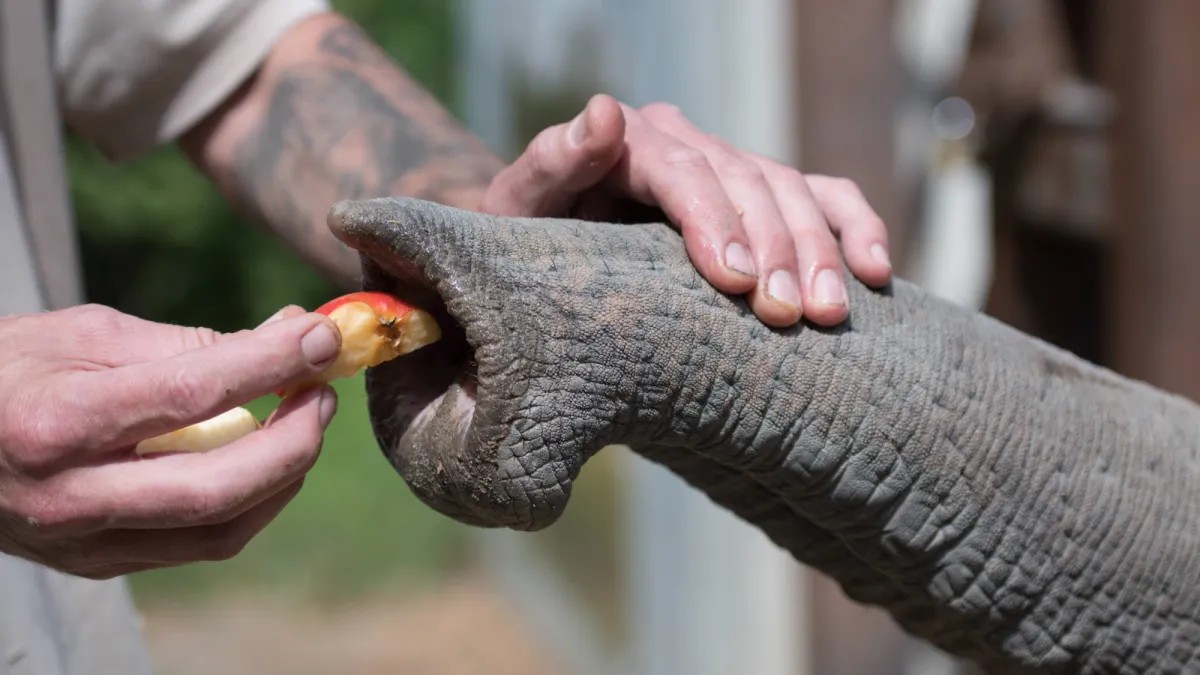
Elephants possess a remarkable sense of touch thanks to the 1,000 whiskers embedded in their trunks. These whiskers aren’t just sensory tools, but demonstrate a natural “embodied intelligence” that engineers are now studying to improve robotic designs. The unique structure of elephant whiskers allows them to manipulate objects with surprising dexterity, despite their poor eyesight and thick skin.
The Unexpected Design
Researchers from Germany’s Max Planck Institute, Humboldt University, and the University of Stuttgart collaborated to examine the mechanics of elephant whiskers. They anticipated similarities to rodent whiskers—solid, uniformly stiff, and circular in cross-section. Instead, they discovered a design more akin to those found on cats: flattened, blade-like, with hollow bases and internal channels. This porous structure reduces mass and enhances impact resistance, essential for an animal consuming hundreds of pounds of food daily without damaging these irreplaceable sensors.
Stiffness Gradient: A Natural Innovation
The key to the whiskers’ effectiveness lies in a functional gradient—a transition from a stiff base to a soft, rubber-like tip. This design is unlike the uniformly stiff whiskers of mice and rats. The change in stiffness allows elephants to pinpoint contact along each whisker, enabling them to handle objects with precision. Researchers demonstrated this by creating a 3D-printed “whisker wand,” finding that contact felt distinct at the base versus the tip without even looking.
Why This Matters
The study underscores how evolution has optimized natural systems for efficiency. The elephant’s whisker design isn’t just a biological quirk; it’s a sophisticated sensor system that engineers can learn from. The stiffness gradient allows the elephant to detect precisely where an object touches its trunk, whether it’s a brittle tortilla chip or a small peanut. This embodied intelligence—where sensing and action are seamlessly integrated into the physical structure—is a valuable model for robotics.
The researchers believe that these insights could lead to more precise and adaptable sensors for future robots, mirroring the elegant simplicity of an elephant’s natural design.