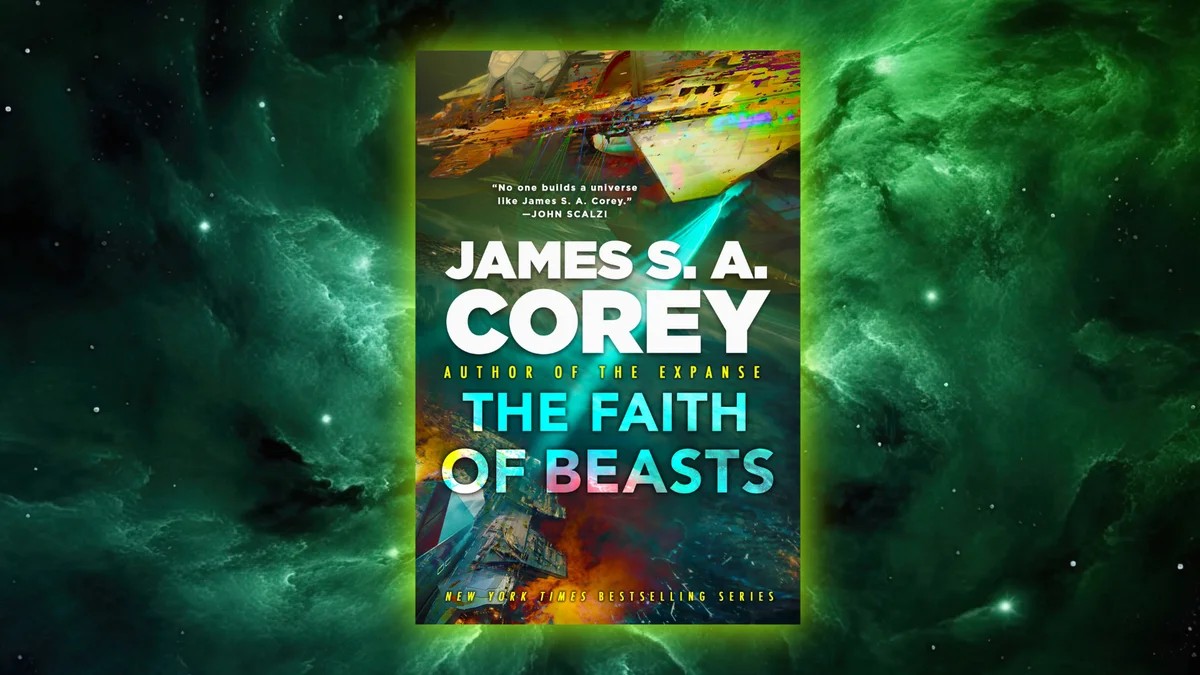
The authors behind the Hugo Award–winning The Expanse saga, writing under the pen name James S. A. Corey, are shifting their gaze from the human struggle for space supremacy to a much more unsettling premise: what happens when humanity loses the fight?
In their new series, The Captive’s War, the focus moves away from the near-future, human-centric politics of their previous work. Instead, the second installment, The Faith of Beasts , explores a far-future reality where humans are no longer the masters of their destiny, but subjects of a ruthlessly powerful alien empire.
A Shift in Scale and Power
In an interview with Scientific American, authors Daniel Abraham and Ty Franck discussed the creative pivot required to move away from the “human-centric” epic of The Expanse. While their previous series focused on humanity’s expansion, The Captive’s War explores a much more desperate dynamic.
“The Expanse was very human-centric… this was a chance to do something that was very far-future and not human-centric. Humans are integral to the story, but they are, in many ways, the least powerful.” — Ty Franck
This shift changes the fundamental nature of the conflict. In many science fiction tropes, humanity survives an invasion through technological ingenuity or sheer military force—think of missiles defeating alien ships or a sudden biological fluke. Abraham and Franck intentionally reject this “punching our way out” narrative. In their world, the aliens are so overwhelmingly powerful that traditional warfare is futile.
Resistance Through Existence
Because violence cannot win this war, the series explores more subtle forms of rebellion. The authors draw inspiration from the Book of Daniel, focusing on “softer” forms of power and the idea of resistance through mere survival.
- The Power of Niche: Rather than conquering the invaders, characters must find “cracks in the asphalt”—small, overlooked spaces in a hostile environment where they can exist and, eventually, find ways to push back.
- The Failure of Violence: The authors highlight the futility of aggression by including characters who believe they can win through combat, only to be dismissed by the alien overlords as mere footnotes.
Exploring the “Other”: Biology and Identity
One of the most distinct elements of the series is its deep dive into non-human biology and consciousness. By moving away from human-like aliens, the authors can explore concepts that challenge our understanding of personhood:
The Superorganism
The primary antagonists, the Carryx, function as a superorganism. This presents a unique psychological landscape: individuals who are part of a hive but possess distinct, sentient thoughts. This raises profound questions about agency: What does it mean to be an individual when your very body and status are dictated by a collective hive mind?
The Evolution of Self
The series also features “the swarm,” a creature that serves as a blank slate. As the swarm gains experience, it undergoes physical and cognitive changes, effectively “deciding” to become a person. This allows the authors to touch on themes of neuropsychology and Buddhism, questioning whether there is a single, unified “soul” or if the “self” is merely a collection of cognitive processes.
The Absurdity of Survival
Even in the face of planetary subjugation, the authors find room for dark, observational humor regarding human institutions. In the series, the aliens demand scientific research from human captives, raising the stakes of academic survival to an existential level.
“The difference between this and tenure track is that if you don’t get tenure, the university doesn’t kill your whole family. These guys are going, ‘If you don’t get tenure here, we just eradicate your species.'” — Ty Franck
This serves as a commentary on how societies—both human and alien—assign value. The aliens mistakenly assume that “high-status” individuals (like academics) are the most capable, overlooking the essential utility of workers like janitors and builders.
Conclusion
By moving away from the familiar tropes of human dominance, The Captive’s War offers a more complex look at survival, identity, and the terrifying reality of encountering a truly alien intelligence. It suggests that in the face of overwhelming power, the greatest act of rebellion may simply be the refusal to disappear.