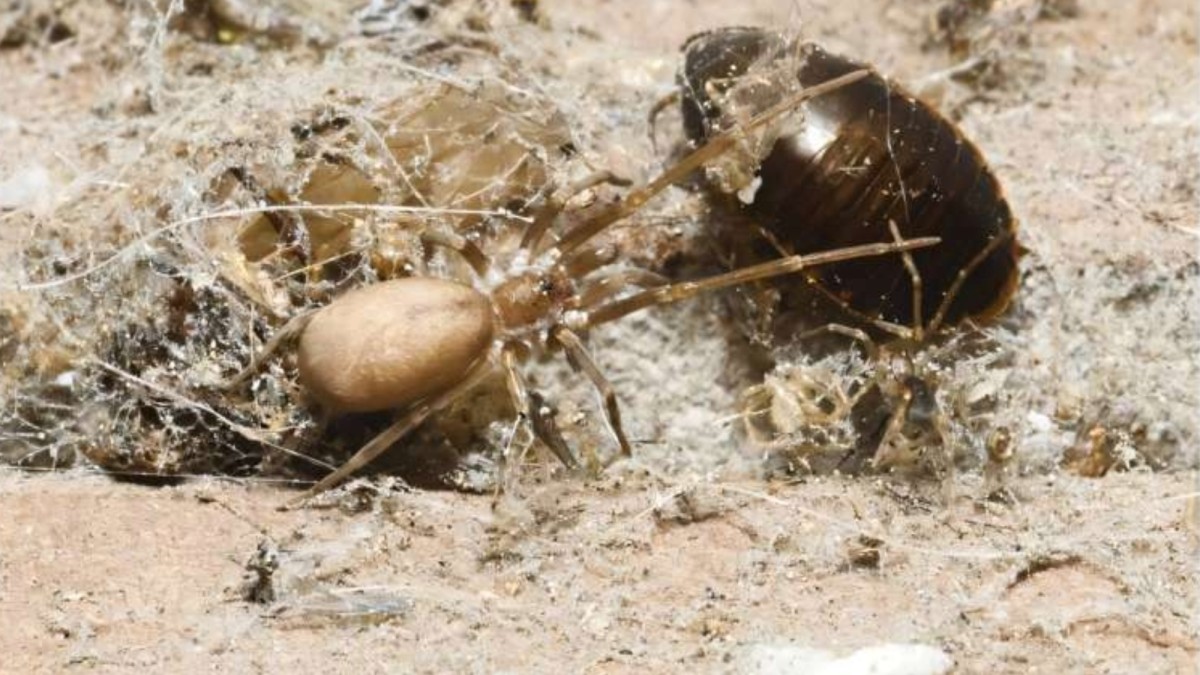
Scientists have officially identified a new species of crevice weaver spider in Colombia, and it carries a name inspired by rock history. Formally named Pikelinia floydmuraria , the species pays homage to the legendary English rock band Pink Floyd and its iconic 1979 album, The Wall.
The name is a clever linguistic blend: “Muraria” is derived from the Latin word for “wall,” referencing both the spider’s preferred habitat and the band’s psychedelic masterpiece.
A Master Hunter in Small Packages
Despite their diminutive size—measuring only about 3 to 4 millimeters (roughly a tenth of an inch)—these spiders are formidable predators. Researchers discovered that P. floydmuraria possesses extraordinary hunting capabilities, frequently taking down prey that is six times its own body mass.
Their diet primarily consists of common insects, including:
– Flies
– Beetles
– Ants
To maximize their hunting efficiency, these spiders often build their webs near streetlights. This is a strategic evolutionary advantage, as the artificial glow attracts insects, effectively turning urban lighting into a reliable feeding station.
Living Among Us: The Synanthropic Advantage
The researchers classified this species as synanthropic, meaning they have adapted to live in close proximity to human environments. Rather than retreating to deep forests, these spiders thrive in the cracks and crevices of buildings, even appearing on colorful murals in the Quindío region of Colombia.
This adaptation is significant for urban ecology. By hunting near human structures, these spiders act as a natural form of pest control, helping to regulate local insect populations within cities.
An Evolutionary Mystery
One of the most intriguing aspects of this discovery is the spider’s unexpected connection to the Galápagos Islands. Despite being separated by the Pacific Ocean and the massive Andes Mountains, P. floydmuraria is a very close relative of the Galápagos species Pikelinia fasciata.
The two species are nearly identical in appearance, raising a compelling biological question: How did such similar species end up living over 1,000 miles apart?
While the exact mechanism behind this distribution remains unknown, scientists believe that further research—specifically DNA barcoding —will be essential to uncovering their evolutionary history and understanding how they crossed such vast geographical barriers.
While these spiders may be tiny, their role in maintaining a balanced urban ecosystem is significant, proving that even the smallest inhabitants can have a massive impact on their environment.
Conclusion: The discovery of Pikelinia floydmuraria highlights the hidden biodiversity within our cities and underscores the need for further genetic research to understand how species migrate and evolve across vast distances.