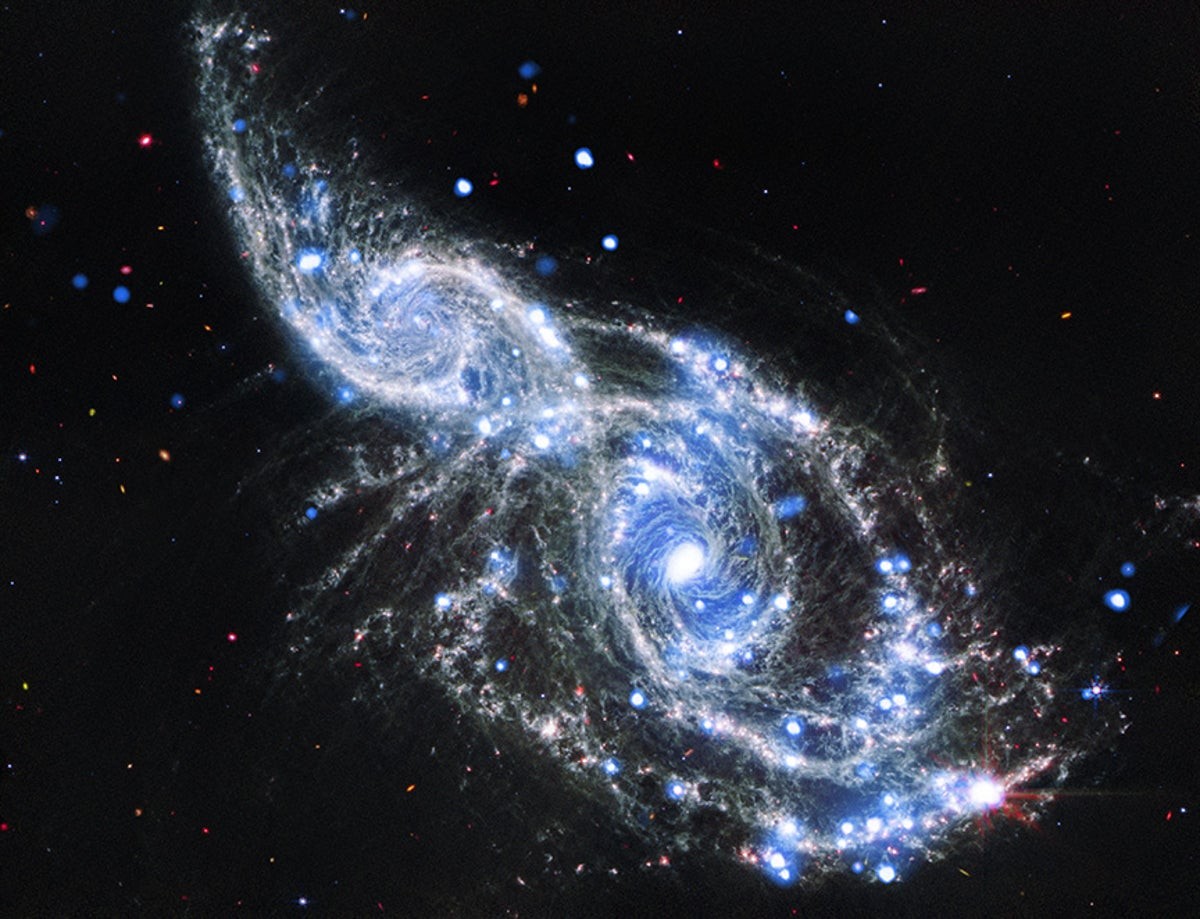
Two of NASA’s premier observatories, the James Webb Space Telescope (JWST) and the Chandra X-ray Observatory, have collaborated to produce a breathtaking new image of two spiral galaxies locked in a slow-motion cosmic crash. The combined data reveals a level of detail previously unseen, offering astronomers valuable insight into how galaxies evolve through mergers.
A Unique Perspective on Galactic Interaction
The two telescopes’ complementary strengths make this observation particularly powerful. JWST, orbiting the sun, excels at capturing infrared light, revealing cooler dust and gas. Chandra, in Earth orbit, detects high-energy X-rays emitted from violent processes like star formation. By merging these datasets, NASA has created a composite view of IC 2163 and NGC 2207, two galaxies roughly 120 million light-years away.
The Dance of Destruction and Creation
The larger galaxy, NGC 2207, is exerting a powerful gravitational pull on its smaller companion, IC 2163. This interaction is not a sudden impact, but a drawn-out process spanning billions of years. As NGC 2207 stretches and strips material from IC 2163, intense bursts of star formation ignite within the disrupted gas and dust. The JWST data highlights these cooler regions in white, gray, and red, while Chandra’s X-ray observations pinpoint the high-energy star-birth zones in vibrant blue.
These galactic mergers are essential to understanding how galaxies grow over cosmic timescales. Each collision reshapes their structure, triggering star formation, and ultimately leading to the creation of larger, more complex galactic systems.
Why Galactic Mergers Matter
Galactic collisions are not rare; they are a fundamental part of the universe’s evolution. The Milky Way, our home galaxy, is itself on a collision course with the Andromeda Galaxy, expected to occur in roughly 4.5 billion years. Studying these events now allows astronomers to refine models of galactic evolution and predict the long-term fate of our own cosmic neighborhood.
This combined observation from JWST and Chandra is a striking reminder of the dynamic and violent forces shaping the universe, and provides valuable data for ongoing research into galactic interactions.