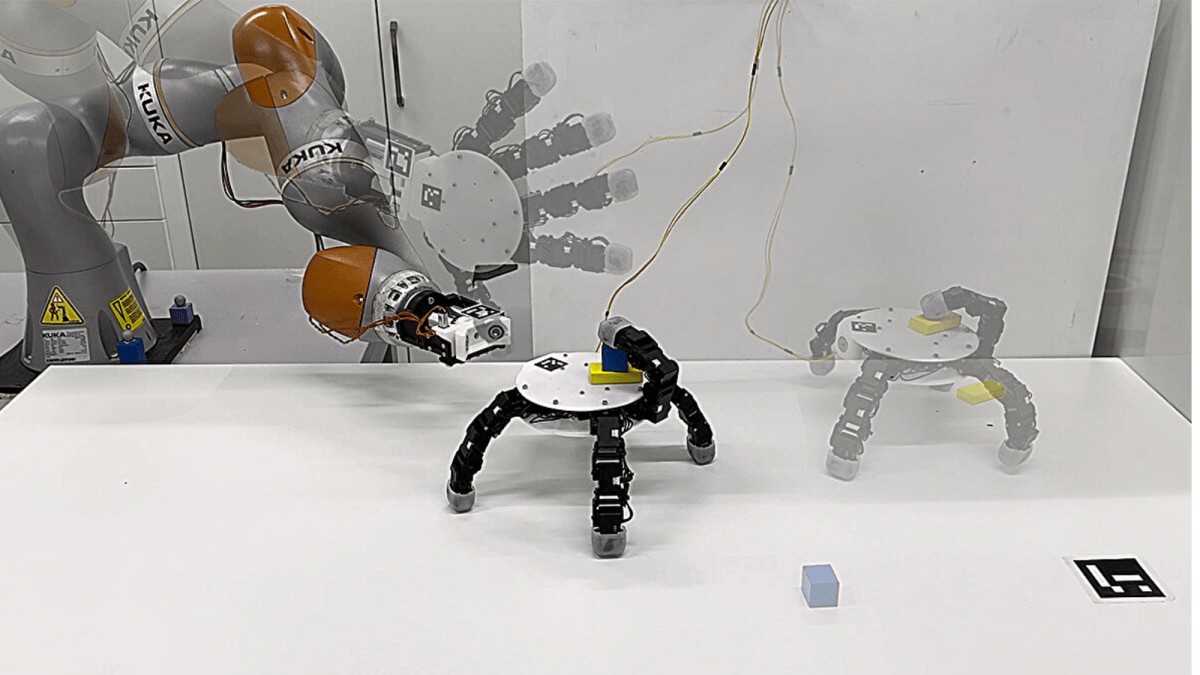
Engineers at the Swiss Federal Institute of Technology have unveiled a groundbreaking robotic hand that can detach from its arm and independently crawl around to manipulate multiple objects. This development, detailed in Nature Communications, challenges conventional robotics by prioritizing efficiency over biomimicry—the hand is designed to exceed human capabilities rather than simply replicate them.
Beyond Biological Constraints
The robot hand, which resembles a disconcerting creature from a video game, is fully symmetrical, allowing it to grasp objects on either side simultaneously. This contrasts with the limitations of the human hand, which is constrained by its asymmetrical shape and single opposable thumb. Researchers argue that evolution’s “slow process” doesn’t explore all potential design possibilities, and this hand proves it.
The device can lift up to three objects weighing a combined five pounds, replicating 33 different human grasping motions with greater flexibility. Video demonstrations show the hand detaching and scurrying to pick up a banana, flipping it onto its back using a single finger, while holding other objects.
Inspired by Octopuses and Insects
The design draws inspiration from animals like octopuses, known for their simultaneous manipulation of objects, and certain insects that use limbs for both locomotion and grasping. This approach is distinct from the current trend in robotics, where companies such as Figure and Tesla are investing heavily in humanoid robots that mimic human hands to perform human tasks. The Swiss team’s crawler prioritizes raw functionality over replication.
Diminishing Returns with Additional Fingers
Interestingly, the researchers found that adding more than five fingers provided diminishing returns. Each extra finger increases mass and the potential for collisions, reducing overall efficiency. The optimal design, they determined through algorithmic analysis, balances grasping and crawling capabilities.
Future Implications
While it’s unclear if this design will become widespread, the crawler could revolutionize industrial tasks. Picture a humanoid robot performing factory work, then deploying the detachable hand to reach distant or cluttered spaces. The technology may also find use in specialized robotics where efficiency trumps biomimicry.
“Evolution is a slow process… It does not explore all that could be possible.” — Swiss Federal Institute of Technology Researchers
This robot hand demonstrates that the future of robotics may not lie in perfect imitation of human anatomy, but in pushing the boundaries of what’s mechanically possible.