The secant function is one of the six most important trigonometric functions you should know. You might come across it while studying the basics of geometry or calculus. Although often overshadowed by sine and cosine, it plays a special role in understanding right triangles and advanced mathematics.
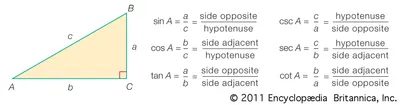
In a right triangle ABC, the secant of angle A is simply defined. This is the ratio of the length of the hypotenuse to the side adjacent to angle A.
$$ \sec A = \frac{\text{Length of the hypotenuse}}{\text{Length of the side adjacent to the angle} A} $$
The other five functions in this series are sine (sin ), cosine (cos ), tangent (tan ), cosecant (csc ), and cotangent (cot ). Understanding these relationships will help you solve problems faster.
Why you need to consider secants
Most students focus on sine and cosine because these are the most common. However, the secant is the reciprocal of cosine. This means:
$$ \frac{1}{\sec A} = \cos A $$
This relationship is useful. If you know the cosine of the angle, you can invert it to get the secant value. You don’t need another table for that.
There is also an important identity that connects the secant and the tangent. According to the definition of tangent ($ \tan A = \frac{\text{opposite}}{\text{adjacent}} $) and the Pythagorean theorem, we get:
$$ \tan^2 A + 1 = \sec^2 A $$
This identity is useful for simplifying equations. You can switch between the tangent and secant terms when solving complex trigonometric problems.
Behavior of the secant function
When you graph the secant function, it looks like a series of U-shaped curves. It is not a smooth wave like sine or cosine.
If the angle A is in radians, the period of this function is $2\pi$. Important things to know:
- At 0, the value is 1.
- At $\pi$, the value is -1.
- The function branches to $\pi/2$. If you approach from the left, it will shoot towards positive infinity, and if you approach from the right, it will come towards negative infinity.
- It differs again in $3\pi/2$. Go from left to negative infinity and from right to positive infinity.
The function is even. This means $\sec(-A) = \sec A$. The graph is symmetrical along the y-axis.
Differentiation and integration
If you study calculus, you should know how to handle secant in differentiation and integration.
The derivative of $\sec x$ with respect to $x$ is:
$$ \frac{d}{dx}(\sec x) = \sec x \tan x $$
Indefinite integrals are even trickier. This includes natural logarithms.
$$ \int \sec x \, dx = \ln |\sec x + \tan x| + C$$
where $C$ is the constant of integration and $\ln$ is the natural logarithm.
Common Questions About Secant
**How do I