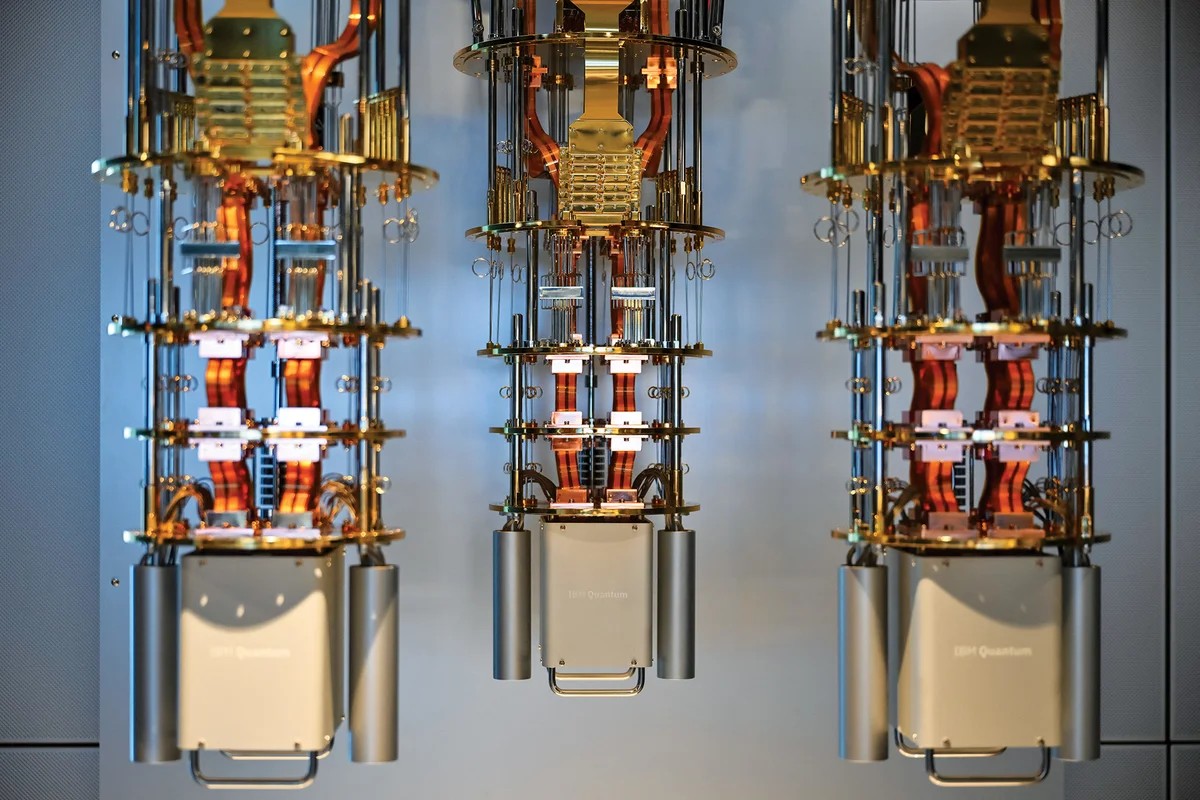
Inside a low-slung office building near San Francisco, white tanks glow blue.
They hold superconducting chips suspended by gold chandelier structures, submerged in liquid helium and nitrogen. Next door, scientists in white suits fight fume hoods to fabricate those very chips.
This is Rigetti Computing’s main plant.
Each tank holds one of their top quantum processing units. The goal is speed. Not just a little faster, but exponentially faster. Rigetti CEO Subodh Kulkarni puts it simply.
“We can potentially solve problems that are unsolv able today.”
He speaks of a million-fold increase in speed at a fraction of the energy cost. That’s the pitch.
Start-ups and tech giants like IBM and Google are betting big on this dream. Venture capitalists pumped $1.2 billion into quantum ventures in 2023. Governments want it too, mostly to break codes they think are unbreakable.
Silicon Valley hype says quantum computing will supercharge AI. Experts aren’t sure. They’re more interested in drug discovery or weather modeling. But none of this is guaranteed.
We are at a make-or-break moment.
Scientists hope to scale these systems in the coming decades. If they succeed, classical machines get beaten at useful tasks. If they fail, the promise evaporates. Obstacles loom. Until we clear them, quantum’s potential remains theoretical.
The cat is both dead and alive
What exactly is a quantum computer?
It’s not just a device that obeys quantum physics. All matter does that. Even the silicon transistor in your phone relies on quantum effects to function. That definition is useless.
To understand the difference, you have to think about a cat.
Erwin Schrödinger proposed his famous thought experiment in the 1930es. He put a cat in a sealed box with radioactive metal, a poison vial, and a sensor. If the metal emits radiation, the vial breaks, the cat dies. If not, it lives.
Quantum physics says that before you look, the radiation is in a superposition. It has both emitted and not emitted particles. The vial is both smashed and intact.
The cat is simultaneously dead and alive.
Until you open the box.
Then the wave collapses. You choose a reality. But imagine checking slightly early. Maybe the cat is 60% alive, 40% dead. By timing it right, you can tune that mixture to anything.
This tunability is the engine of quantum computing.
Classical computers use bits. Zeros and ones. Quantum computers use qubits. A qubit is like the cat before the box opens. It holds both states at once, in a precise blend.
And like the cat, qubits must be entangled with their surroundings.
In Schrödinger’s box, the cat’s fate is tied to the metal, the detector, and the poison. A quantum computer forces qubits to do this on command. It controls exactly which qubits link and how. This entanglement allows the machine to process vast amounts of data in ways classical machines can’t touch.
Consider Shor’s algorithm, invented in 1994 by MIT researcher Peter Shor. It factors large numbers. A classical supercomputer might need millions of years for certain tasks. A quantum computer could do it in days.
Why does this matter?
Because most web encryption relies on the difficulty of factoring large numbers. A powerful quantum computer could shatter the cryptography holding the Internet together.
“Faster is a bit of an understatement,” says one expert, noting that quantum speed isn’t linear, but exponential.
That’s why intelligence agencies care. They’re racing to build these machines before everyone else.
The environment is the enemy
There is a catch, however.
Decoherence.
Schrödinger’s cat gets entangled with its box easily. You, the reader, are slightly entangled with your chair and the air around you. This happens naturally whenever quantum systems interact with the world.
For a quantum computer, this natural entanglement is fatal. It destroys the delicate state needed for calculation.
To work, qubits must stay isolated. They need total control.
Keeping them cool helps. Heat causes atomic motion, which creates unwanted links. That’s why those tanks in California use liquid helium. Temperatures near absolute zero silence the noise.
But isolation is hard. Maintaining it even for a fraction of a second is difficult. Preventing interactions inside the computer is the biggest hurdle between today’s modest devices and future giants.
So what makes a qubit?
There is no consensus. Standard bits use voltage on silicon. Qubits require much finer control. They need a specific starting state, then precise logic gates to manipulate entanglement, all while staying pure.
Some skeptics thought this impossible in the 198os. They weren’t entirely wrong. We only have working quantum computers now, small ones with a few hundred qubits. Not enough for real work. Too simple.
To scale up, researchers bet on different architectures.
Two paths, same problem
The leading contenders are superconducting circuits and trapped ions.
Superconducting qubits are tiny circuits made of materials like aluminum. At cold temperatures, they lose electrical resistance. We can manufacture them using existing chip fabrication tech. They are fast.
The downside? They contain billions of atoms. More atoms mean more noise. Even near absolute zero, decoherence strikes in tens of microseconds.
Trapped ions use single atoms held by electric fields. They are far less noisy. An individual atom doesn’t decohere easily. They can stay coherent for milliseconds.
The downside? They are slow to manipulate. Engineers can’t just spin them up like standard chips.
Right now, both approaches hit similar performance limits before decoherence ruins the calculation. Superconducting computers lead the field today, but ion traps aren’t far behind.
The solution might not be better hardware. It might be smarter software.
Errors will always creep in. Decoherence is inevitable. But quantum error correction can compensate.
The process groups many physical qubits together to form a single logical qubit. This redundancy means one faulty physical qubit doesn’t kill the computation. It’s like checking on Schrödinger’s cat through a peephole, correcting the balance of life and death without fully opening the door.
It works in theory. The code exists.
But the cost is steep.
One logical qubit might require 1,000 physical qubits. To run useful applications, we need thousands of logical qubits.
Do the math. You need millions of physical qubits to do something interesting.
We don’t have them. Building them requires overcoming noise, scaling fabrication, and managing immense complexity.
We are good at building small things that work. We are terrible at building large things that don’t collapse under their own weight.
The dream is there, sitting in those blue-lit tanks. It is fragile.
Will we fix it, or will the cat stay in the box forever?