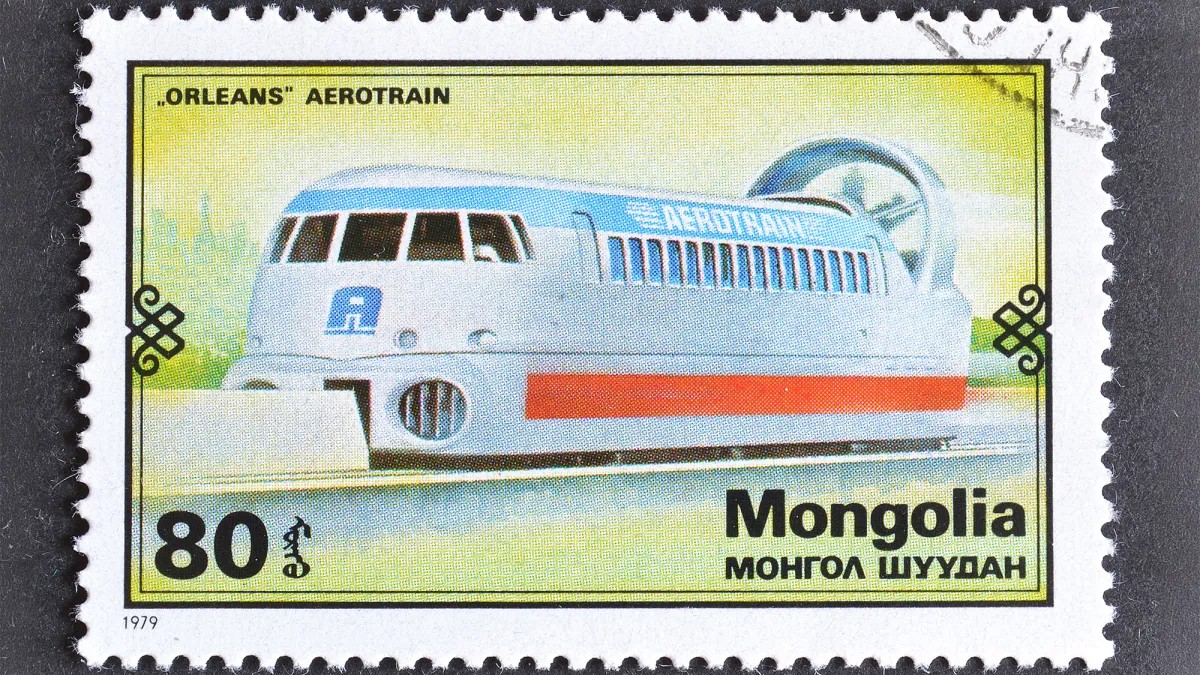
Trains were losing. By the late 1950s the steam locomotive was looking increasingly like a dinosaur. Cars had stolen the daily commute. Planes—subsidized heavily by governments in Europe and the U.S.—stole the long-distance routes. And let’s not forget that France Belgium and the Netherlands had literally bombed much of their own rail networks into rubble during the war.
So what did engineers do? They looked at the sky and decided trains should fly too. Or at least hover.
Enter the Aérotrain. It wasn’t a train in the traditional sense. It was a silver bullet shaped like a cross between a jet cockpit and an Airstream trailer. With bold red lettering and a nose cone that screamed “aerodynamic efficiency,” it looked like something plucked directly from a comic book.
Then there was the engine.
Depending on the model, it either spun a giant propeller or burned jet fuel with the ferocity of a Boeing 727. The thing didn’t use wheels. It rode on a cushion of compressed air over an inverted-T concrete guide rail. No metal on metal. No friction. Just pure, unadulterated lift.
It was loud. Oh, it was deafening. Think small jet taking off. But it was fast. December 1969 saw Popular Science dub it “the first guided vehicle to ride air instead of wheels.” It hit 270 mph. In theory it would never touch the ground.
So where is it? Stored in a warehouse near Paris. Forgotten.
Fast. Loud. Useless?
Jean Bertin was an aeronautical engineer before he became a rail dreamer. His company, Bertin & Cie, had worked on hovercrafts in Britain. He simply moved the hovercraft onto a track. He called it the Terraplane first, but history knows it as the Aérotrain.
The principle was borrowed from aviation. “Ground effect.” Pressurize the space under the hull, create lift, go.
“It’s basically little airplanes,” says James Cohen a professor who has studied this mess for years. “Sardine cans pushed forward by propellers.”
He’s not wrong.
The French government saw potential. A direct link from Paris business districts to the airports? Efficient. Modern. Futuristic. They gave Bertin a contract to build a line to Cergy-Pontoise.
Prototypes carried 80 passengers. They sat two-abreast in rows that felt uncomfortably close. The ride was smooth until you considered the noise pollution. You can’t run this thing through a residential neighborhood without the residents rioting.
It required custom-built concrete rails. Existing tracks wouldn’t cut it. The costs ballooned. The timelines slipped. The 1970s brought oil shocks and recession. The mood shifted.
Nobody wanted expensive science experiments anymore. They wanted cheaper fares and reliable schedules.
“It will not be the average Jean-Claud Z who takes the Aérotrain but his CEO,” Pierre Merlin wrote in the journal Technology and Culture. The elite would zoom between offices while the rest of the country struggled with inflation. The public turned cold.
A Victim of Its Own Time
Optimism kills more ideas than pragmatism saves. Albert J. Churella a train historian, notes that the Aérotrain was born of a specific cultural moment. Post-WWII society believed technology would fix everything. Nylon. Penicillin. Atomic energy that was “too cheap to meter.”
Why not floating trains?
Journalists loved the shiny designs. The visuals were perfect for TV. But reality is messy. The French government pulled funding. The project died quietly.
The United States tried the same dance. Lyndon B. Johnson’s Department of Transportation dumped $90 million into “Tracked Air Cushion Vehicles.” They built the Rohr Industries Aerotrain. They even planned a test route in Colorado.
It died too.
Funding was spread too thin across too many competing prototypes. Commuters didn’t care. They just wanted to get to work without screaming through the atmosphere.
“Hovertrains were an idea without an market,” Churella says. “Few people wanted them. Nobody needed them.”
Conventional trains just kept improving. The wheels didn’t have to disappear to go faster. Lighter materials and better engineering allowed the traditional wheel-on-rail setup to reach incredible speeds while staying on tracks already in the ground. France’s TGV is basically a 19th-century concept refined with 20th-century math. It works. It’s compatible with history.
The Echoes of the Hover
Call it a failure if you like. But look at where the technology went.
Jean Bertin’s air-cushion train paved the way for magnetic levitation. Maglev.
Maglev trains don’t use air. They use powerful electromagnets. The physics are different, but the lineage is clear. Today maglevs operate in Japan South Korea and China.
The Shanghai Transrapid connects Pudong Airport to Longyang Road. It covers 19 miles in eight minutes. It hits 268 mph. Cruising at a slightly more reasonable 186 mph because physics and engineering constraints exist.
That’s fast. That’s real. And the underlying principles of contactless transport have spun off into other areas. Airport baggage systems. Military tech. Even components for wind turbines.
Cohen argues we shouldn’t laugh at the “wacko” train. New technologies rarely go in straight lines. They mutate.
“To say it’s wacko is to miss the point,” Cohen says. The Aérotrain didn’t solve transportation in 1969. It died. But it helped plant seeds that are still growing today. We just couldn’t see the forest for the sardine can.