Bobcat Cave isn’t a place for the claustrophobic. Tucked near Huntsville, Alabama, this limestone network is barely 1,490 feet long, but it’s a tight squeeze. You don’t walk through here. You crawl. Waterlogged tunnels and mud-slicked crawlways define the only way forward. For nearly forty years, cavers have kept an eye on a single, fragile resident: the Alabama cave shrimp (Palaemonias alabamae ). These tiny, translucent crustaceans are nearly invisible to the naked eye. They are also critically endangered, found nowhere else on Earth except specific cave systems between Alabama and Tennessee. They matter. Conservationists watch them closely because losing them would mean losing a piece of biological history that no one else has.
But the cave holds secrets it hasn’t shown in decades.
Recent expeditions into Bobcat Cave revealed something unexpected lurking in the dark. Not a shrimp. A fish.
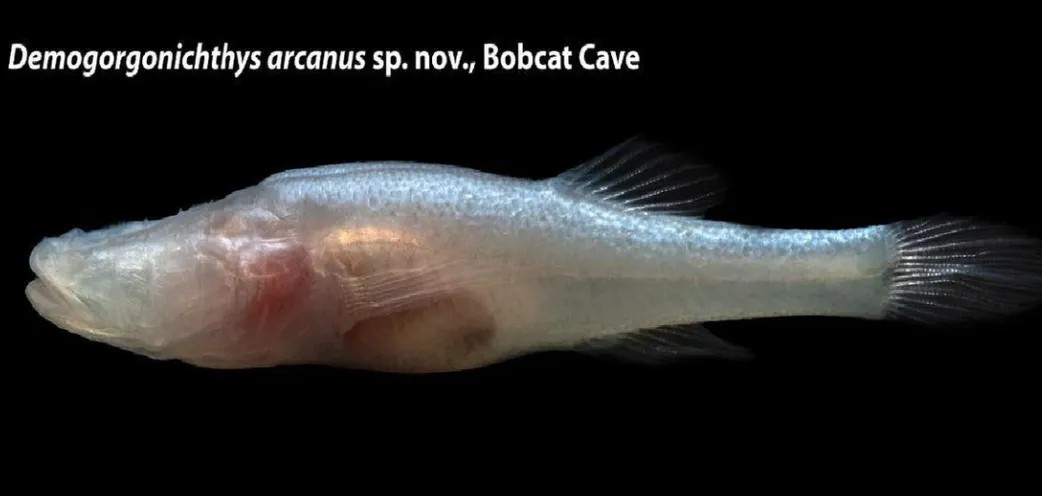
Pale. Eyeless. Smaller than two inches. This creature is the demon cavefish (Demogorgonichthys arcanus . Yes, the name sounds like a villain from a sci-fi movie, but the biology is serious. The discovery, published in Scientific Reports, represents more than just a new name for a local bug-eater. It represents a genetic outlier so distinct that scientists had to create an entirely new genus for it. That makes it potentially one of the rarest fish on the planet.
A Genetic Anomaly in the Dark
“We are finding differences within organisms we already knew,” said Jonathan Armbruster, study co-author and curator at Auburn University. “This was different. This had not been seen before. That is really rare.”
The fish belongs to the family of cave-dwelling species related to the southern cavefish (Typhlichthys subterrane ) and the equally elusive Alabama cavefish (Speoplatyrhinus poulsoni ). But look closer at Demogorgonichthys arcanus . The snout is unique. The body shape diverges from its relatives. And the color? Nothing there. It’s pale white, blind, and built for a life without sunlight.
The most striking difference, however, is inside its DNA.
Most cavefish retain some vestigial light sensitivity. It’s evolutionary baggage. But the demon cavefish has lost the manual entirely. Specifically, a part of the rhodopsin gene—essential for detecting light—is missing.
“The Southern Cavefish clearly has some kind response to light,” Armbruster noted. “With this fish, we don’t. Part of the rhodopsin is missing. It is no longer functional.”
It doesn’t need eyes. It doesn’t need light. It just needs water and stability in a dark, limestone labyrinth.
Why the Scary Name?
Let’s address the elephant in the cave (or the fish, actually). Demogorgonichthys. It sounds terrifying. It recalls the Upside-Down monster from Stranger Things. But the name doesn’t start in Hawkins, Indiana. It goes back to Ancient Greece.
John Milton used it in Paradise Lost. Pamela Hart, a co-author and biologist at the University of Alabama, has long kept a running list of underworld mythological figures. She needed a name that fit the vibe of a creature that lives in the absolute dark. Demogorgon fit.
The second part of the name, arcanus, is Latin. It means hidden. Or secret.
That’s fitting. Researchers have only seen about 20 of these fish at a time. They don’t hide out of malice. They hide because the ecosystem is small, and they are few.
“It may have been living down in the anifer and only recently made its way up.” Armbruster explains the logistical puzzle. “Or it may have been there the whole time, and we just never saw it. The tunnels are tight. Visibility is zero.”
The Conservation Imperative
The discovery of the demon cavefish isn’t just a victory for taxonomy. It’s a warning label for Alabama’s karst landscape.
These ecosystems are delicate. The water that filters through limestone is pristine but vulnerable to contamination, drought, and development. The Alabama cave shrimp already teeters on the edge of extinction. Now we know the cave also shelters this genetically unique, blind fish.
Protecting one means protecting the other. The hydrology that feeds the shrimp feeds the fish. Damage the aquifer, and both vanish. No shrimp. No demon cavefish. Just empty caves.
“Like the Alabama cave shrimp, biologists see this fish as another reason to strengthen conservation efforts in these unique ecosystems.”
We rarely find new species in well-trodden places like Alabama. Bobcat Cave is mapped. It’s known. So why did this fish stay hidden until now?
Maybe it’s smaller than we thought. Maybe it’s more elusive. Or maybe we were just looking in the wrong water.
One thing is certain. The dark water of Bobcat Cave is richer than we gave it credit for. And for a species that has no eyes, visibility is everything.