The difference between active and passive voice boils down to who is doing what. It is not just a grammar rule. It is about direction.
In the active voice, the subject is the engine. It drives the action forward. Take a simple sentence: “Pedro compra caramelos.” Pedro is the buyer. He is the one moving. The subject performs the verb. This is the default way we speak. It is direct. It is clear.
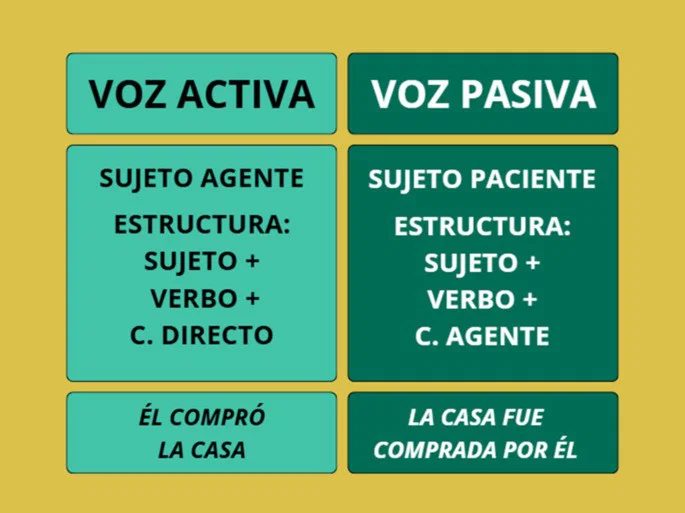
In the active voice, the subject participates actively and performs the action denoted by the verb.
But language has another side. The passive voice flips the script. Here, the subject does not act. It receives. The action happens to it. Look at the same scenario: “Los caramelos son comprados por Pedro.” The candies are the subject now. They are sitting still. Someone else is buying them.
Why the Subject Matters
Understanding this distinction helps you control emphasis. You choose the voice based on what you want to highlight.
In active sentences, the focus is on the doer. Consider this example: “El policía detuvo al ladrón.” We know who caught whom. The policeman is the hero of the sentence. The structure is straightforward.
In passive sentences, the focus shifts to the receiver. The doer becomes optional or secondary. The sentence “El ladrón fue detenido por el policía” changes the perspective. The thief is the center of attention. The action is something that happened to him.
How to Identify the Difference
The key is the relationship between the subject and the verb.
- Active Voice: The subject does the action. It initiates.
- Passive Voice: The subject receives the action. It experiences.
This shift changes how you read and write. It affects clarity. It affects tone. Knowing when to use which voice is part of mastering Spanish syntax.
Why does this matter to you? If you are learning the language, recognizing these structures helps you decode complex texts. If you are teaching, it helps you explain sentence construction clearly. The mechanics are simple. The application requires practice.
Start by looking at the subject. Ask yourself: is it acting or being acted upon? Once you spot the pattern, the rest falls into place.
Language shifts depending on who holds the power in a sentence. You might not notice it until you try to flip it. Take a simple statement: El lector abrió el libro. The reader opened the book.
Here, the reader is the doer. The book is the receiver. It’s straightforward. But swap the roles. Now the book is the focus. El libro fue abierto por el lector. The structure breaks and reforms. The object becomes the subject. The original subject retreats to the background.
This shift isn’t just grammar trivia. It changes how we perceive agency. It dictates who is responsible and who is affected. Understanding this mechanic helps you write with precision. Or at least, it helps you stop confusing the two modes when you’re trying to edit a draft.
Why Active Voice Usually Wins
In an active sentence, the subject performs the action. We call this the agentive subject. It’s the engine of the sentence. The formula is simple: Subject + Verb + Direct Object.
Most writing advice tells you to stick to this. It’s direct. It’s energetic. It doesn’t bury the actor.
Consider these everyday examples:
- The judge convicted the thief. (The judge acts.)
- The bird flaps its wings. (The bird acts.)
- The wind knocked down a tree. (The wind acts.)
More instances where the subject drives the plot:
- The rain put out the fire.
- The goat ate the paper.
- The athlete will win gold in the event.
- The clock struck eight.
- The virus caused fever.
- Maria buys fish at the supermarket.
- The technicians changed the living room router.
- The tide covered the beach with seaweed.
- The knife cut the meat cleanly.
- Your neighbor washes the motorcycle every week.
In each case, you know exactly who is doing what. There is no ambiguity. The energy flows forward.
When Passive Voice Takes Over
Now look at the other side. In the passive voice, the subject experiences the action. It’s the patientive subject. Nothing happens to it; it just has something happen to it.
There are two main ways to build this in Spanish (and similar structures exist in English).
First, you have the periphrastic passive. This uses the verb ser (to be) plus a past participle.
Structure: Subject + Verb ser + Participle + Agentive Complement.
Second, you have reflexive passives using se.
Example: La mantequilla se unta en el pan (Butter is spread on bread).
Crucial rule: You can only use the passive voice with transitive verbs. Verbs that take a direct object. Comer, lleva, apagar, comprar, cortar. Intransitive verbs? They don’t work here.
Examples of passive construction:
- The bird was hunted by the cat.
- The socks are put in the dresser drawer.
- The log was dragged by the current.
- The vaccines will be sold this year.
- The motorcycle was fixed by the mechanic.
- The act is organized by the director.
- The fossil was found by the paleontologist.
- The soup is eaten with a spoon.
- The earth had been trampled by the livestock.
- The tree was cut down by the lumberjacks.
The Mechanics of the Swap
How do you actually move between these states? It’s a mechanical process. You don’t need to reinvent the wheel. You just rearrange the pieces.
Start with the active sentence: El lector abrió el libro.
1. Identify the direct object: el libro.
2. Make that object the new subject.
3. Change the verb to a form of ser + past participle (fue abierto ).
4. The old subject (el lector ) becomes the agentive complement, usually introduced by por.
Result: El libro fue abierto por el lector.
The meaning stays the same