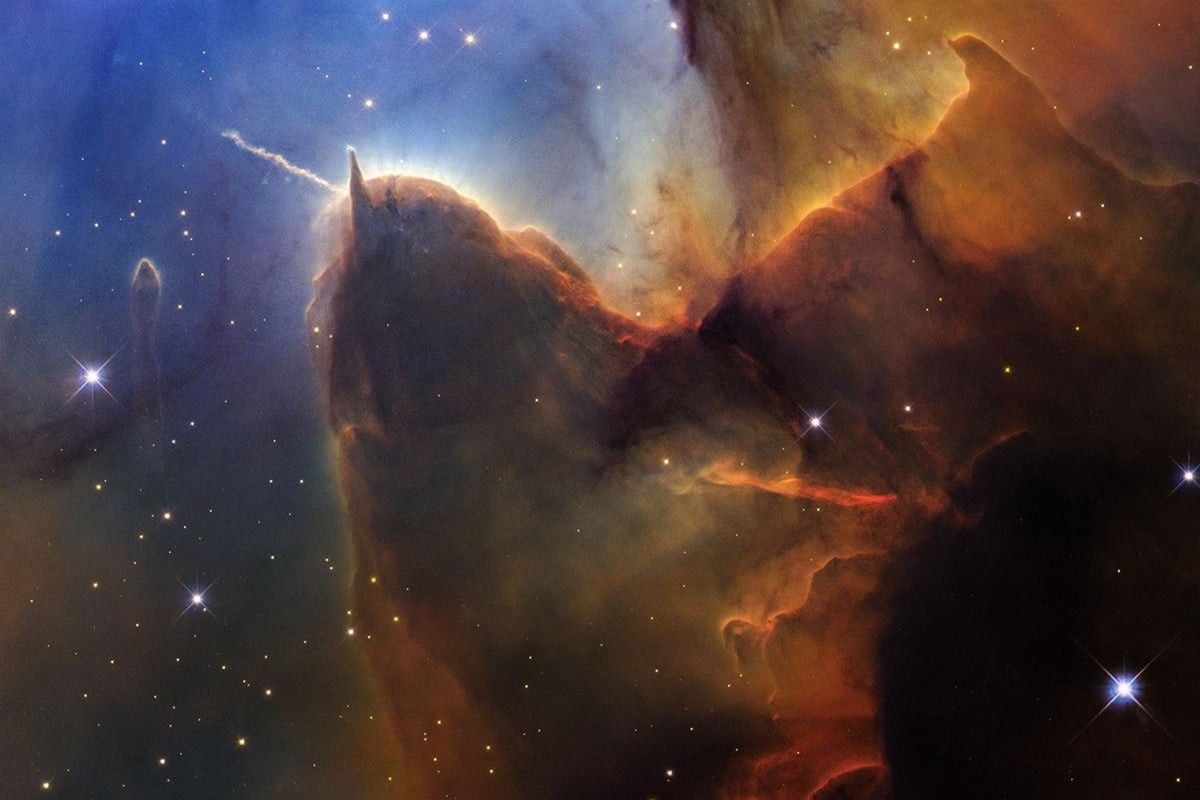
NASA has released a striking new image from the Hubble Space Telescope, revealing a celestial formation nicknamed the “Cosmic Sea Lemon” (or “Cosmic Sea Slug”). Located approximately 5,000 light-years from Earth, this ethereal structure is tucked away within a dense stellar nursery.
A Decades-Long Observation
This isn’t Hubble’s first encounter with this particular phenomenon. The telescope originally captured this gassy region within the Trifid Nebula —situated in the constellation Sagittarius—back in 1997.
To mark the 36th anniversary of Hubble’s launch on April 24, 1990, astronomers decided to revisit this site. By comparing the new photograph with the 1997 original, scientists are able to perform a rare feat in astronomy: observing real-time cosmic evolution.
Signs of Growth and Change
While the Trifid Nebula remains as cloud-filled as ever, a side-by-side comparison reveals significant shifts in the “Sea Lemon’s” anatomy:
- The “Horn”: A jet of plasma expelled by a protostar (a star in the process of forming) has grown noticeably longer since the last observation.
- The “Body”: A vibrant streak of orange and red light along the formation’s edge has expanded toward the right.
Why These Changes Matter
In the vast scale of the universe, seeing physical changes in a nebula provides critical data for astrophysicists. These subtle shifts are not merely aesthetic; they serve as visual evidence of the violent and energetic processes driving star formation.
By tracking the expansion of plasma jets and the movement of gas, researchers can better understand how protostars interact with their surrounding environments and how these “stellar nurseries” eventually give rise to stable solar systems.
The evolution of the “Cosmic Sea Lemon” offers a rare glimpse into the dynamic, shifting nature of star-forming regions, proving that even the most distant corners of our galaxy are constantly in motion.
Conclusion
By revisiting a target photographed nearly three decades ago, Hubble provides astronomers with a vital longitudinal study of stellar birth. These observations help bridge the gap between theoretical models and the actual, changing reality of the cosmos.