The fashion industry is facing a mounting environmental crisis. While the heavy water consumption of textile manufacturing and the ethical concerns of animal leather are well-documented, footwear presents a particularly stubborn challenge. Currently, an estimated 95 percent of all shoes end up in landfills, where the combination of rubber, plastic, and synthetic foam can take centuries to decompose.
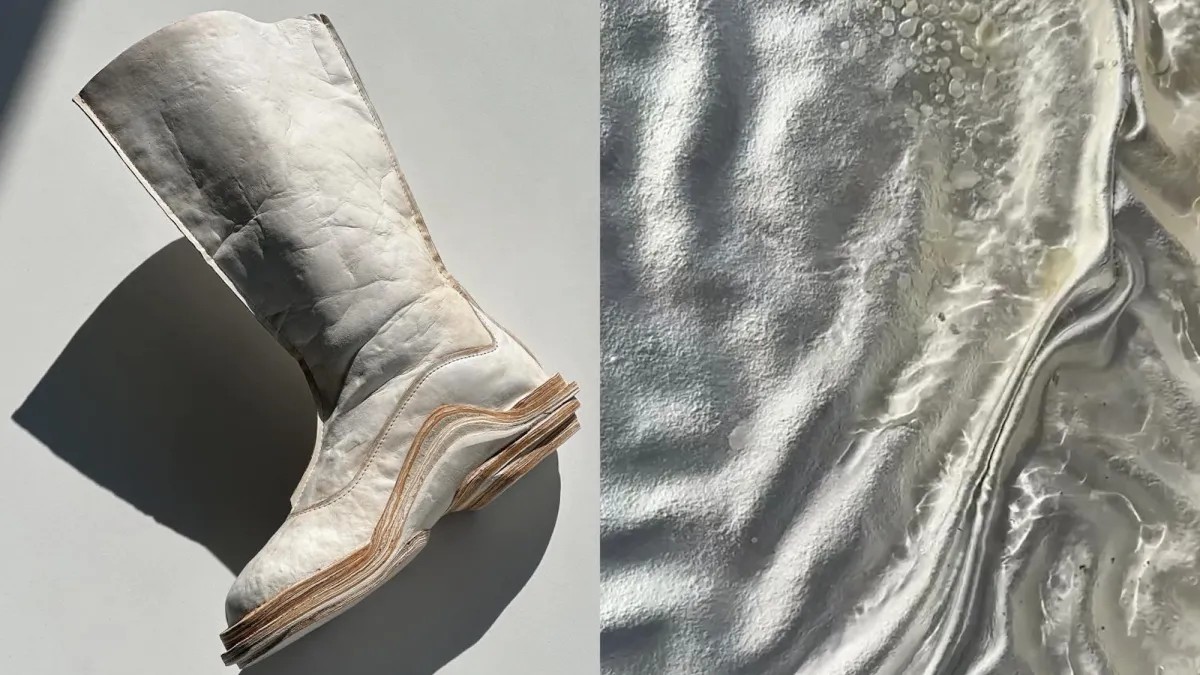
In a bid to break this cycle of waste, researchers at Belgium’s Vrije Universiteit Brussel (VUB) have unveiled a groundbreaking prototype: the world’s first boot crafted entirely from mycelium.
The Intelligence Beneath Our Feet
To understand this innovation, one must look beneath the visible mushroom. While mushrooms are the most recognizable part of a fungus, they are merely the “fruit.” The real engine of the organism is the mycelium —a vast, underground network of fibrous webs.
These networks are so sophisticated that mycologists often describe them as a form of biological intelligence, as they transport vital data regarding soil health, sunlight, and moisture between organisms. Today, this “biological internet” is being explored for uses ranging from organic computing to sustainable sanitation. Now, scientists are proving it can also be used to engineer functional consumer goods.
Overcoming the Engineering Hurdle
Previous attempts at “mushroom fashion” have largely focused on using fungi as a surface-level leather substitute. However, creating a complete, functional shoe requires more than just a soft covering; it requires structural integrity and support.
The VUB team, working alongside head shoemaker Marie De Ryck from the La Monnaie/De Munt opera house, spent two years overcoming the technical limitations of the material. The primary challenge was dimensionality. While mycelium grows easily in flat sheets, transforming it into a three-dimensional, supportive sole proved difficult.
The solution involved a dual-fungi approach:
– Type 1: A specific strain engineered to create a foam-like, malleable material for the sole.
– Type 2: A different strain used to create the durable, leathery material for the upper section of the boot.
A Conceptual Milestone
While this prototype is a conceptual piece rather than a mass-market product, its significance lies in what it proves is possible.
“It reflects how we grow and craft this material, made from a microorganism, into a functional three-dimensional form,” explained VUB designer Lars Dittrich.
The project demonstrates that we are moving past the stage of mere “alternatives” and toward a future where products are grown from the ground up to meet specific technical requirements.
Conclusion
By successfully transforming mycelium into both a flexible sole and a durable upper, researchers have moved one step closer to a circular fashion economy. This breakthrough suggests that the future of footwear may not be manufactured in a factory, but grown in a lab.